
与先前治疗相比,罗莫佐单抗治疗后转换疗法在骨质疏松症治疗中的效果。
The Effects of Switch Therapy in Osteoporosis Treatment after Romosozumab after Comparing with Prior Treatment.
作者信息
Horikawa Akira, Kasukawa Yuji, Hongo Michio, Sano Akihisa, Miyakoshi Naohisa
机构信息
Shizuoka Tokushukai Hospital, 1-11 Surugaku-Simokawahara-Minami, Shizuoka 421 0117, Japan.
Department of Orthopedic Surgery, Akita University Graduate School of Medicine, 1-1-1 Hondo, Akita 010-8543, Japan.
出版信息
J Osteoporos. 2024 Jan 9;2024:2144527. doi: 10.1155/2024/2144527. eCollection 2024.
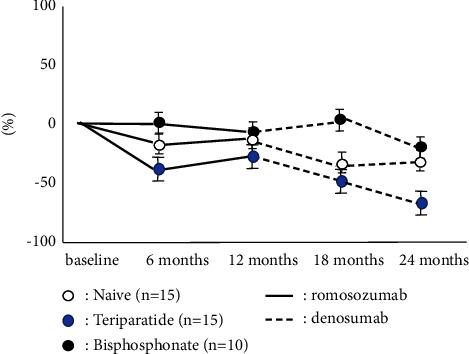
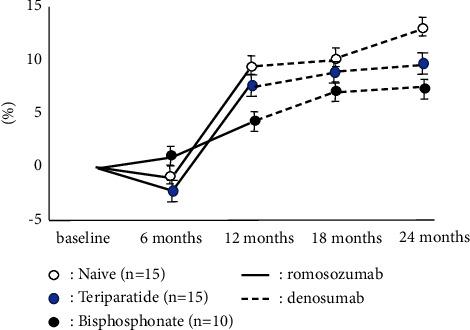
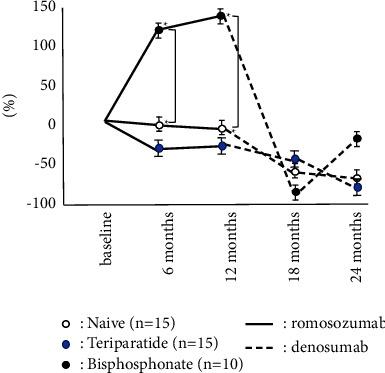
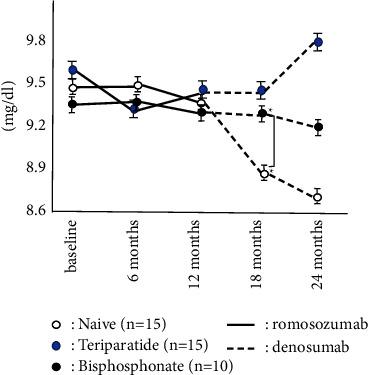
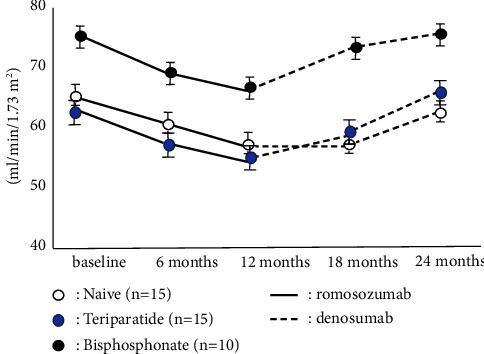
. Although romosozumab is one of the most effective treatments for osteoporosis by increasing bone mineral density in the lumbar spine and femur and recommended for denosumab as switch therapy, these effects regarding its prior treatment have not yet been evaluated clearly. This study focused on the effects of switch therapy from romosozumab to denosumab in regard to prior treatment of osteoporosis including bone mineral density and bone turnover marker and other related factors. . 15 osteoporotic patients were assigned to the naïve group, 15 were assigned to the teriparatide group, and 10 were assigned to the bisphosphonate group. . Patients who were treated as outpatients for osteoporosis with romosozumab for 1 year and switched to denosumab between 2020 and 2022 at our hospital were examined. Our hospital registry included 40 osteoporotic patients who were over 65 years of age with bone mineral density (bone mineral density): T score <-2.5 standard deviations (SDs) and fracture assessment tool (FRAX) score >20%. . The naïve group had the highest increase in LS BMD among these three groups during switch therapy from romosozumab to denosumab, while there were no significant differences about adverse drug events and serum Ca concentration among them. There was no incidence of fracture. . These findings indicate that the effects of osteoporotic treatment of switch therapy from romosozumab to denosumab were likely to affect prior treatment of osteoporosis.
虽然罗莫佐单抗是治疗骨质疏松症最有效的药物之一,可增加腰椎和股骨的骨矿物质密度,并被推荐作为地诺单抗的转换疗法,但这些关于其先前治疗的效果尚未得到明确评估。本研究聚焦于从罗莫佐单抗转换为地诺单抗的转换疗法对骨质疏松症先前治疗的影响,包括骨矿物质密度、骨转换标志物及其他相关因素。15名骨质疏松症患者被分配至初治组,15名被分配至特立帕肽组,10名被分配至双膦酸盐组。对在我院门诊接受罗莫佐单抗治疗骨质疏松症1年并于2020年至2022年期间转换为地诺单抗的患者进行了检查。我院登记册中有40名65岁以上的骨质疏松症患者,其骨矿物质密度(骨密度):T值<-2.5标准差(SDs),骨折评估工具(FRAX)评分>20%。在从罗莫佐单抗转换为地诺单抗的转换治疗期间,初治组在这三组中腰椎骨密度增加最多,而它们之间的药物不良事件和血清钙浓度无显著差异。无骨折发生。这些发现表明,从罗莫佐单抗转换为地诺单抗的转换疗法对骨质疏松症治疗的效果可能会影响骨质疏松症的先前治疗。

 Zotero 插件