
评估 COVID-19 相关公共卫生干预措施对中国动物源性和媒介传播疾病的长期影响:一项中断时间序列分析。
Evaluating the long-term impact of COVID-19-associated public health interventions on zoonotic and vector-borne diseases in China: an interrupted time series analysis.
机构信息
Department of Epidemiology and Health Statistics, School of Public Health, School of Medical Technology, The First Affiliated Hospital, Xinxiang Medical University, No. 601 Jinsui Road, Hongqi District, Xinxiang, 453003, Henan, People's Republic of China.
Beijing Key Laboratory of Antimicrobial Agents/Laboratory of Pharmacology, Institute of Medicinal Biotechnology, Chinese Academy of Medical Sciences & Peking Union Medical College, Beijing, 100050, China.
出版信息
J Transl Med. 2024 Jan 20;22(1):81. doi: 10.1186/s12967-024-04855-y.
BACKGROUND
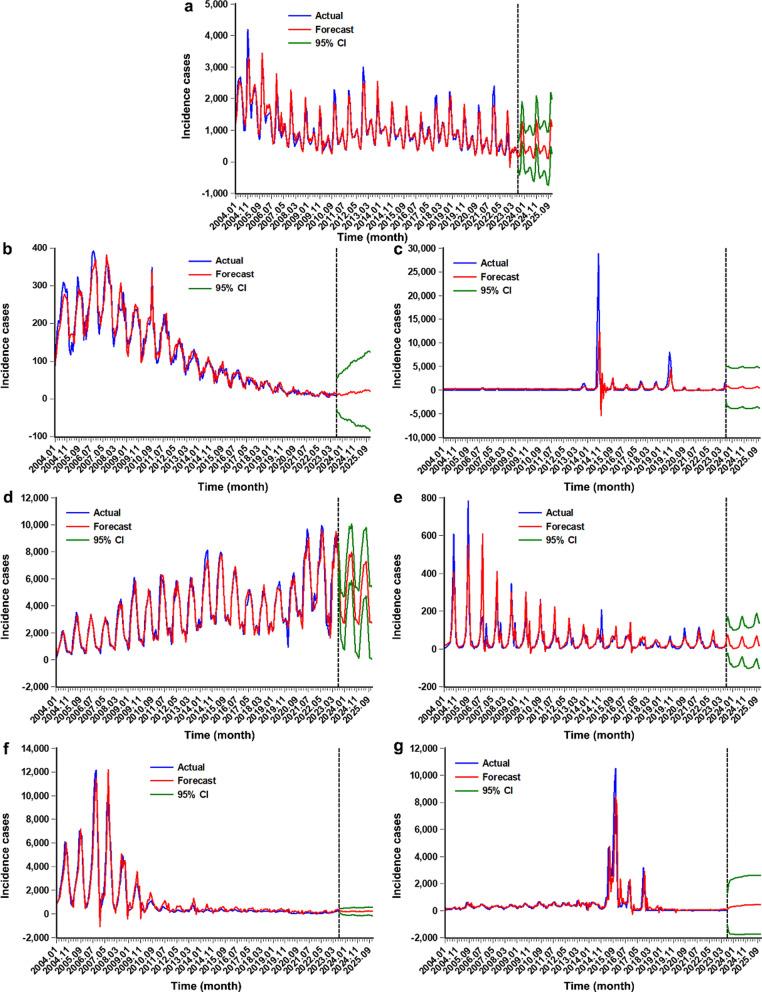
The long-term impact of COVID-19-associated public health interventions on zoonotic and vector-borne infectious diseases (ZVBs) remains uncertain. This study sought to examine the changes in ZVBs in China during the COVID-19 pandemic and predict their future trends.
METHODS
Monthly incidents of seven ZVBs (Hemorrhagic fever with renal syndrome [HFRS], Rabies, Dengue fever [DF], Human brucellosis [HB], Leptospirosis, Malaria, and Schistosomiasis) were gathered from January 2004 to July 2023. An autoregressive fractionally integrated moving average (ARFIMA) by incorporating the COVID-19-associated public health intervention variables was developed to evaluate the long-term effectiveness of interventions and forecast ZVBs epidemics from August 2023 to December 2025.
RESULTS
Over the study period, there were 1,599,647 ZVBs incidents. HFRS and rabies exhibited declining trends, HB showed an upward trajectory, while the others remained relatively stable. The ARFIMA, incorporating a pulse pattern, estimated the average monthly number of changes of - 83 (95% confidence interval [CI] - 353-189) cases, - 3 (95% CI - 33-29) cases, - 468 (95% CI - 1531-597) cases, 2191 (95% CI 1056-3326) cases, 7 (95% CI - 24-38) cases, - 84 (95% CI - 222-55) cases, and - 214 (95% CI - 1036-608) cases for HFRS, rabies, DF, HB, leptospirosis, malaria, and schistosomiasis, respectively, although these changes were not statistically significant besides HB. ARFIMA predicted a decrease in HB cases between August 2023 and December 2025, while indicating a relative plateau for the others.
CONCLUSIONS
China's dynamic zero COVID-19 strategy may have exerted a lasting influence on HFRS, rabies, DF, malaria, and schistosomiasis, beyond immediate consequences, but not affect HB and leptospirosis. ARFIMA emerges as a potent tool for intervention analysis, providing valuable insights into the sustained effectiveness of interventions. Consequently, the application of ARFIMA contributes to informed decision-making, the design of effective interventions, and advancements across various fields.
背景
新冠疫情相关公共卫生干预措施对人畜共患和媒介传播传染病(ZVB)的长期影响尚不确定。本研究旨在探讨中国在新冠疫情期间 ZVB 的变化情况,并预测其未来趋势。
方法
从 2004 年 1 月至 2023 年 7 月,收集了七种 ZVB(肾综合征出血热[HFRS]、狂犬病、登革热[DF]、人布鲁氏菌病[HB]、钩端螺旋体病、疟疾和血吸虫病)的每月发病情况。采用自回归分数阶积分移动平均(ARFIMA)方法,纳入新冠疫情相关公共卫生干预变量,评估干预措施的长期效果,并预测 2023 年 8 月至 2025 年 12 月的 ZVB 疫情。
结果
在研究期间,共发生了 1599647 例 ZVB 事件。HFRS 和狂犬病呈下降趋势,HB 呈上升趋势,而其他疾病则相对稳定。包含脉冲模式的 ARFIMA 估计每月变化平均数量为-83(95%置信区间[CI]:-353189)例、-3(95%CI:-3329)例、-468(95%CI:-1531597)例、2191(95%CI:10563326)例、7(95%CI:-2438)例、-84(95%CI:-22255)例和-214(95%CI:-1036~608)例,分别为 HFRS、狂犬病、DF、HB、钩端螺旋体病、疟疾和血吸虫病。然而,除了 HB 外,这些变化并不具有统计学意义。ARFIMA 预测 2023 年 8 月至 2025 年 12 月期间 HB 病例将减少,而其他疾病则相对稳定。
结论
中国动态的“零新冠”策略可能对 HFRS、狂犬病、DF、疟疾和血吸虫病产生持久影响,而不仅仅是直接影响,而对 HB 和钩端螺旋体病则没有影响。ARFIMA 成为干预分析的有力工具,为干预措施的持续有效性提供了有价值的见解。因此,ARFIMA 的应用有助于做出明智的决策、设计有效的干预措施,并推动各个领域的发展。


 Zotero 插件