
中风试验中报告的量表的最小临床重要差异:一项综述。
Minimal Clinically Important Difference of Scales Reported in Stroke Trials: A Review.
作者信息
Mishra Biswamohan, Sudheer Pachipala, Agarwal Ayush, Nilima Nilima, Srivastava Madakasira Vasantha Padma, Vishnu Venugopalan Y
机构信息
Department of Neurology, All India Institute of Medical Sciences, New Delhi 110029, India.
Department of Biostatics, All India Institute of Medical Sciences, New Delhi 110029, India.
出版信息
Brain Sci. 2024 Jan 13;14(1):80. doi: 10.3390/brainsci14010080.
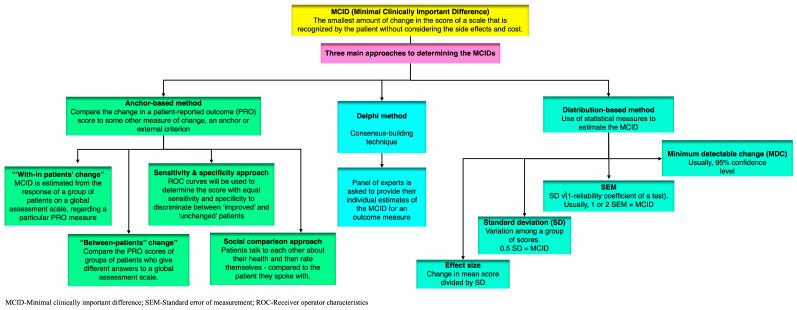
There is a growing awareness of the significance of using minimum clinically important differences (MCIDs) in stroke research. An MCID is the smallest change in an outcome measure that is considered clinically meaningful. This review is the first to provide a comprehensive summary of various scales and patient-reported outcome measures (PROMs) used in stroke research and their MCID values reported in the literature, including a concise overview of the concept of and methods for determining MCIDs in stroke research. Despite the controversies and limitations surrounding the estimation of MCIDs, their importance in modern clinical trials cannot be overstated. Anchor-based and distribution-based methods are recommended for estimating MCIDs, with patient self-evaluation being a crucial component in capturing the patient's perspective on their health. A combination of methods can provide a more comprehensive understanding of the clinical relevance of treatment effects, and incorporating the patient's perspective can enhance the care of stroke patients.
在中风研究中,人们越来越意识到使用最小临床重要差异(MCID)的重要性。MCID是结局指标中被认为具有临床意义的最小变化。本综述首次全面总结了中风研究中使用的各种量表和患者报告结局指标(PROMs)以及文献中报道的它们的MCID值,包括对中风研究中MCID概念和确定方法的简要概述。尽管围绕MCID估计存在争议和局限性,但其在现代临床试验中的重要性再怎么强调也不为过。推荐使用基于锚定和基于分布的方法来估计MCID,患者自我评估是获取患者对自身健康看法的关键组成部分。多种方法相结合可以更全面地理解治疗效果的临床相关性,纳入患者的观点可以改善中风患者的护理。
 Zotero 插件