
基于金叉指电极阵列的电化学生阻抗免疫传感器用于无标记即时检测 COVID-19 抗体
Faradaic Impedimetric Immunosensor for Label-Free Point-of-Care Detection of COVID-19 Antibodies Using Gold-Interdigitated Electrode Array.
机构信息
Department of Electrical and Computer Engineering, University of Alberta, Edmonton, AB T6G 1H9, Canada.
Department of Laboratory Medicine and Pathology, University of Alberta, Edmonton, AB T6G 1C9, Canada.
出版信息
Biosensors (Basel). 2023 Dec 22;14(1):6. doi: 10.3390/bios14010006.
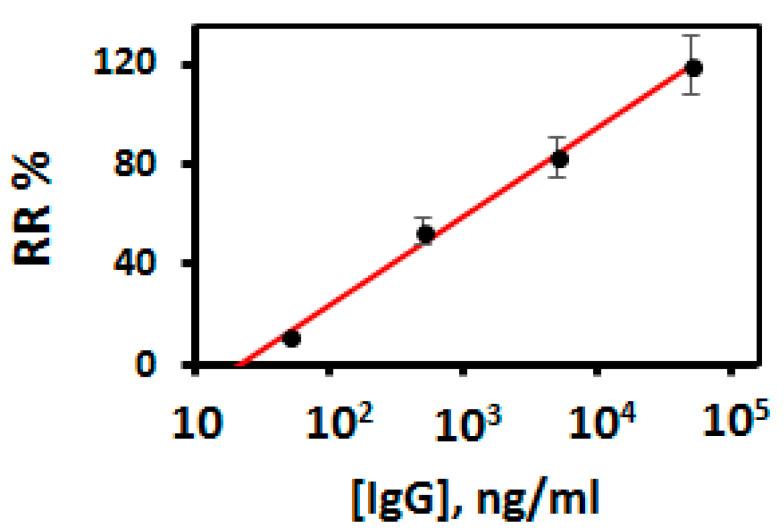
Label-free electrochemical biosensors have many desirable characteristics in terms of miniaturization, scalability, digitization, and other attributes associated with point-of-care (POC) applications. In the era of COVID-19 and pandemic preparedness, further development of such biosensors will be immensely beneficial for rapid testing and disease management. Label-free electrochemical biosensors often employ [Fe(CN)] redox probes to detect low-concentration target analytes as they dramatically enhance sensitivity. However, such Faradaic-based sensors are reported to experience baseline signal drift, which compromises the performance of these devices. Here, we describe the use of a mecaptohexanoic (MHA) self-assembled monolayer (SAM) modified Au-interdigitated electrode arrays (IDA) to investigate the origin of the baseline signal drift, developed a protocol to resolve the issue, and presented insights into the underlying mechanism on the working of label-free electrochemical biosensors. Using this protocol, we demonstrate the application of MHA SAM-modified Au-IDA for POC analysis of human serum samples. We describe the use of a label-free electrochemical biosensor based on covalently conjugated SARS-CoV-2 spike protein for POC detection of COVID-19 antibodies. The test requires a short incubation time (10 min), and has a sensitivity of 35.4/decade (35.4%/10 ng mL) and LOD of 21 ng/mL. Negligible cross reactivity to seasonal human coronavirus or other endogenous antibodies was observed. Our studies also show that Faradaic biosensors are ~17 times more sensitive than non-Faradaic biosensors. We believe the work presented here contributes to the fundamental understanding of the underlying mechanisms of baseline signal drift and will be applicable to future development of electrochemical biosensors for POC applications.
无标记电化学生物传感器在小型化、可扩展性、数字化和其他与即时护理 (POC) 应用相关的属性方面具有许多理想的特点。在 COVID-19 和大流行准备的时代,进一步开发这种生物传感器将非常有利于快速检测和疾病管理。无标记电化学生物传感器通常使用 [Fe(CN)] 氧化还原探针来检测低浓度的目标分析物,因为它们极大地提高了灵敏度。然而,这种基于法拉第的传感器据报道会出现基线信号漂移,从而影响这些设备的性能。在这里,我们描述了使用巯基己酸 (MHA) 自组装单层 (SAM) 修饰的 Au 叉指电极阵列 (IDA) 来研究基线信号漂移的起源,开发了一种解决该问题的方案,并深入了解无标记电化学生物传感器工作的潜在机制。使用该方案,我们展示了 MHA SAM 修饰的 Au-IDA 在即时护理分析人血清样本中的应用。我们描述了一种基于共价偶联 SARS-CoV-2 刺突蛋白的无标记电化学生物传感器在即时护理检测 COVID-19 抗体中的应用。该测试需要 10 分钟的短孵育时间,灵敏度为 35.4/decade(35.4%/10ng/mL),LOD 为 21ng/mL。对季节性人类冠状病毒或其他内源性抗体几乎没有交叉反应。我们的研究还表明,法拉第生物传感器比非法拉第生物传感器灵敏约 17 倍。我们相信,这里提出的工作有助于对基线信号漂移的潜在机制的基本理解,并将适用于未来即时护理应用的电化学生物传感器的开发。



 Zotero 插件