
多功能非POU结构域含八聚体结合蛋白(NonO)和富含脯氨酸和谷氨酰胺的剪接因子(SFPQ)的既定作用与演变作用
Established and Evolving Roles of the Multifunctional Non-POU Domain-Containing Octamer-Binding Protein (NonO) and Splicing Factor Proline- and Glutamine-Rich (SFPQ).
作者信息
Yu Danyang, Huang Ching-Jung, Tucker Haley O
机构信息
Department of Biology, New York University in Shanghai, Shanghai 200122, China.
Molecular Biosciences, Institute for Cellular and Molecular Biology, University of Texas at Austin, 1 University Station A5000, Austin, TX 78712, USA.
出版信息
J Dev Biol. 2024 Jan 5;12(1):3. doi: 10.3390/jdb12010003.
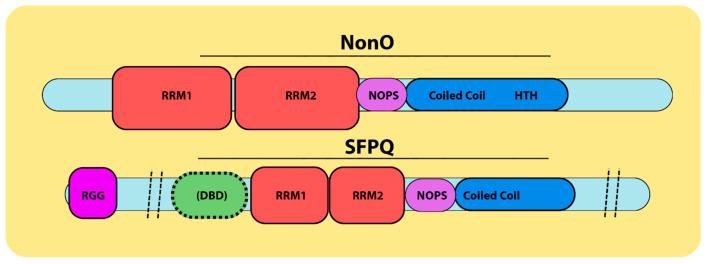
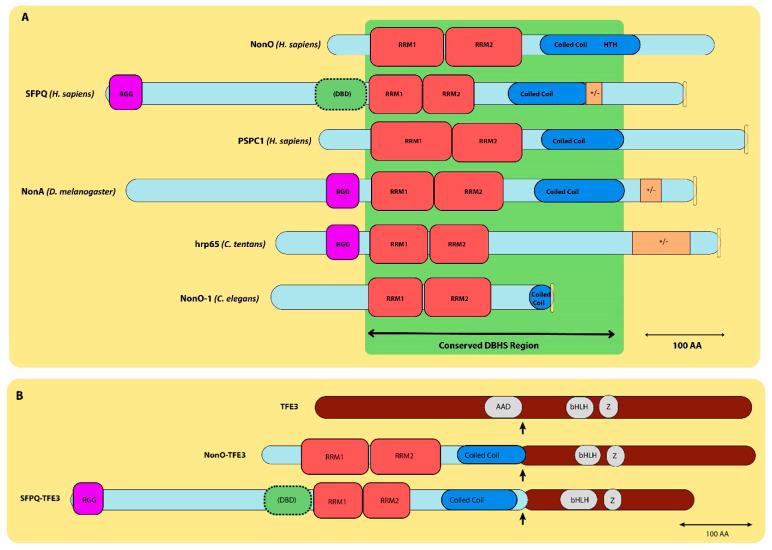
It has been more than three decades since the discovery of multifunctional factors, the Non-POU-Domain-Containing Octamer-Binding Protein, NonO, and the Splicing Factor Proline- and Glutamine-Rich, SFPQ. Some of their functions, including their participation in transcriptional and posttranscriptional regulation as well as their contribution to paraspeckle subnuclear body organization, have been well documented. In this review, we focus on several other established roles of NonO and SFPQ, including their participation in the cell cycle, nonhomologous end-joining (NHEJ), homologous recombination (HR), telomere stability, childhood birth defects and cancer. In each of these contexts, the absence or malfunction of either or both NonO and SFPQ leads to either genome instability, tumor development or mental impairment.
自多功能因子——不含POU结构域的八聚体结合蛋白(NonO)和富含脯氨酸和谷氨酰胺的剪接因子(SFPQ)被发现以来,已经过去了三十多年。它们的一些功能,包括参与转录和转录后调控以及对副斑点亚核体组织的贡献,都有充分的文献记载。在这篇综述中,我们聚焦于NonO和SFPQ的其他几个既定作用,包括它们在细胞周期、非同源末端连接(NHEJ)、同源重组(HR)、端粒稳定性、儿童出生缺陷和癌症中的参与情况。在上述每种情况下,NonO和SFPQ其中之一或两者的缺失或功能异常都会导致基因组不稳定、肿瘤发展或智力障碍。

 Zotero 插件