
载叶绿素的介孔硅纳米粒子用于癌细胞系光动力疗法的评价。
Evaluation of chlorophyll-loaded mesoporous silica nanoparticles for photodynamic therapy on cancer cell lines.
机构信息
Biotechnology Department, Faculty of Science, Cairo University, Cairo, Egypt.
Chemistry Department, Faculty of Science, Cairo University, Cairo, Egypt.
出版信息
Lasers Med Sci. 2024 Jan 23;39(1):45. doi: 10.1007/s10103-024-03988-2.
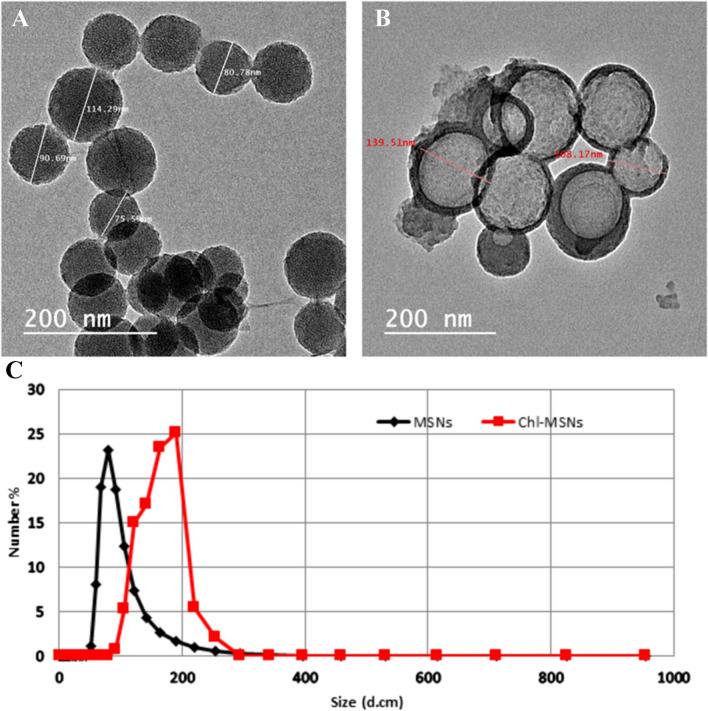
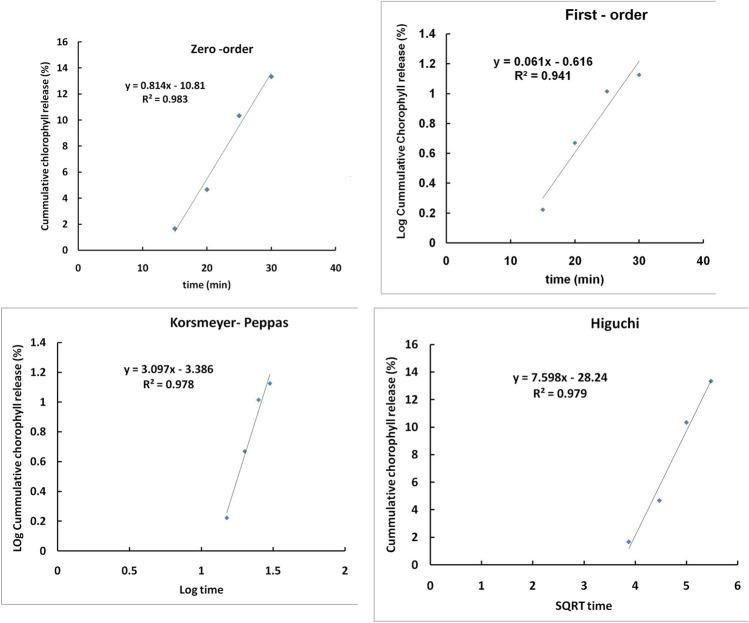
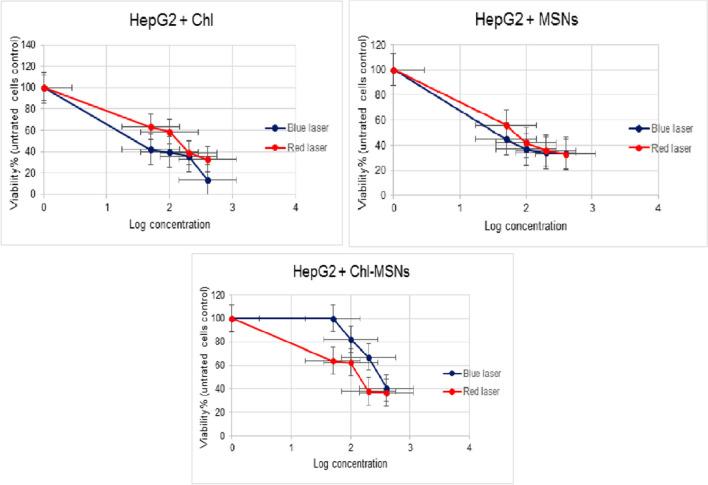
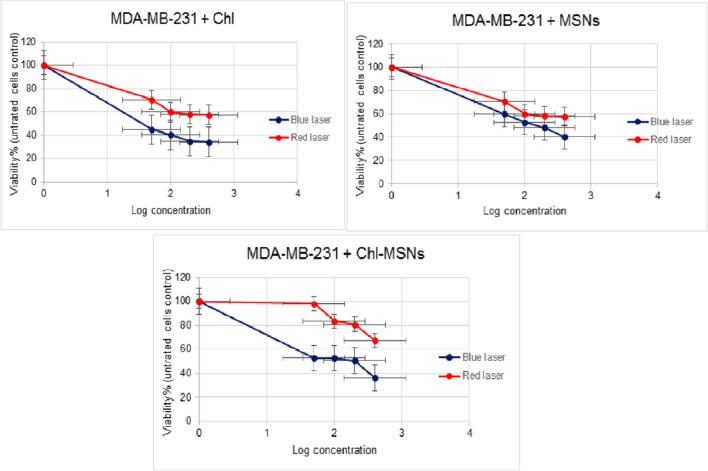
Chlorophyll (Chl) is a promising natural photosensitizer (PS) in photodynamic treatment (PDT). Mesoporous silica nanoparticles (MSNs) were chosen to increase the effectiveness of PDT. This study aimed to evaluate the synergistic efficacy of chlorophyll-loaded mesoporous silica nanoparticles (Chl-MSNs) with photodynamic therapy (PDT) and to investigate their potential toxicity in HepG2, MDA-MB-231, and HSF cell lines. Chl-MSNs were prepared via the physical adsorption method. TEM, DLS, and zeta potential examined morphology, size, and surface characteristics. MSNs and Chl-MSNs were characterized using the same techniques. HPLC was used to assess the encapsulation efficiency. At pH 7.4, an in vitro release experiment of Chl-MSNs was performed. Chl, MSNs, and Chl-MSNs were applied to the three cell lines at different concentrations and subjected to red (650 nm) and blue (450-500 nm) lasers. MSNs and Chl-MSNs' sizes were 90.338 ± 38.49 nm and 123.84 ± 15.67 nm, respectively, as obtained by TEM; the hydrodynamic diameter for MSNs (93.69 ± 20.53 nm) and Chl-MSNs (212.95 ± 19.76 nm); and their zeta potential values are - 16.7 ± 2.19 mV and - 18.84 ± 1.40 mV. The encapsulation efficiency of Chl-MSNs was 70%. Chl-MSNs displayed no toxicity in dark conditions but showed excellent photostability under blue and red light exposure. Furthermore, using Chl over Chl-MSNs has a higher PDT efficiency than the tested cell lines. Chl-MSNs have the potential to be an effective delivery system. PDT proved to be an essential technique for cancer treatment. Blue laser is recommended over red laser with Chl and MSNs for destroying cancer cells.
叶绿素(Chl)是光动力疗法(PDT)中很有前途的天然光敏剂(PS)。介孔硅纳米粒子(MSNs)被选择来提高 PDT 的效果。本研究旨在评估负载叶绿素的介孔硅纳米粒子(Chl-MSNs)与光动力疗法(PDT)的协同疗效,并研究它们在 HepG2、MDA-MB-231 和 HSF 细胞系中的潜在毒性。Chl-MSNs 通过物理吸附法制备。TEM、DLS 和 zeta 电位分析形态、大小和表面特性。MSNs 和 Chl-MSNs 采用相同的技术进行表征。HPLC 用于评估包封效率。在 pH 7.4 下,进行了 Chl-MSNs 的体外释放实验。Chl、MSNs 和 Chl-MSNs 以不同浓度应用于三种细胞系,并分别用红(650nm)和蓝(450-500nm)激光照射。TEM 结果表明,MSNs 和 Chl-MSNs 的粒径分别为 90.338±38.49nm 和 123.84±15.67nm;MSNs(93.69±20.53nm)和 Chl-MSNs(212.95±19.76nm)的水动力直径;它们的 zeta 电位值分别为-16.7±2.19mV 和-18.84±1.40mV。Chl-MSNs 的包封效率为 70%。Chl-MSNs 在黑暗条件下没有毒性,但在蓝光和红光照射下表现出极好的光稳定性。此外,与测试细胞系相比,使用 Chl 比使用 Chl-MSNs 具有更高的 PDT 效率。Chl-MSNs 有可能成为一种有效的递药系统。PDT 被证明是癌症治疗的重要技术。与 Chl 和 MSNs 相比,建议使用蓝激光而不是红激光来破坏癌细胞。

 Zotero 插件