
一种用于生化反应网络时间尺度分解的数据驱动方法。
A data-driven approach for timescale decomposition of biochemical reaction networks.
作者信息
Akbari Amir, Haiman Zachary B, Palsson Bernhard O
机构信息
Department of Bioengineering, University of California San Diego , La Jolla, California, USA.
Novo Nordisk Foundation Center for Biosustainability, Technical University of Denmark , Lyngby, Denmark.
出版信息
mSystems. 2024 Feb 20;9(2):e0100123. doi: 10.1128/msystems.01001-23. Epub 2024 Jan 23.
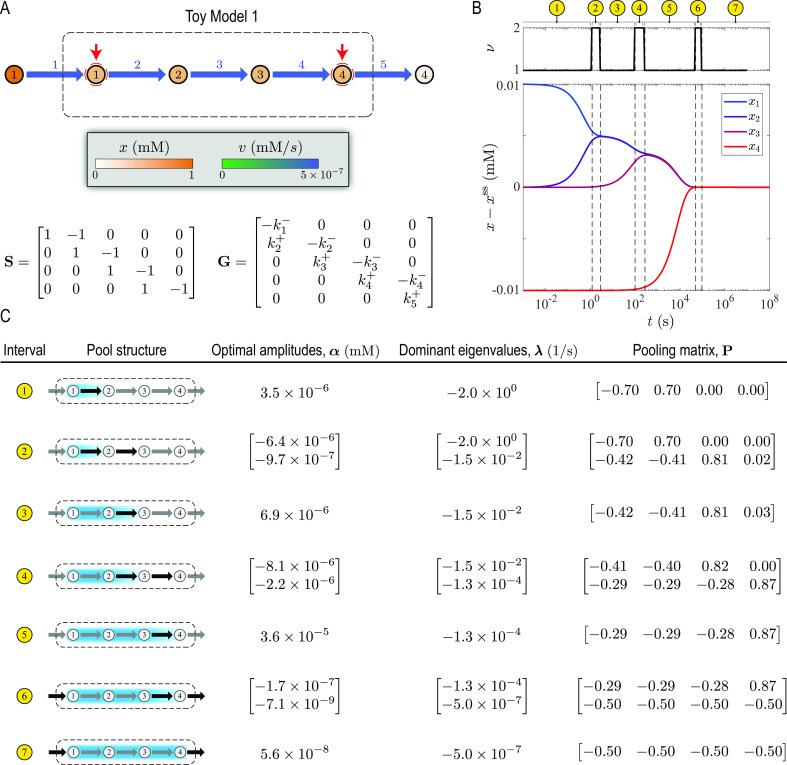
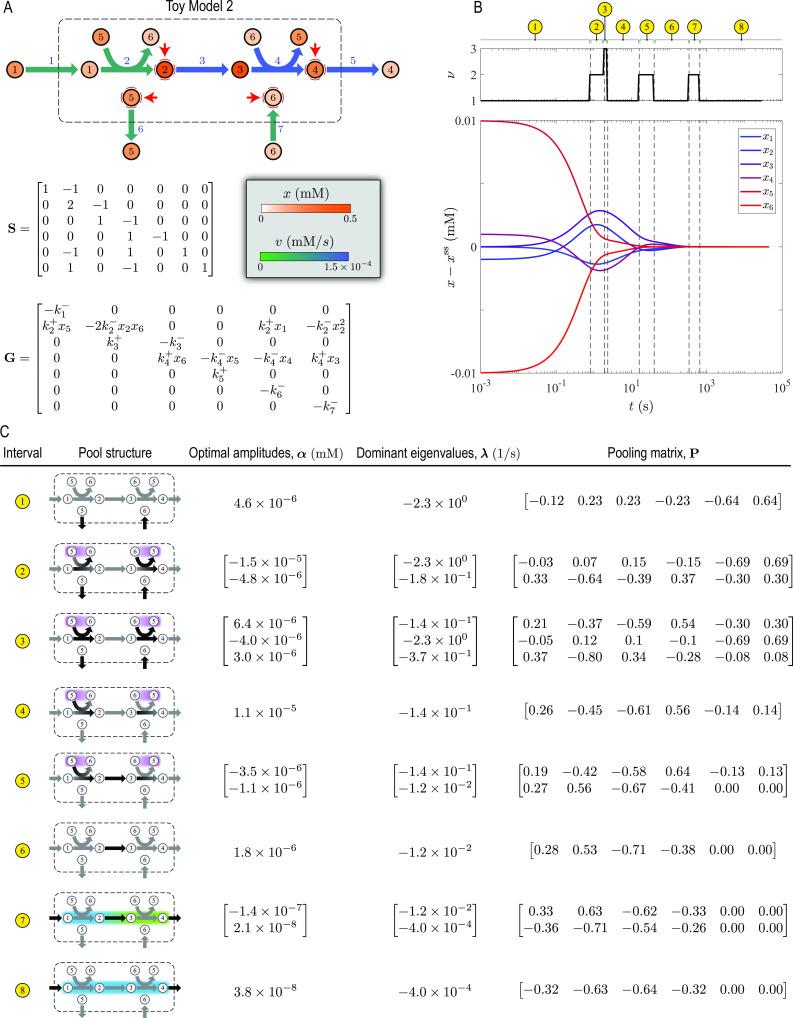
Understanding the dynamics of biological systems in evolving environments is a challenge due to their scale and complexity. Here, we present a computational framework for the timescale decomposition of biochemical reaction networks to distill essential patterns from their intricate dynamics. This approach identifies timescale hierarchies, concentration pools, and coherent structures from time-series data, providing a system-level description of reaction networks at physiologically important timescales. We apply this technique to kinetic models of hypothetical and biological pathways, validating it by reproducing analytically characterized or previously known concentration pools of these pathways. Moreover, by analyzing the timescale hierarchy of the glycolytic pathway, we elucidate the connections between the stoichiometric and dissipative structures of reaction networks and the temporal organization of coherent structures. Specifically, we show that glycolysis is a cofactor-driven pathway, the slowest dynamics of which are described by a balance between high-energy phosphate bond and redox trafficking. Overall, this approach provides more biologically interpretable characterizations of network dynamics than large-scale kinetic models, thus facilitating model reduction and personalized medicine applications. IMPORTANCE Complex interactions within interconnected biochemical reaction networks enable cellular responses to a wide range of unpredictable environmental perturbations. Understanding how biological functions arise from these intricate interactions has been a long-standing problem in biology. Here, we introduce a computational approach to dissect complex biological systems' dynamics in evolving environments. This approach characterizes the timescale hierarchies of complex reaction networks, offering a system-level understanding at physiologically relevant timescales. Analyzing various hypothetical and biological pathways, we show how stoichiometric properties shape the way energy is dissipated throughout reaction networks. Notably, we establish that glycolysis operates as a cofactor-driven pathway, where the slowest dynamics are governed by a balance between high-energy phosphate bonds and redox trafficking. This approach enhances our understanding of network dynamics and facilitates the development of reduced-order kinetic models with biologically interpretable components.
由于生物系统的规模和复杂性,理解其在不断变化的环境中的动态是一项挑战。在此,我们提出了一个用于生化反应网络时间尺度分解的计算框架,以从其复杂的动态中提取基本模式。该方法从时间序列数据中识别时间尺度层次结构、浓度池和相干结构,在生理上重要的时间尺度上提供反应网络的系统级描述。我们将此技术应用于假设的和生物途径的动力学模型,并通过重现这些途径的分析表征或先前已知的浓度池来验证它。此外,通过分析糖酵解途径的时间尺度层次结构,我们阐明了反应网络的化学计量和耗散结构与相干结构的时间组织之间的联系。具体而言,我们表明糖酵解是一条由辅因子驱动的途径,其最慢的动态由高能磷酸键和氧化还原转运之间的平衡来描述。总体而言,与大规模动力学模型相比,这种方法提供了更具生物学可解释性的网络动态特征,从而促进了模型简化和个性化医学应用。重要性 相互连接的生化反应网络中的复杂相互作用使细胞能够对各种不可预测的环境扰动做出反应。理解这些复杂相互作用如何产生生物学功能一直是生物学中的一个长期问题。在此,我们引入一种计算方法来剖析不断变化的环境中复杂生物系统的动态。这种方法表征了复杂反应网络的时间尺度层次结构,在生理相关的时间尺度上提供系统级理解。通过分析各种假设的和生物途径,我们展示了化学计量特性如何塑造能量在整个反应网络中耗散的方式。值得注意的是,我们确定糖酵解作为一条由辅因子驱动的途径运行,其中最慢的动态由高能磷酸键和氧化还原转运之间的平衡控制。这种方法增强了我们对网络动态的理解,并促进了具有生物学可解释组件的降阶动力学模型的开发。



 Zotero 插件