
肿瘤免疫中的抗原提呈细胞与免疫检查点阻断的介导作用。
Antigen presenting cells in cancer immunity and mediation of immune checkpoint blockade.
机构信息
Computer Science and Artificial Intelligence Laboratory, Massachusetts Institute of Technology, Cambridge, MA, USA.
Broad Institute of MIT and Harvard, Cambridge, MA, USA.
出版信息
Clin Exp Metastasis. 2024 Aug;41(4):333-349. doi: 10.1007/s10585-023-10257-z. Epub 2024 Jan 23.
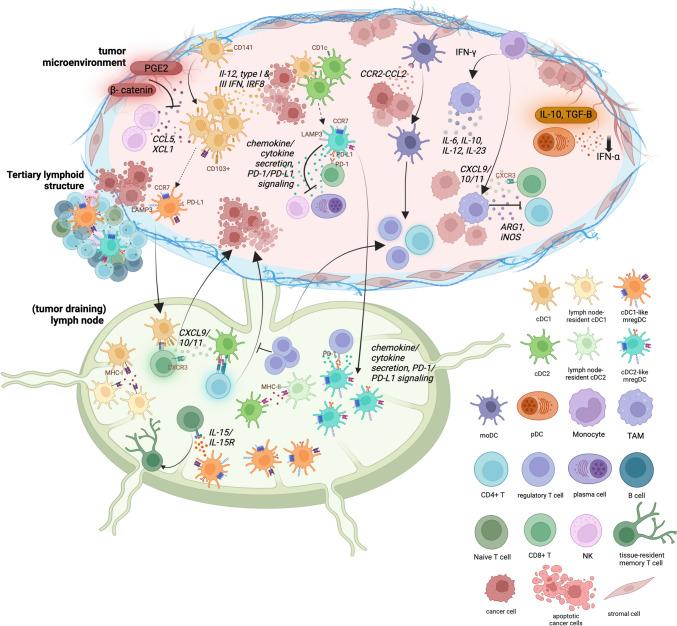
Antigen-presenting cells (APCs) are pivotal mediators of immune responses. Their role has increasingly been spotlighted in the realm of cancer immunology, particularly as our understanding of immunotherapy continues to evolve and improve. There is growing evidence that these cells play a non-trivial role in cancer immunity and have roles dependent on surface markers, growth factors, transcription factors, and their surrounding environment. The main dendritic cell (DC) subsets found in cancer are conventional DCs (cDC1 and cDC2), monocyte-derived DCs (moDC), plasmacytoid DCs (pDC), and mature and regulatory DCs (mregDC). The notable subsets of monocytes and macrophages include classical and non-classical monocytes, macrophages, which demonstrate a continuum from a pro-inflammatory (M1) phenotype to an anti-inflammatory (M2) phenotype, and tumor-associated macrophages (TAMs). Despite their classification in the same cell type, each subset may take on an immune-activating or immunosuppressive phenotype, shaped by factors in the tumor microenvironment (TME). In this review, we introduce the role of DCs, monocytes, and macrophages and recent studies investigating them in the cancer immunity context. Additionally, we review how certain characteristics such as abundance, surface markers, and indirect or direct signaling pathways of DCs and macrophages may influence tumor response to immune checkpoint blockade (ICB) therapy. We also highlight existing knowledge gaps regarding the precise contributions of different myeloid cell subsets in influencing the response to ICB therapy. These findings provide a summary of our current understanding of myeloid cells in mediating cancer immunity and ICB and offer insight into alternative or combination therapies that may enhance the success of ICB in cancers.
抗原提呈细胞 (APCs) 是免疫反应的关键介质。随着我们对免疫疗法的理解不断发展和完善,它们在癌症免疫学领域的作用越来越受到关注。越来越多的证据表明,这些细胞在癌症免疫中发挥着重要作用,并且它们的作用依赖于表面标志物、生长因子、转录因子及其周围环境。在癌症中发现的主要树突状细胞 (DC) 亚群包括经典 DC (cDC1 和 cDC2)、单核细胞衍生的 DC (moDC)、浆细胞样 DC (pDC) 和成熟和调节性 DC (mregDC)。单核细胞和巨噬细胞的显著亚群包括经典和非经典单核细胞、巨噬细胞,它们表现出从促炎 (M1) 表型到抗炎 (M2) 表型的连续变化,以及肿瘤相关巨噬细胞 (TAMs)。尽管它们被归为同一细胞类型,但每个亚群都可能具有免疫激活或免疫抑制表型,这取决于肿瘤微环境 (TME) 中的因素。在这篇综述中,我们介绍了 DC、单核细胞和巨噬细胞的作用以及最近在癌症免疫背景下对它们的研究。此外,我们还回顾了 DC 和巨噬细胞的某些特征,如丰度、表面标志物以及间接或直接信号通路,如何影响肿瘤对免疫检查点阻断 (ICB) 治疗的反应。我们还强调了关于不同髓样细胞亚群在影响 ICB 治疗反应方面的确切贡献的现有知识空白。这些发现总结了我们目前对髓样细胞在介导癌症免疫和 ICB 中的理解,并为增强 ICB 在癌症中的成功的替代或联合治疗提供了思路。

 Zotero 插件