
唾液微小RNA、临床及人口统计学特征在结直肠癌诊断中的评估
Assessment of salivary miRNA, clinical, and demographic characterization in colorectal cancer diagnosis.
作者信息
Koopaie Maryam, Manifar Soheila, Talebi Mona Mohammad, Kolahdooz Sajad, Razavi Amirnader Emami, Davoudi Mansour, Pourshahidi Sara
机构信息
Department of Oral Medicine, School of Dentistry, Tehran University of Medical Sciences, Tehran, Iran.
Department of Oral Medicine, Imam Khomeini Hospital, Tehran University of Medical Sciences, Tehran, Iran.
出版信息
Transl Oncol. 2024 Mar;41:101880. doi: 10.1016/j.tranon.2024.101880. Epub 2024 Jan 22.
AIM
Colorectal cancer (CRC), as the third most frequent malignancy in the world, is the fourth major cause of cancer-related mortality. Its early detection contributes significantly to a reduction in mortality. The objective of this case-control research was to analyze the salivary expression of microRNA-29a (miR-29a) and microRNA-92a (miR-92a), and also to consider demographic, clinical, and nutritional habits for differentiation between CRC patients and healthy controls, especially in the early stages.
METHOD
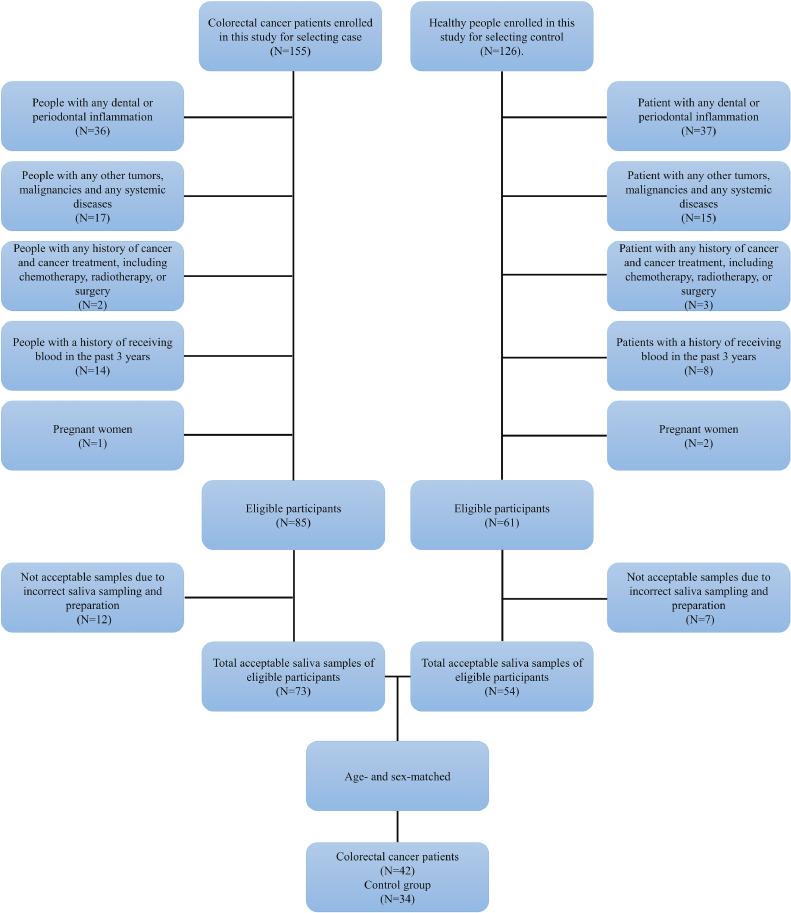
A standard checklist was used to obtain the demographic information, clinical features, and dietary habits of the case and control groups. Samplings of whole unstimulated saliva samples were obtained from 33 healthy persons and 42 CRC patients. Through real-time PCR, statistical analyses, and machine learning analyses, miR-29a and miR-92a salivary expression levels were evaluated.
RESULTS
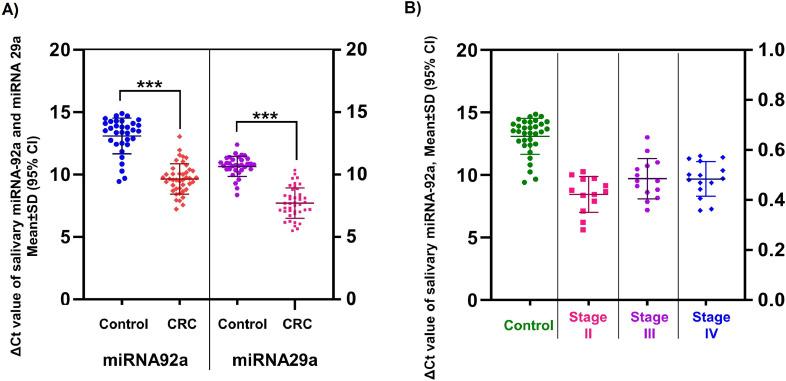
The mean salivary expression of miR-92a and miR-29a in CRC patients was significantly higher than in healthy controls (p < 0.001). The area under the receiver operating characteristic curve for miR-92a and miR-29a salivary biomarkers was 0.947 and 0.978, respectively. The sensitivity and specificity values for miR-92a were 95.24 % and 84.85 %, respectively, whereas sensitivity and specificity for miR-29a were equal to 95.20 % and 87.88 %, respectively. Multiple logistic regressions considering demographics, clinical features, and nutritional habits led to values of 95.35 % and 96.88 % as sensitivity and specificity, respectively, and machine learning analysis led to values of 88.89 % and 86.67 % as sensitivity and specificity, respectively.
CONCLUSION
CRC could be accurately diagnosed based on miR-92a and miR-29a levels in saliva. Statistical analysis and machine learning might develop cost-effective models for the distinction of CRC using a noninvasive technique.
目的
结直肠癌(CRC)是全球第三常见的恶性肿瘤,是癌症相关死亡的第四大主要原因。其早期检测对降低死亡率有显著贡献。本病例对照研究的目的是分析微小RNA-29a(miR-29a)和微小RNA-92a(miR-92a)的唾液表达情况,并考虑人口统计学、临床和营养习惯,以区分CRC患者和健康对照,特别是在早期阶段。
方法
使用标准检查表获取病例组和对照组的人口统计学信息、临床特征和饮食习惯。从33名健康人和42名CRC患者中采集未刺激的全唾液样本。通过实时PCR、统计分析和机器学习分析,评估miR-29a和miR-92a的唾液表达水平。
结果
CRC患者中miR-92a和miR-29a的平均唾液表达显著高于健康对照(p < 0.001)。miR-92a和miR-29a唾液生物标志物的受试者工作特征曲线下面积分别为0.947和0.978。miR-92a的敏感性和特异性值分别为95.24%和84.85%,而miR-29a的敏感性和特异性分别为95.20%和87.88%。考虑人口统计学、临床特征和营养习惯的多因素逻辑回归分析得出的敏感性和特异性值分别为95.35%和96.88%,机器学习分析得出的敏感性和特异性值分别为88.89%和86.67%。
结论
基于唾液中miR-92a和miR-29a的水平可准确诊断CRC。统计分析和机器学习可能会开发出使用非侵入性技术区分CRC的经济高效模型。



 Zotero 插件