
银杏叶对 2 型糖尿病患者血液代谢的影响及安全性:系统评价和荟萃分析。
Effects and safety of Ginkgo biloba on blood metabolism in type 2 diabetes mellitus: a systematic review and meta-analysis.
机构信息
Department of Endocrinology, Shidong Hospital, Yangpu District, Shidong Hospital Affiliated to University of Shanghai for Science and Technology, Shanghai, China.
出版信息
Front Endocrinol (Lausanne). 2024 Jan 8;14:1231053. doi: 10.3389/fendo.2023.1231053. eCollection 2023.
BACKGROUND
There has existed controversy regarding the use of Ginkgo biloba (GKB) for blood metabolism among type 2 diabetes mellitus(T2DM) patients, and we tried to analyze the effects and safety of GKB on T2DM patients.
METHODS
We conducted a literature search between January 2003 and December 2022 of seven online databases (PubMed, Scopus, Embase, Google Scholar, Web of Sciences, Cochrane Library, and China National Knowledge Infrastructure). A systematic literature review and meta-analysis were performed to compare the effects and safety of GKB among T2DM patients. Four groups of parameters were extracted and analyzed: hemorheology parameters, lipid profile, glycemic control markers, and adverse events.
RESULTS
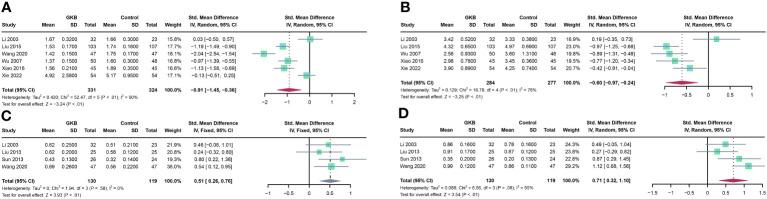
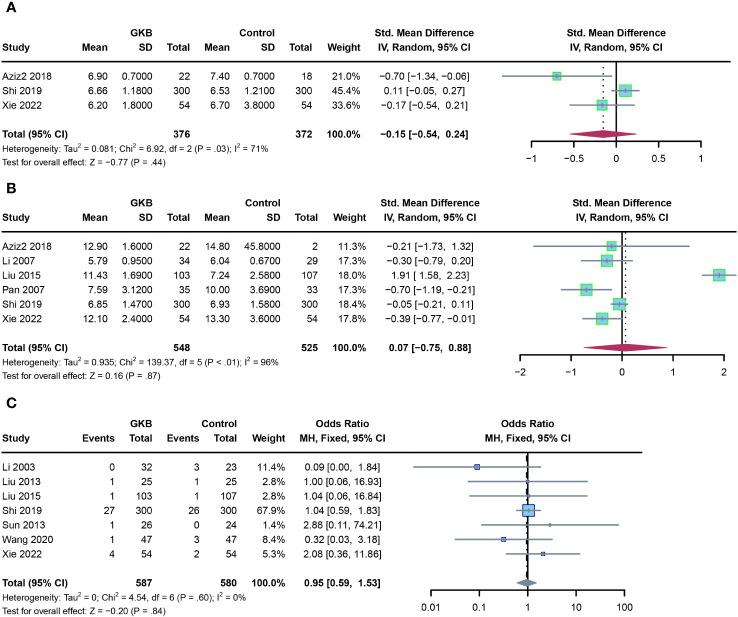
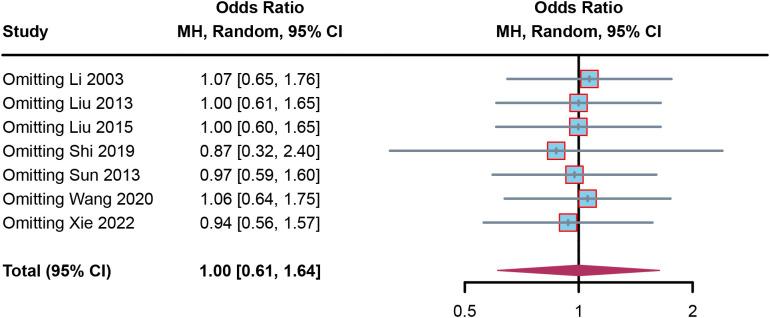
In the end, 13 eligible articles with 11 indicators among 1573 patients were included. In the hemorheology parameters section, GKB showed significantly lower plasma viscosity (PV) (SMD=-0.91, 95%CI [-1.45, -0.36], <0.01) and hematocrit (Hct) (SMD=-0.60, 95%CI [-0.97, -0.24], <0.01) than the control group. GKB shoed higher velocity of the dorsalis pedis artery (VDPA) (SMD=0.51, 95%CI [0.26, 0.76], <0.01) and ankle brachial index (ABI) (SMD=0.71, 95%CI [0.32, 1.10], <0.01) than the control. In both the lipid profile and glycemic control markers sections, we did not find any difference between GKB and control groups, including total cholesterol (TC), triglyceride (TG), low-density lipoprotein (LDL), high-density lipoprotein (HDL), hemoglobin A1c (HbA1c), and fasting serum glucose (FSG). In addition, we saw no difference in adverse events (AE). The sensitivity analysis and funnel plot showed that the results in this research were robust and had no publication bias.
CONCLUSION
In conclusion, GKB might safely reduce the risk of peripheral arterial or even systemic cardiovascular disease. However, GKB did not directly improve lipid and blood glucose levels in T2DM patients.
SYSTEMATIC REVIEW REGISTRATION
https://inplasy.com/, identifier INPLASY202350096.
背景
银杏叶(Ginkgo biloba,GKB)在 2 型糖尿病(T2DM)患者的血液代谢方面的应用存在争议,我们试图分析 GKB 对 T2DM 患者的疗效和安全性。
方法
我们检索了 2003 年 1 月至 2022 年 12 月七个在线数据库(PubMed、Scopus、Embase、Google Scholar、Web of Sciences、Cochrane Library 和中国知网)中的文献,对 GKB 治疗 T2DM 患者的疗效和安全性进行了系统评价和荟萃分析。提取并分析了四组参数:血液流变学参数、血脂谱、血糖控制标志物和不良事件。
结果
最终纳入了 13 项研究,包含 1573 例患者的 11 项指标。在血液流变学参数方面,与对照组相比,GKB 可显著降低血浆黏度(SMD=-0.91,95%CI [-1.45,-0.36],<0.01)和红细胞压积(SMD=-0.60,95%CI [-0.97,-0.24],<0.01)。GKB 可显著提高足背动脉(SMD=0.51,95%CI [0.26,0.76],<0.01)和踝肱指数(SMD=0.71,95%CI [0.32,1.10],<0.01)。在血脂谱和血糖控制标志物方面,GKB 与对照组相比,总胆固醇(TC)、三酰甘油(TG)、低密度脂蛋白(LDL)、高密度脂蛋白(HDL)、糖化血红蛋白(HbA1c)和空腹血糖(FSG)均无差异。此外,两组不良事件(AE)也无差异。敏感性分析和漏斗图表明,本研究结果稳健,不存在发表偏倚。
结论
总之,GKB 可能安全地降低 T2DM 患者外周动脉甚至全身性心血管疾病的风险。然而,GKB 并不能直接改善 T2DM 患者的血脂和血糖水平。
系统评价注册
https://inplasy.com/,注册号 INPLASY202350096。



 Zotero 插件