
自杀的生物心理社会模型的证据:对使用机器学习的全人建模研究的综述
Evidence for the biopsychosocial model of suicide: a review of whole person modeling studies using machine learning.
作者信息
Tio Earvin S, Misztal Melissa C, Felsky Daniel
机构信息
Krembil Centre for Neuroinformatics, Centre for Addiction and Mental Health, Toronto, ON, Canada.
Institute of Medical Science, Temerty Faculty of Medicine, University of Toronto, Toronto, ON, Canada.
出版信息
Front Psychiatry. 2024 Jan 11;14:1294666. doi: 10.3389/fpsyt.2023.1294666. eCollection 2023.
BACKGROUND
Traditional approaches to modeling suicide-related thoughts and behaviors focus on few data types from often-siloed disciplines. While psychosocial aspects of risk for these phenotypes are frequently studied, there is a lack of research assessing their impact in the context of biological factors, which are important in determining an individual's fulsome risk profile. To directly test this biopsychosocial model of suicide and identify the relative importance of predictive measures when considered together, a transdisciplinary, multivariate approach is needed. Here, we systematically review the emerging literature on large-scale studies using machine learning to integrate measures of psychological, social, and biological factors simultaneously in the study of suicide.
METHODS
We conducted a systematic review of studies that used machine learning to model suicide-related outcomes in human populations including at least one predictor from each of biological, psychological, and sociological data domains. Electronic databases MEDLINE, EMBASE, PsychINFO, PubMed, and Web of Science were searched for reports published between August 2013 and August 30, 2023. We evaluated populations studied, features emerging most consistently as risk or resilience factors, methods used, and strength of evidence for or against the biopsychosocial model of suicide.
RESULTS
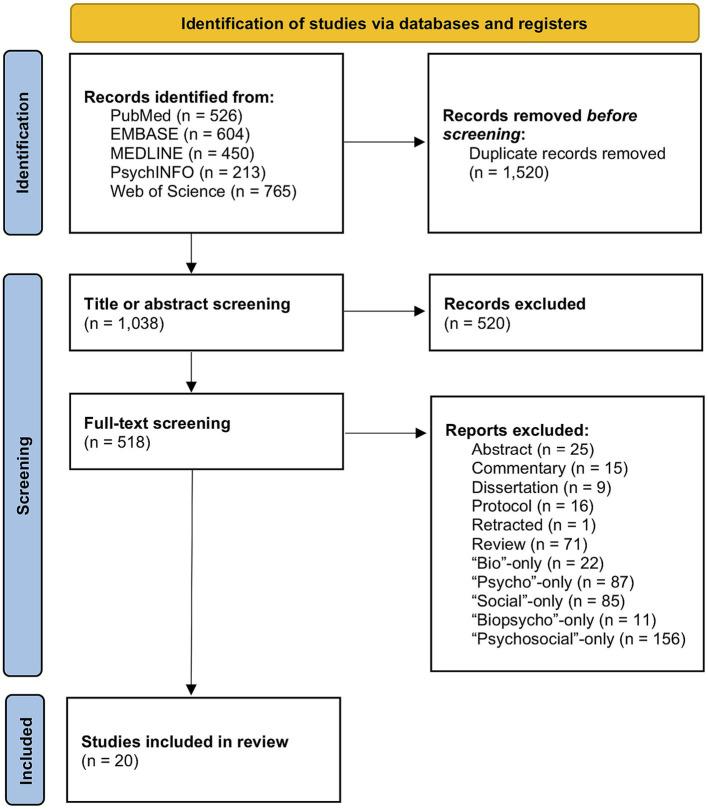
Out of 518 full-text articles screened, we identified a total of 20 studies meeting our inclusion criteria, including eight studies conducted in general population samples and 12 in clinical populations. Common important features identified included depressive and anxious symptoms, comorbid psychiatric disorders, social behaviors, lifestyle factors such as exercise, alcohol intake, smoking exposure, and marital and vocational status, and biological factors such as hypothalamic-pituitary-thyroid axis activity markers, sleep-related measures, and selected genetic markers. A minority of studies conducted iterative modeling testing each data type for contribution to model performance, instead of reporting basic measures of relative feature importance.
CONCLUSION
Studies combining biopsychosocial measures to predict suicide-related phenotypes are beginning to proliferate. This literature provides some early empirical evidence for the biopsychosocial model of suicide, though it is marred by harmonization challenges. For future studies, more specific definitions of suicide-related outcomes, inclusion of a greater breadth of biological data, and more diversity in study populations will be needed.
背景
传统的自杀相关想法和行为建模方法侧重于来自常被孤立的学科的少数数据类型。虽然这些表型风险的心理社会方面经常被研究,但缺乏在生物因素背景下评估其影响的研究,而生物因素在确定个体的全面风险概况中很重要。为了直接检验这种自杀的生物心理社会模型,并确定综合考虑时预测指标的相对重要性,需要一种跨学科的多变量方法。在此,我们系统回顾了关于大规模研究的新兴文献,这些研究使用机器学习在自杀研究中同时整合心理、社会和生物因素的测量指标。
方法
我们对使用机器学习对人群中的自杀相关结果进行建模的研究进行了系统回顾,这些研究包括来自生物、心理和社会学数据领域中每个领域的至少一个预测指标。在电子数据库MEDLINE、EMBASE、PsychINFO、PubMed和Web of Science中搜索了2013年8月至2023年8月30日期间发表的报告。我们评估了所研究的人群、最一致地作为风险或复原力因素出现的特征、使用的方法以及支持或反对自杀生物心理社会模型的证据强度。
结果
在筛选的518篇全文文章中,我们共确定了20项符合我们纳入标准的研究,包括8项在一般人群样本中进行的研究和12项在临床人群中进行的研究。确定的常见重要特征包括抑郁和焦虑症状、共病精神障碍、社会行为、生活方式因素(如运动、饮酒、吸烟暴露以及婚姻和职业状况)以及生物因素(如下丘脑 - 垂体 - 甲状腺轴活动标志物、与睡眠相关的测量指标以及选定的基因标志物)。少数研究进行了迭代建模,测试每种数据类型对模型性能的贡献,而不是报告相对特征重要性的基本测量指标。
结论
结合生物心理社会测量指标来预测自杀相关表型的研究开始增多。该文献为自杀的生物心理社会模型提供了一些早期实证证据,尽管它受到协调挑战的影响。对于未来的研究,将需要对自杀相关结果进行更具体的定义、纳入更广泛的生物数据以及增加研究人群的多样性。

 Zotero 插件