
日本新冠肺炎住院患者抗新冠病毒药物的真实世界处方情况。
Real-world prescription of anti-COVID-19 drugs in hospitalized patients with COVID-19 in Japan.
作者信息
Shida Haruka, Komamine Maki, Kajiyama Kazuhiro, Waki Takashi, Maruyama Hotaka, Uyama Yoshiaki
机构信息
Office of Medical Informatics and Epidemiology, Pharmaceuticals and Medical Devices Agency, Tokyo, Japan.
出版信息
PLoS One. 2024 Jan 26;19(1):e0297679. doi: 10.1371/journal.pone.0297679. eCollection 2024.
OBJECTIVE
Prescription trends and patterns of anti-COVID-19 drugs in hospitalized patients were examined based on real world data to understand the use of anti-COVID-19 drugs in clinical practice in Japan.
DESIGN
The longitudinal and cross-sectional study was conducted utilizing data from January 1, 2019 to December 31, 2021 of the MID-NET® medical information database, which stored the electronic medical records, administrative claim data, and diagnosis procedure combination data of patients in Japan.
PARTICIPANTS
Hospitalized patients with a COVID-19-related diagnosis who received at least one anti-COVID-19 drug between April 1, 2020 and December 31, 2021.
EXPOSURES
The following 14 drugs were included in this study: remdesivir, baricitinib, combination product of casirivimab and imdevimab, favipiravir, dexamethasone, ivermectin, azithromycin, nafamostat mesylate, camostat mesylate, ciclesonide, tocilizumab, sarilumab, combination product of lopinavir and ritonavir, and hydroxychloroquine.
RESULTS
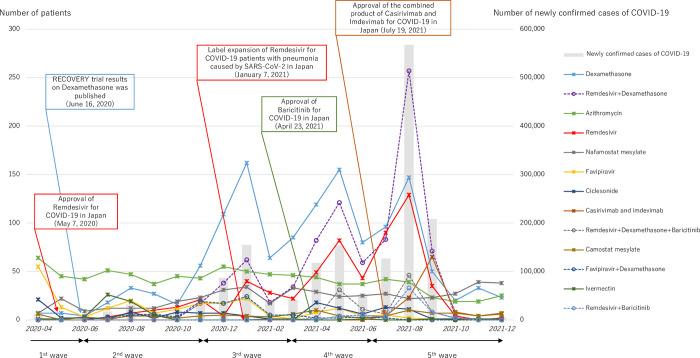
We identified 5,717 patients hospitalized with COVID-19 and prescribed at least one anti-COVID-19 drug. The entire cohort generally included patients over 41-50 years and more males. The most common prescription pattern was dexamethasone monotherapy (22.9%), followed by the concomitant use of remdesivir and dexamethasone (15.0%), azithromycin monotherapy (15.0%), remdesivir monotherapy (10.2%), and nafamostat mesylate monotherapy (8.5%). However, an often prescribed anti-COVID-19 drug differed depending on the period.
CONCLUSIONS AND RELEVANCE
This study revealed the real-world situation of anti-COVID-19 drug prescriptions in hospitalized COVID-19 patients in Japan. A prescribed drug would depend on the latest scientific evidence, such as efficacy, safety, and approval status, at the time of prescription. Understanding the prescription of anti-COVID-19 drugs will be important for providing the most up-to-date treatments to patients and evaluating the benefit and/or risk of anti-COVID-19 drugs based on the utilization of an electronic medical record database.
目的
基于真实世界数据,研究住院患者中抗新冠病毒药物的处方趋势和模式,以了解日本临床实践中抗新冠病毒药物的使用情况。
设计
利用MID-NET®医学信息数据库2019年1月1日至2021年12月31日的数据进行纵向和横断面研究,该数据库存储了日本患者的电子病历、行政索赔数据和诊断程序组合数据。
参与者
2020年4月1日至2021年12月31日期间因新冠病毒相关诊断住院且接受至少一种抗新冠病毒药物治疗的患者。
暴露因素
本研究纳入以下14种药物:瑞德西韦、巴瑞替尼、卡西瑞韦单抗与伊德维单抗联合制剂、法匹拉韦、地塞米松、伊维菌素、阿奇霉素、甲磺酸萘莫司他、甲磺酸卡莫司他、环索奈德、托珠单抗、萨瑞鲁单抗、洛匹那韦与利托那韦联合制剂、羟氯喹。
结果
我们确定了5717例因新冠病毒住院且至少开具了一种抗新冠病毒药物的患者。整个队列一般包括41-50岁以上的患者且男性居多。最常见的处方模式是地塞米松单药治疗(22.9%),其次是瑞德西韦与地塞米松联合使用(15.0%)、阿奇霉素单药治疗(15.0%)、瑞德西韦单药治疗(10.2%)、甲磺酸萘莫司他单药治疗(8.5%)。然而,常用的抗新冠病毒药物因时间段而异。
结论及意义
本研究揭示了日本住院新冠病毒患者中抗新冠病毒药物处方的真实情况。开具的药物将取决于处方时的最新科学证据,如疗效、安全性和获批情况。了解抗新冠病毒药物的处方情况对于为患者提供最新治疗以及基于电子病历数据库的使用评估抗新冠病毒药物的益处和/或风险至关重要。

 Zotero 插件