
SUMO化修饰在健康与疾病中的机制及功能:聚焦免疫细胞的综述
Mechanisms and functions of SUMOylation in health and disease: a review focusing on immune cells.
作者信息
Huang Chien-Hsin, Yang Tsan-Tzu, Lin Kuo-I
机构信息
Genomics Research Center, Academia Sinica, 128 Academia Road, Sec. 2, Nankang District, Taipei, 115, Taiwan.
Graduate Institute of Immunology, College of Medicine, National Taiwan University, Taipei, 110, Taiwan.
出版信息
J Biomed Sci. 2024 Jan 27;31(1):16. doi: 10.1186/s12929-024-01003-y.
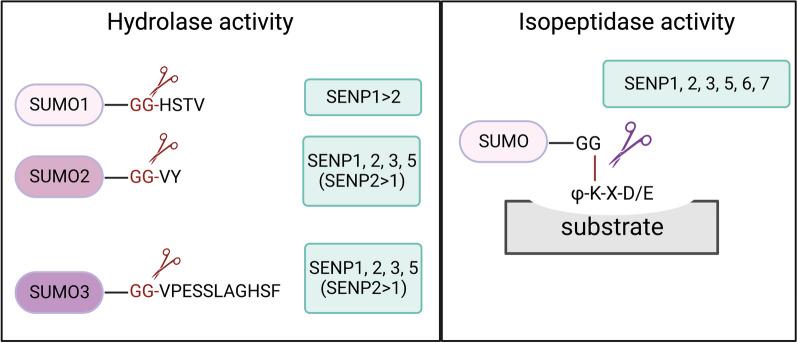
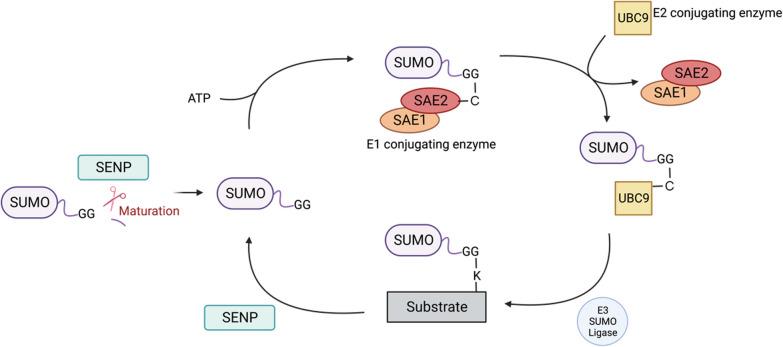
SUMOylation, which is a type of post-translational modification that involves covalent conjugation of small ubiquitin-like modifier (SUMO) proteins to target substrates, regulates various important molecular and cellular processes, including transcription, the cell cycle, cell signaling, and DNA synthesis and repair. Newly synthesized SUMO is immature and cleaved by the SUMO-specific protease family, resulting in exposure of the C-terminal Gly-Gly motif to become the mature form. In the presence of ATP, mature SUMO is conjugated with the activating enzyme E1 through the cysteine residue of E1, followed by transfer to the cysteine residue of E2-conjugating enzyme Ubc9 in humans that recognizes and modifies the lysine residue of a substrate protein. E3 SUMO ligases promote SUMOylation. SUMOylation is a reversible modification and mediated by SUMO-specific proteases. Cumulative studies have indicated that SUMOylation affects the functions of protein substrates in various manners, including cellular localization and protein stability. Gene knockout studies in mice have revealed that several SUMO cycling machinery proteins are crucial for the development and differentiation of various cell lineages, including immune cells. Aberrant SUMOylation has been implicated in several types of diseases, including cancers, cardiovascular diseases, and autoimmune diseases. This review summarizes the biochemistry of SUMO modification and the general biological functions of proteins involved in SUMOylation. In particular, this review focuses on the molecular mechanisms by which SUMOylation regulates the development, maturation, and functions of immune cells, including T, B, dendritic, and myeloid cells. This review also discusses the underlying relevance of disruption of SUMO cycling and site-specific interruption of SUMOylation on target proteins in immune cells in diseases, including cancers and infectious diseases.
SUMO化是一种翻译后修饰,涉及小泛素样修饰物(SUMO)蛋白与靶底物的共价结合,它调节各种重要的分子和细胞过程,包括转录、细胞周期、细胞信号传导以及DNA合成和修复。新合成的SUMO是不成熟的,会被SUMO特异性蛋白酶家族切割,导致C末端甘氨酸 - 甘氨酸基序暴露成为成熟形式。在ATP存在的情况下,成熟的SUMO通过E1的半胱氨酸残基与激活酶E1结合,随后转移至人类E2结合酶Ubc9的半胱氨酸残基,Ubc9识别并修饰底物蛋白的赖氨酸残基。E3 SUMO连接酶促进SUMO化。SUMO化是一种可逆修饰,由SUMO特异性蛋白酶介导。累积研究表明,SUMO化以多种方式影响蛋白质底物的功能,包括细胞定位和蛋白质稳定性。小鼠的基因敲除研究表明,几种SUMO循环机制蛋白对于包括免疫细胞在内的各种细胞谱系的发育和分化至关重要。异常的SUMO化与多种疾病有关,包括癌症、心血管疾病和自身免疫性疾病。本综述总结了SUMO修饰的生物化学以及参与SUMO化的蛋白质的一般生物学功能。特别是,本综述重点关注SUMO化调节免疫细胞(包括T细胞、B细胞、树突状细胞和髓样细胞)的发育、成熟和功能的分子机制。本综述还讨论了SUMO循环破坏和免疫细胞中靶蛋白SUMO化位点特异性中断在包括癌症和传染病在内的疾病中的潜在相关性。
 Zotero 插件