
在妊娠大鼠中使用微透析技术对作为帕罗韦德组分的利托那韦进行胎盘转运的药代动力学分析。
Pharmacokinetic analysis of placental transfer of ritonavir as a component of paxlovid using microdialysis in pregnant rats.
作者信息
Sun Chung-Kai, Lee Wan-Hsin, Yang Muh-Hwa, Tsai Tung-Hu
机构信息
Institute of Traditional Medicine, College of Medicine, National Yang Ming Chiao Tung University, Taipei 112, Taiwan.
Institute of Clinical Medicine, College of Medicine, National Yang Ming Chiao Tung University, Taipei 112, Taiwan.
出版信息
Heliyon. 2024 Jan 10;10(2):e24333. doi: 10.1016/j.heliyon.2024.e24333. eCollection 2024 Jan 30.
BACKGROUND
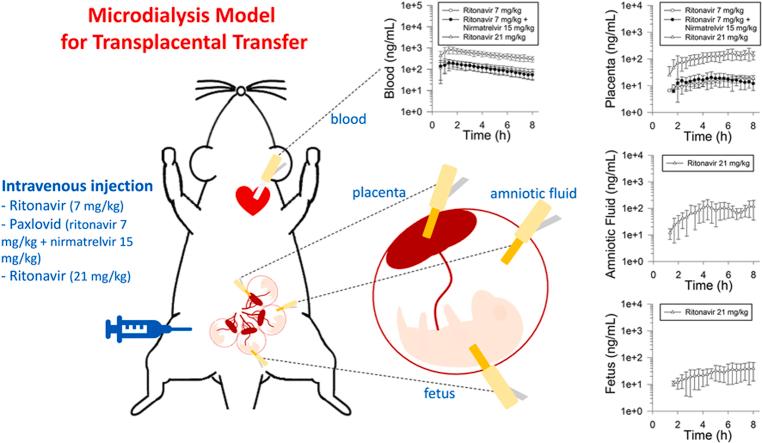
Ritonavir is one of the most potent CYP3A4 inhibitor currently on the market, and is often used together with other antiviral drugs to increase their bioavailability and efficacy. Paxlovid, consisting of nirmatrelvir and ritonavir, was approved for the treatment of COVID-19. As previous studies regarding the use of ritonavir during pregnancy were limited to ex-vivo experiments and systemic safety data, to fully explore the detailed pharmacokinetics of ritonavir in pregnant rats' blood and conceptus, an analytical method consisted of multi-microdialysis coupled with UHPLC-MS/MS were developed to analyze the pharmacokinetics of ritonavir, both as a component of Paxlovid and by itself. 17 days pregnant female Sprague-Dawley rats were randomly split into three experimental group: normal dosage of ritonavir alone (7 mg kg), normal dosage of Paxlovid (ritonavir 7 mg kg + nirmatrelvir 15 mg kg), and 3× dosage of ritonavir (21 mg kg).
RESULTS
3× dosage of ritonavir produced a more than 3× increase in rats' blood and placenta. Transfer rate of ritonavir to the placenta, amniotic fluid, and fetus were determined to be 20.7%, 13.8%, and 4.7% respectively. Concentration of ritonavir in the placenta, amniotic fluid, and fetus did not significantly go down after 8 h.
SIGNIFICANCE
Overall, ritonavir's metabolism was not influenced by the presence of nirmatrelvir in pregnant rats. A 3× increase in dosage produced a concentration of roughly 4×, most likely a result of ritonavir's auto-inhibition effect on cytochrome P450 proteins. Accumulation of ritonavir is possible in placenta, amniotic fluid, and fetus.
背景
利托那韦是目前市面上最强效的CYP3A4抑制剂之一,常与其他抗病毒药物联合使用以提高其生物利用度和疗效。由奈玛特韦和利托那韦组成的帕罗韦德已被批准用于治疗新冠肺炎。由于先前关于孕期使用利托那韦的研究仅限于体外实验和全身安全性数据,为全面探究利托那韦在孕鼠血液和胎儿中的详细药代动力学,开发了一种由多微透析与超高效液相色谱-串联质谱联用组成的分析方法,以分析利托那韦作为帕罗韦德的成分以及单独使用时的药代动力学。将怀孕17天的雌性斯普拉格-道利大鼠随机分为三个实验组:单独使用正常剂量的利托那韦(7毫克/千克)、正常剂量的帕罗韦德(利托那韦7毫克/千克+奈玛特韦15毫克/千克)和3倍剂量的利托那韦(21毫克/千克)。
结果
3倍剂量的利托那韦使大鼠血液和胎盘中的药物浓度增加了3倍以上。利托那韦向胎盘、羊水和胎儿的转运率分别为20.7%、13.8%和4.7%。8小时后,胎盘、羊水和胎儿中利托那韦的浓度没有明显下降。
意义
总体而言,在孕鼠中,利托那韦的代谢不受奈玛特韦的影响。剂量增加3倍导致浓度增加约4倍,这很可能是利托那韦对细胞色素P450蛋白的自身抑制作用所致。利托那韦有可能在胎盘、羊水和胎儿中蓄积。


 Zotero 插件