
印度喜马拉雅地区新冠疫情第一、二、三波期间病毒载量的趋势:北阿坎德邦的一项观察性研究
Trend of viral load during the first, second, and third wave of COVID-19 in the Indian Himalayan region: an observational study of the Uttarakhand state.
作者信息
Negi Shailender, Kalita Deepjyoti, Ranakoti Neeraj, Negi Ashish, Kandwal Diksha, Gupta Shailesh Kumar, Mathuria Yogendra Pratap
机构信息
Viral Research and Diagnostic Laboratory (VRDL), All India Institute of Medical Sciences, Rishikesh, India.
Department of Microbiology, All India Institute of Medical Sciences, Guwahati, India.
出版信息
Front Microbiol. 2024 Jan 15;14:1279632. doi: 10.3389/fmicb.2023.1279632. eCollection 2023.
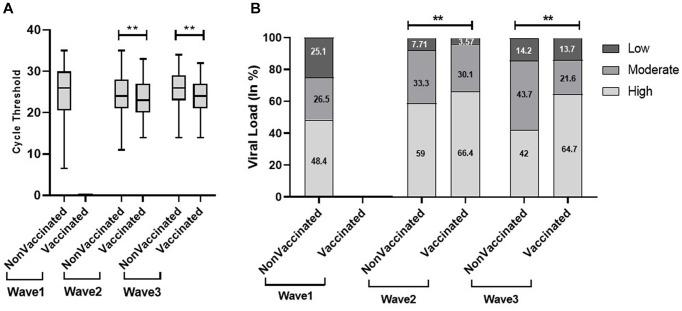
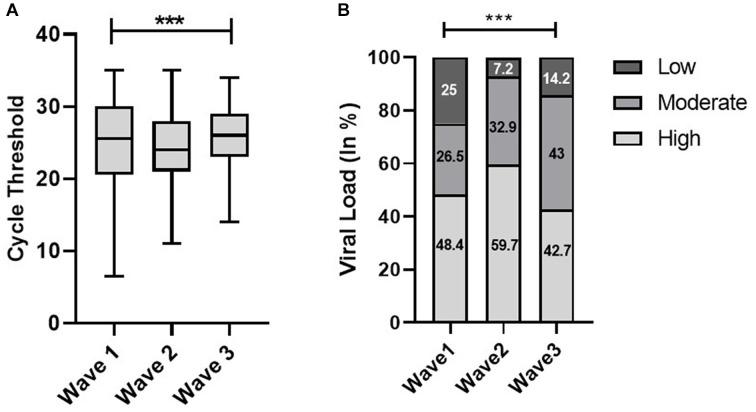
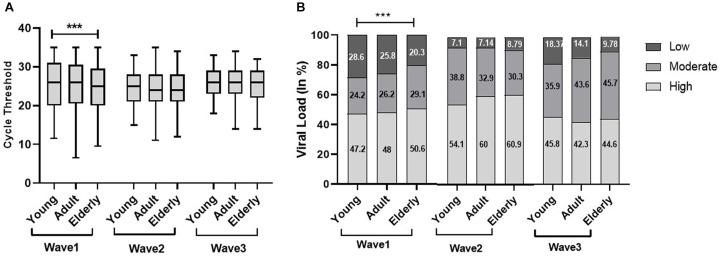
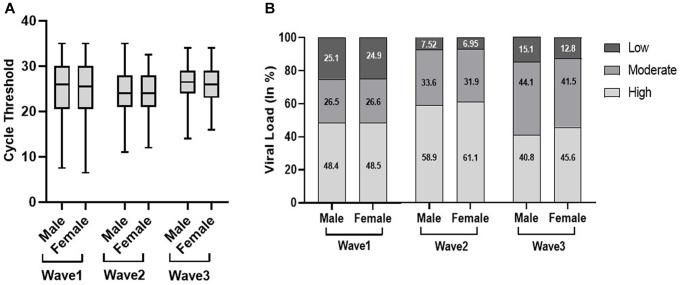
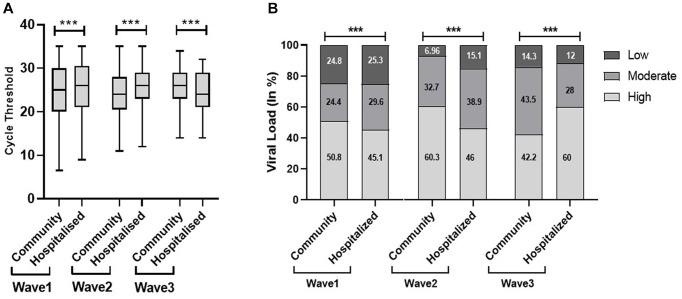
India had faced three waves throughout the Coronavirus disease 2019 (COVID-19) pandemic, which had already impacted economic lives and affected the healthcare setting and infrastructure. The widespread impacts have inspired researchers to look for clinical indicators of severe acute respiratory syndrome coronavirus 2 (SARS-CoV-2) infection prognosis. Cyclic threshold values have been used to correlate the viral load in COVID-19 patients and for viral transmission. In light of this correlation, a retrospective study was conducted to assess the trend of viral load in clinical and demographic profiles across the three waves. Data of a total of 11,125 COVID-19-positive patients were obtained, which had a Ct value of <35. We stratified Ct values as follows: under 25 (high viral load), 25-30 (moderate viral load), and over 30 (low viral load). We found a significantly high proportion of patients with high viral load during the second wave. A significantly high viral load across the symptomatic and vaccinated populations was found in all three waves, whereas a significantly high viral load across age groups was found only in the first wave. With the widespread availability of real-time PCR and the limited use of genomic surveillance, the Ct value and viral load could be a suitable tool for population-level monitoring and forecasting.
在2019冠状病毒病(COVID-19)大流行期间,印度经历了三波疫情,这已经影响了经济生活,并对医疗环境和基础设施造成了影响。这些广泛的影响促使研究人员寻找严重急性呼吸综合征冠状病毒2(SARS-CoV-2)感染预后的临床指标。循环阈值已被用于关联COVID-19患者的病毒载量以及病毒传播情况。鉴于这种关联,开展了一项回顾性研究,以评估三波疫情期间临床和人口统计学特征中病毒载量的趋势。共获取了11125例COVID-19阳性患者的数据,其Ct值<35。我们将Ct值分层如下:低于25(高病毒载量)、25-30(中等病毒载量)和高于30(低病毒载量)。我们发现第二波疫情期间病毒载量高的患者比例显著较高。在所有三波疫情中,有症状人群和接种疫苗人群的病毒载量均显著较高,而仅在第一波疫情中各年龄组的病毒载量显著较高。随着实时PCR的广泛应用以及基因组监测的有限使用,Ct值和病毒载量可能是进行人群水平监测和预测的合适工具。

 Zotero 插件