
和基因多态性可能与中国过敏性疾病患者血清 sIgE 和血嗜酸性粒细胞水平相关。
Genetic Polymorphisms of and may be Associated with Serum sIgE and Blood Eosinophil Levels in Chinese Patients with Allergic Diseases.
机构信息
State Key Laboratory of Complex Severe and Rare Diseases, Allergy Department, Peking Union Medical College Hospital, Chinese Academy of Medical Sciences and Peking Union Medical College, Beijing, China.
Beijing Key Laboratory of Precision Medicine for Diagnosis and Treatment of Allergic Diseases, Allergy Department, National Clinical Research Center for Dermatologic and Immunologic Diseases, Peking Union Medical College Hospital, Chinese Academy of Medical Sciences and Peking Union Medical College, Beijing, China.
出版信息
Endocr Metab Immune Disord Drug Targets. 2024;24(10):1215-1223. doi: 10.2174/0118715303285101240118062549.
BACKGROUND
It has been suggested that genetic factors may be substantially linked to allergy disorders.
OBJECTIVE
This study aims to investigate the relationship between the serum specific Immunoglobulin E (sIgE), blood eosinophil, and the polymorphisms of glycoprotein Ib alpha gene () rs6065, platelet endothelial aggregation receptor 1 gene () rs12041331, and plasminogen activator inhibitor 1 gene () rs1799762.
METHODS
From the Peking Union Medical College Hospital, this study enrolled 60 healthy participants and 283 participants with allergic diseases. TaqMan-minor groove binder (MGB) quantitative polymerase chain reaction (qPCR) was used to examine the gene polymorphisms in each group.
RESULTS
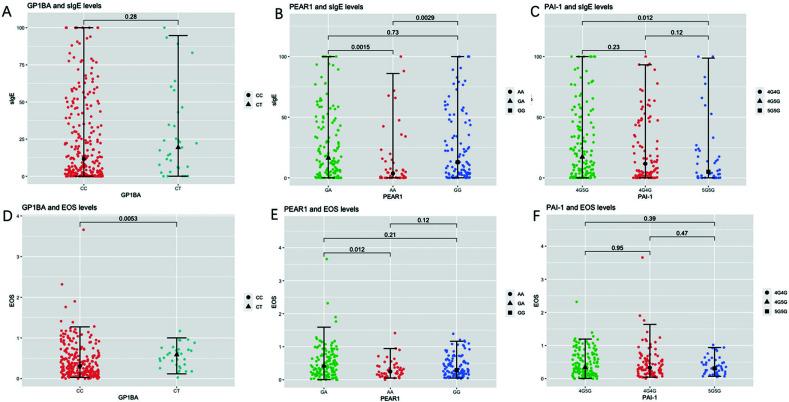
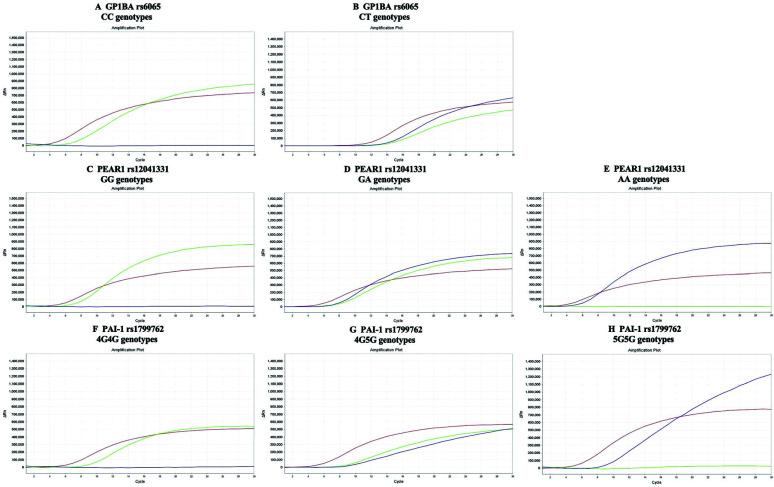
The TaqMan-MGB qPCR results were completely consistent with the DNA sequencing results, according to other studies in this medical center (Kappa =1, <0.001). The rs6065, rs12041331, and rs1799762 polymorphisms did not show different distribution between allergy patients and healthy individuals. Concerning allergy patients, the CT (n=33) genotype of rs6065 had higher blood eosinophil level than the CC (n=250) genotype (0.59, IQR 0.32-0.72 vs 0.31, IQR 0.15-0.61, *10/L, =0.005). The serum sIgE of AA (n=46) genotype of rs12041331 was lower (median 3.7, interquartile quartiles (IQR) 0.2-16.8, kU/L) than the GA (n=136) and GG (n=101) genotypes (GA median 16.3, IQR 3.1-46.3, kU/L, = 0.002; GG median 12.9, IQR 3.0-46.9, kU/L, =0.003). The GA genotypes of PEAR1 rs12041331were with higher blood eosinophil levels (median 0.42, IQR 0.17-0.74 10/L) than the AA genotype (median 0.25, IQR 0.15-0.4110/L, =0.012). The sIgE of the 5G5G (n=44) genotype of rs1799762 was lower (median 5.0, IQR 0.1-22.8, kU/L) than the 4G5G (n=144) (median 17.3, IQR 3.7-46.0, kU/L, = 0.012).
CONCLUSION
The rs6065, rs12041331, and rs1799762 polymorphisms may be associated with the genetic susceptibility of serum sIgE or blood eosinophil in Chinese allergic disease patients.
背景
遗传因素可能与过敏疾病有很大关系。
目的
本研究旨在探讨血清特异性免疫球蛋白 E(sIgE)、血嗜酸性粒细胞与糖蛋白 Ib alpha 基因()rs6065、血小板内皮细胞聚集受体 1 基因()rs12041331 和纤溶酶原激活物抑制物 1 基因()rs1799762 多态性之间的关系。
方法
本研究从北京协和医院招募了 60 名健康参与者和 283 名过敏性疾病患者。采用 TaqMan-小沟结合物(MGB)实时定量聚合酶链反应(qPCR)检测各组基因多态性。
结果
TaqMan-MGB qPCR 结果与该医学中心其他研究的 DNA 测序结果完全一致(Kappa=1, <0.001)。rs6065、rs12041331 和 rs1799762 多态性在过敏患者和健康个体之间没有不同的分布。在过敏患者中,rs6065 的 CT(n=33)基因型的血嗜酸性粒细胞水平高于 CC(n=250)基因型(0.59,IQR 0.32-0.72 比 0.31,IQR 0.15-0.61,10/L,=0.005)。rs12041331 的 AA(n=46)基因型的血清 sIgE 较低(中位数 3.7,四分位间距(IQR)0.2-16.8,kU/L)比 GA(n=136)和 GG(n=101)基因型(GA 中位数 16.3,IQR 3.1-46.3,kU/L,=0.002;GG 中位数 12.9,IQR 3.0-46.9,kU/L,=0.003)。PEAR1 rs12041331 的 GA 基因型的血嗜酸性粒细胞水平较高(中位数 0.42,IQR 0.17-0.7410/L)比 AA 基因型(中位数 0.25,IQR 0.15-0.41*10/L,=0.012)。rs1799762 的 5G5G(n=44)基因型的 sIgE 较低(中位数 5.0,IQR 0.1-22.8,kU/L)比 4G5G(n=144)(中位数 17.3,IQR 3.7-46.0,kU/L,=0.012)。
结论
rs6065、rs12041331 和 rs1799762 多态性可能与中国过敏疾病患者血清 sIgE 或血嗜酸性粒细胞的遗传易感性有关。
 Zotero 插件