
鉴定和验证高尔基体相关特征,用于预测乳腺癌的预后和免疫治疗反应。
Identification and validation of Golgi apparatus-related signature for predicting prognosis and immunotherapy response in breast cancer.
机构信息
Department of Surgery, Women's Hospital School of Medicine Zhejiang University, Hangzhou, 310003, Zhejiang, China.
Department of Surgery, Ninghai Maternal and Child Health Hospital, Ninghai, 315600, Zhejiang, China.
出版信息
J Cancer Res Clin Oncol. 2024 Feb 1;150(2):61. doi: 10.1007/s00432-024-05612-w.
BACKGROUND
The Golgi apparatus plays a pivotal role in various aspects of cancer. This study aims to investigate the predictive value of Golgi apparatus-related genes (GARGs) in breast cancer prognosis and immunotherapy response evaluation.
METHODS
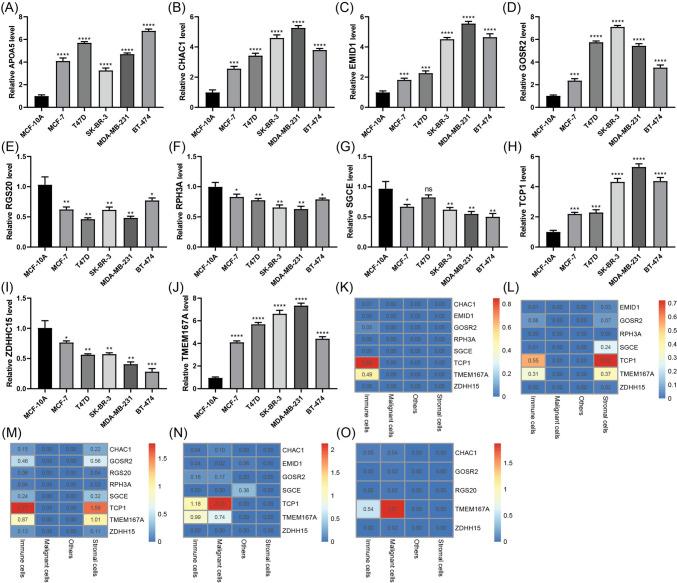
Transcriptional and clinical data from the TCGA-BRCA cohort and GSE96058 cohort were utilized to construct and validate a prognostic model for breast cancer using Cox regression analysis. Differences in immune landscape, somatic mutations, gene expression, drug sensitivity, and immunotherapy response between different risk groups were assessed. A prognostic nomogram for breast cancer was further developed and evaluated. qPCR and single-cell sequencing analyses were performed to validate the expression of GARGs.
RESULTS
A total of 394 GARGs significantly associated with breast cancer prognosis were identified, leading to the construction of a prognostic risk feature comprising 10 GARGs. This feature effectively stratified breast cancer patients into high-risk and low-risk groups, with the high-risk group exhibiting significantly worse prognosis. Meanwhile, significant differences in clinicopathological features, immune infiltration, drug sensitivity, and immunotherapy response were observed between the high- and low-risk groups. The constructed nomogram incorporating these factors showed superior performance in prognostic assessment for breast cancer patients. Ultimately, the utilization of qPCR and single-cell sequencing techniques substantiated the disparate expression patterns of these prognostic genes in breast cancer.
CONCLUSION
Our findings demonstrate that a prognostic risk feature derived from GARGs holds promising application potential for predicting prognosis and evaluating immunotherapy response in breast cancer patients.
背景
高尔基器在癌症的各个方面都起着关键作用。本研究旨在探讨高尔基器相关基因(GARGs)在乳腺癌预后和免疫治疗反应评估中的预测价值。
方法
利用 TCGA-BRCA 队列和 GSE96058 队列的转录组和临床数据,通过 Cox 回归分析构建和验证乳腺癌的预后模型。评估不同风险组之间的免疫景观、体细胞突变、基因表达、药物敏感性和免疫治疗反应的差异。进一步开发和评估用于乳腺癌的预后列线图。进行 qPCR 和单细胞测序分析以验证 GARGs 的表达。
结果
确定了 394 个与乳腺癌预后显著相关的 GARGs,从而构建了一个由 10 个 GARGs 组成的预后风险特征。该特征能够有效地将乳腺癌患者分为高危和低危组,高危组的预后明显更差。同时,高危组和低危组之间在临床病理特征、免疫浸润、药物敏感性和免疫治疗反应方面存在显著差异。纳入这些因素的构建列线图在评估乳腺癌患者的预后方面表现出更好的性能。最终,qPCR 和单细胞测序技术的应用证实了这些预后基因在乳腺癌中的表达模式存在差异。
结论
我们的研究结果表明,由 GARGs 衍生的预后风险特征在预测乳腺癌患者的预后和评估免疫治疗反应方面具有潜在的应用前景。


 Zotero 插件