
共价有机框架膜与水处理
Covalent Organic Framework Membranes and Water Treatment.
作者信息
Asif Muhammad Bilal, Kim Seokjin, Nguyen Thien S, Mahmood Javeed, Yavuz Cafer T
机构信息
Oxide & Organic Nanomaterials for Energy & Environment (ONE) Laboratory, Chemistry Program, Physical Science & Engineering (PSE), King Abdullah University of Science and Technology (KAUST), Thuwal 23955, Saudi Arabia.
Advanced Membranes & Porous Materials (AMPM) Center, Physical Science & Engineering (PSE), King Abdullah University of Science and Technology (KAUST), Thuwal 23955, Saudi Arabia.
出版信息
J Am Chem Soc. 2024 Feb 14;146(6):3567-3584. doi: 10.1021/jacs.3c10832. Epub 2024 Feb 1.
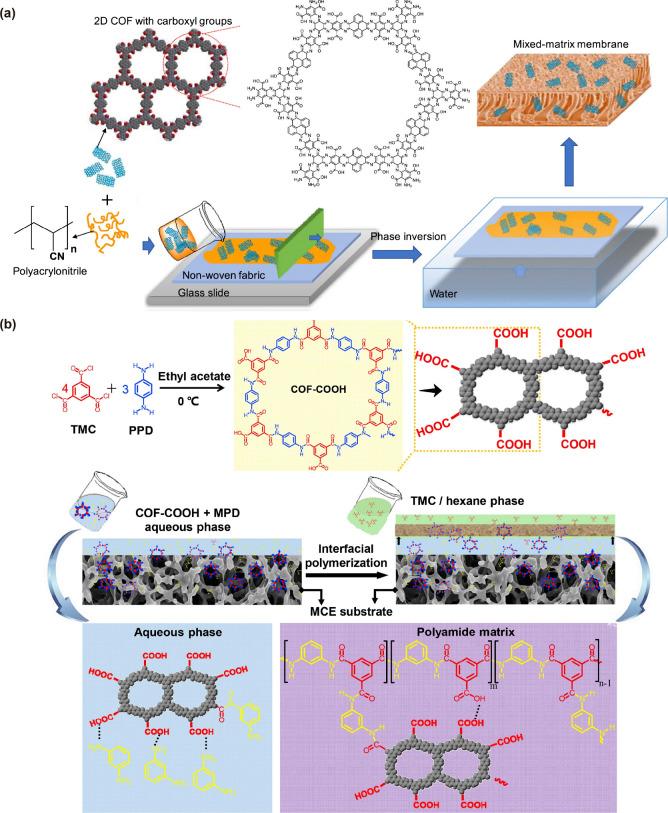
Covalent organic frameworks (COFs) are an emerging class of highly porous crystalline organic polymers comprised entirely of organic linkers connected by strong covalent bonds. Due to their excellent physicochemical properties (e.g., ordered structure, porosity, and stability), COFs are considered ideal materials for developing state-of-the-art separation membranes. In fact, significant advances have been made in the last six years regarding the fabrication and functionalization of COF membranes. In particular, COFs have been utilized to obtain thin-film, composite, and mixed matrix membranes that could achieve effective rejection (mostly above 80%) of organic dyes and model organic foulants (e.g., humic acid). COF-based membranes, especially those prepared by embedding into polyamide thin-films, obtained adequate rejection of salts in desalination applications. However, the claims of ordered structure and separation mechanisms remain unclear and debatable. In this perspective, we analyze critically the design and exploitation of COFs for membrane fabrication and their performance in water treatment applications. In addition, technological challenges associated with COF properties, fabrication methods, and treatment efficacy are highlighted to redirect future research efforts in realizing highly selective separation membranes for scale-up and industrial applications.
共价有机框架(COFs)是一类新兴的高度多孔的结晶有机聚合物,完全由通过强共价键连接的有机连接体组成。由于其优异的物理化学性质(如有序结构、孔隙率和稳定性),COFs被认为是开发先进分离膜的理想材料。事实上,在过去六年中,关于COF膜的制备和功能化已经取得了重大进展。特别是,COFs已被用于制备薄膜、复合和混合基质膜,这些膜能够有效截留(大多高于80%)有机染料和典型有机污染物(如腐殖酸)。基于COF的膜,尤其是那些通过嵌入聚酰胺薄膜制备的膜,在海水淡化应用中对盐具有足够的截留率。然而,关于有序结构和分离机制的说法仍不明确且存在争议。从这个角度出发,我们批判性地分析了用于膜制备的COFs的设计和开发及其在水处理应用中的性能。此外,还强调了与COF性质、制备方法和处理效果相关的技术挑战,以重新引导未来的研究工作,实现用于扩大规模和工业应用的高选择性分离膜。


 Zotero 插件