
母亲吸烟、不同生命阶段的营养因素与 2 型糖尿病发病风险:英国生物库的前瞻性研究。
Maternal smoking, nutritional factors at different life stage, and the risk of incident type 2 diabetes: a prospective study of the UK Biobank.
机构信息
Key Laboratory of Precision Nutrition and Health, Ministry of Education, Department of Nutrition and Food Hygiene, the National Key Discipline, School of Public Health, Harbin Medical University, Harbin, P. R. China.
Department of Cardiology, the First Affiliated Hospital of Harbin Medical University, Harbin, China.
出版信息
BMC Med. 2024 Feb 2;22(1):50. doi: 10.1186/s12916-024-03256-8.
BACKGROUND
This study aims to investigate potential interactions between maternal smoking around birth (MSAB) and type 2 diabetes (T2D) pathway-specific genetic risks in relation to the development of T2D in offspring. Additionally, it seeks to determine whether and how nutritional factors during different life stages may modify the association between MSAB and risk of T2D.
METHODS
This study included 460,234 participants aged 40 to 69 years, who were initially free of T2D from the UK Biobank. MSAB and breastfeeding were collected by questionnaire. The Alternative health eating index(AHEI) and dietary inflammation index(DII) were calculated. The polygenic risk scores(PRS) of T2D and pathway-specific were established, including β-cell function, proinsulin, obesity, lipodystrophy, liver function and glycated haemoglobin(HbA1c). Cox proportion hazards models were performed to evaluate the gene/diet-MSAB interaction on T2D. The relative excess risk due to additive interaction (RERI) were calculated.
RESULTS
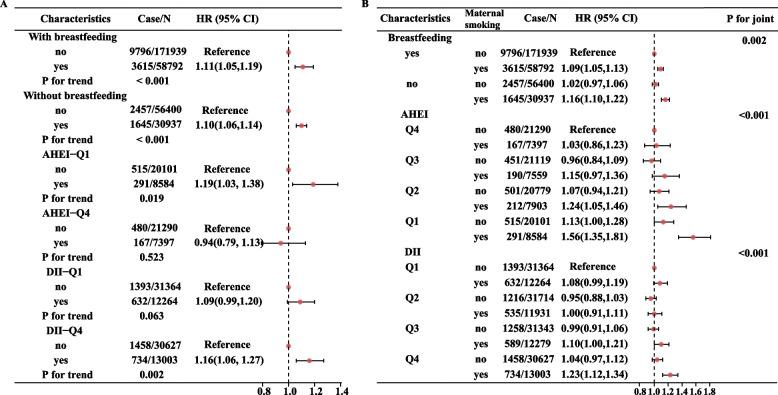
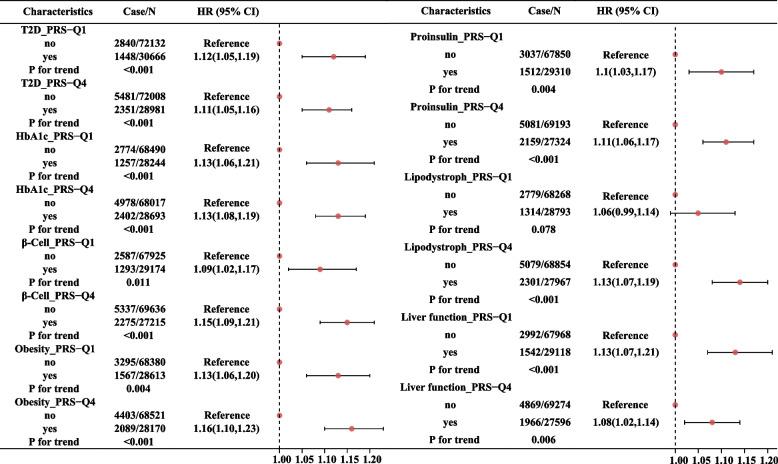
During a median follow-up period of 12.7 years, we identified 27,342 cases of incident T2D. After adjustment for potential confounders, participants exposed to MSAB had an increased risk of T2D (HR=1.11, 95%CI:1.08-1.14), and this association remained significant among the participants with breastfeeding (HR= HR=1.10, 95%CI: 1.06-1.14). Moreover, among the participants in the highest quartile of AHEI or in the lowest quartile of DII, the association between MSAB and the increased risk of T2D become non-significant (HR=0.94, 95%CI: 0.79-1.13 for AHEI; HR=1.09, 95%CI:0.99-1.20 for DII). Additionally, the association between MSAB and risk of T2D became non-significant among the participants with lower genetic risk of lipodystrophy (HR=1.06, 95%CI:0.99-1.14), and exposed to MSAB with a higher genetic risk for β-cell dysfunction or lipodystrophy additively elevated the risk of T2D(RERI=0.18, 95%CI:0.06-0.30 for β-cell function; RERI=0.16, 95%CI:0.04-0.28 for lipodystrophy).
CONCLUSIONS
This study indicates that maintaining a high dietary quality or lower dietary inflammation in diet may reduce the risk of T2D associated with MSAB, and the combination of higher genetic risk of β-cell dysfunction or lipodystrophy and MSAB significantly elevate the risk of T2D in offspring.
背景
本研究旨在探讨围产期母亲吸烟(MSAB)与 2 型糖尿病(T2D)通路特异性遗传风险之间的潜在相互作用,以及它们与后代 T2D 发病风险的关系。此外,本研究还旨在确定营养因素在不同生命阶段是否以及如何可能改变 MSAB 与 T2D 风险之间的关联。
方法
本研究纳入了 460234 名年龄在 40 至 69 岁之间、最初无 T2D 的英国生物库参与者。MSAB 和母乳喂养情况通过问卷调查收集。计算替代健康饮食指数(AHEI)和饮食炎症指数(DII)。建立了 T2D 及通路特异性的多基因风险评分(PRS),包括β细胞功能、胰岛素原、肥胖、脂肪营养不良、肝功能和糖化血红蛋白(HbA1c)。采用 Cox 比例风险模型评估 T2D 基因/饮食/ MSAB 之间的相互作用。计算相对超额危险度归因于相加性交互作用(RERI)。
结果
在中位随访 12.7 年期间,我们共发现 27342 例新发 T2D 病例。调整潜在混杂因素后,暴露于 MSAB 的参与者 T2D 发病风险增加(HR=1.11,95%CI:1.08-1.14),且在母乳喂养参与者中该关联仍然显著(HR=1.10,95%CI:1.06-1.14)。此外,在 AHEI 最高四分位或 DII 最低四分位的参与者中,MSAB 与 T2D 发病风险增加之间的关联变得不显著(HR=0.94,95%CI:0.79-1.13 用于 AHEI;HR=1.09,95%CI:0.99-1.20 用于 DII)。此外,在脂肪营养不良遗传风险较低的参与者中,MSAB 与 T2D 发病风险之间的关联变得不显著(HR=1.06,95%CI:0.99-1.14),且β细胞功能或脂肪营养不良遗传风险较高的参与者中,MSAB 与 T2D 发病风险增加的关联性相加性地升高(HR=0.18,95%CI:0.06-0.30 用于β细胞功能;HR=0.16,95%CI:0.04-0.28 用于脂肪营养不良)。
结论
本研究表明,保持较高的饮食质量或较低的饮食炎症可能会降低与 MSAB 相关的 T2D 发病风险,而β细胞功能障碍或脂肪营养不良遗传风险较高与 MSAB 的联合作用显著增加了后代 T2D 的发病风险。

 Zotero 插件