
血浆蛋白质组学与 2 型糖尿病患者和非 2 型糖尿病患者冠心病发病的相关性:基于人群的 KORA 研究结果。
Association of plasma proteomics with incident coronary heart disease in individuals with and without type 2 diabetes: results from the population-based KORA study.
机构信息
Institute of Epidemiology, Helmholtz Zentrum München, German Research Center for Environmental Health (GmbH), Ingolstaedter Landstraße 1, D-85764, Neuherberg, Germany.
Institute for Medical Information Processing, Biometry and Epidemiology (IBE), Faculty of Medicine, LMU Munich, Pettenkofer School of Public Health, Munich, Germany.
出版信息
Cardiovasc Diabetol. 2024 Feb 3;23(1):53. doi: 10.1186/s12933-024-02143-z.
BACKGROUND
Coronary heart disease (CHD) is a major global health concern, especially among individuals with type 2 diabetes (T2D). Given the crucial role of proteins in various biological processes, this study aimed to elucidate the aetiological role and predictive performance of protein biomarkers on incident CHD in individuals with and without T2D.
METHODS
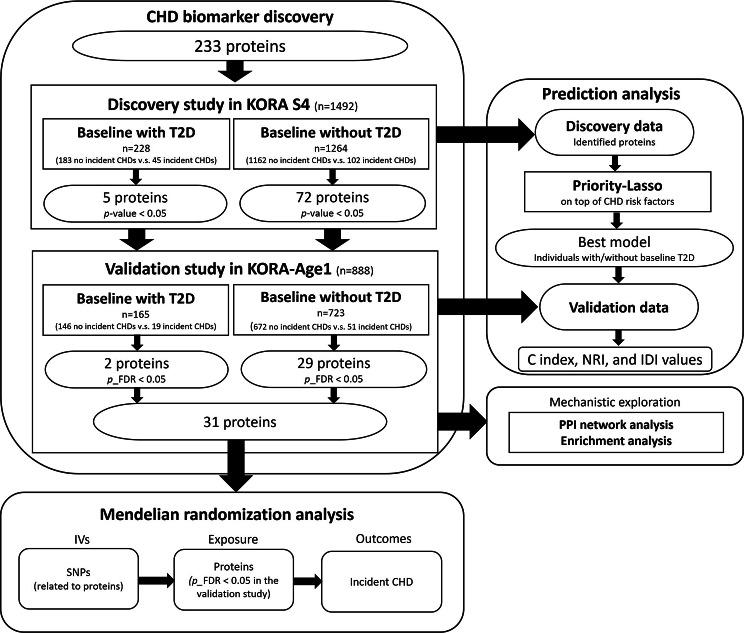
The discovery cohort included 1492 participants from the Cooperative Health Research in the Region of Augsburg (KORA) S4 study with 147 incident CHD cases (45 vs. 102 cases in the group with T2D and without T2D, respectively) during 15.6 years of follow-up. The validation cohort included 888 participants from the KORA-Age1 study with 70 incident CHD cases (19 vs. 51 cases in the group with T2D and without T2D, respectively) during 6.9 years of follow-up. We measured 233 plasma proteins related to cardiovascular disease and inflammation using proximity extension assay technology. Associations of proteins with incident CHD were assessed using Cox regression and Mendelian randomization (MR) analysis. Predictive models were developed using priority-Lasso and were evaluated on top of Framingham risk score variables using the C-index, category-free net reclassification index (cfNRI), and relative integrated discrimination improvement (IDI).
RESULTS
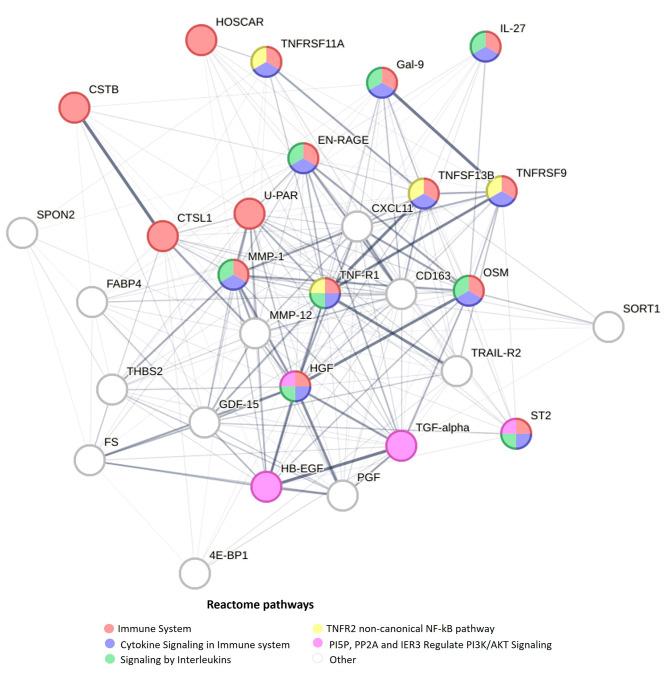
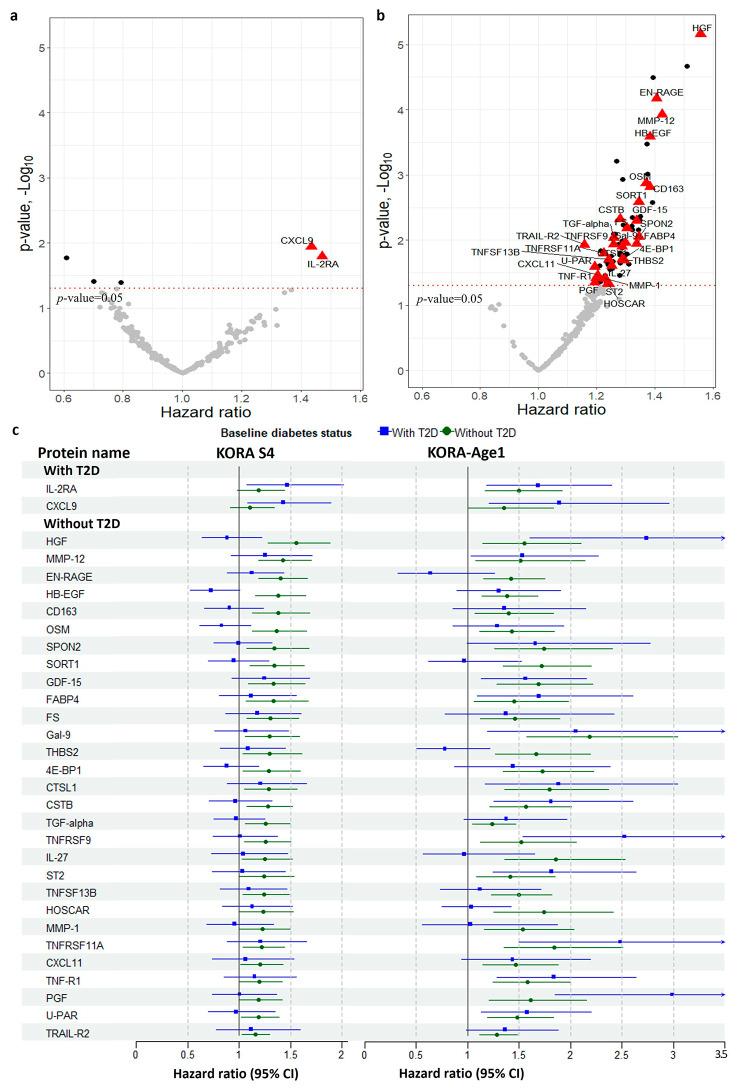
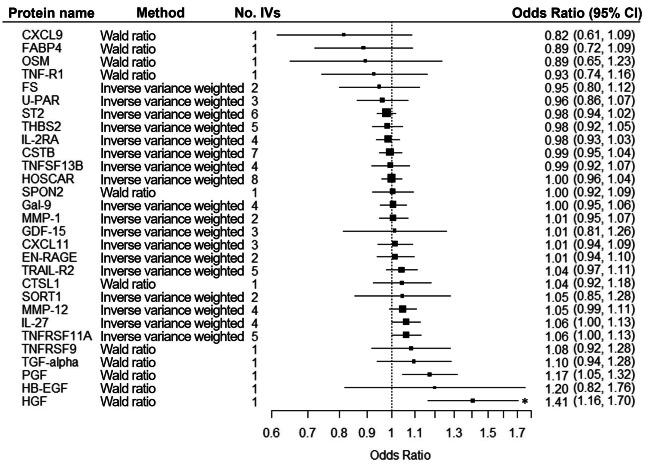
We identified two proteins associated with incident CHD in individuals with and 29 in those without baseline T2D, respectively. Six of these proteins are novel candidates for incident CHD. MR suggested a potential causal role for hepatocyte growth factor in CHD development. The developed four-protein-enriched model for individuals with baseline T2D (ΔC-index: 0.017; cfNRI: 0.253; IDI: 0.051) and the 12-protein-enriched model for individuals without baseline T2D (ΔC-index: 0.054; cfNRI: 0.462; IDI: 0.024) consistently improved CHD prediction in the discovery cohort, while in the validation cohort, significant improvements were only observed for selected performance measures (with T2D: cfNRI: 0.633; without T2D: ΔC-index: 0.038; cfNRI: 0.465).
CONCLUSIONS
This study identified novel protein biomarkers associated with incident CHD in individuals with and without T2D and reaffirmed previously reported protein candidates. These findings enhance our understanding of CHD pathophysiology and provide potential targets for prevention and treatment.
背景
冠心病(CHD)是一个全球性的健康问题,尤其在 2 型糖尿病(T2D)患者中更为严重。鉴于蛋白质在各种生物过程中起着至关重要的作用,本研究旨在阐明蛋白质生物标志物在有和无 T2D 的个体中对 CHD 发病的病因学作用和预测性能。
方法
在协作健康研究在奥格斯堡地区(KORA)S4 研究的发现队列中,包括 1492 名参与者,在 15.6 年的随访期间,有 147 例 CHD 病例(45 例与 T2D 组和无 T2D 组分别为 102 例)。在 KORA-Age1 研究的验证队列中,包括 888 名参与者,在 6.9 年的随访期间,有 70 例 CHD 病例(29 例与 T2D 组和无 T2D 组分别为 51 例)。我们使用邻近延伸分析技术测量了 233 种与心血管疾病和炎症相关的血浆蛋白。使用 Cox 回归和孟德尔随机分析(MR)评估蛋白质与 CHD 发病的相关性。使用优先-Lasso 开发预测模型,并使用 C 指数、类别无净重新分类指数(cfNRI)和相对综合判别改善(IDI)在Framingham 风险评分变量的基础上进行评估。
结果
我们在有基线 T2D 的个体中确定了两个与 CHD 发病相关的蛋白,在没有基线 T2D 的个体中确定了 29 个蛋白。其中 6 种蛋白是 CHD 发病的新候选蛋白。MR 表明肝细胞生长因子在 CHD 发病机制中可能具有潜在的因果作用。为基线 T2D 患者开发的四蛋白富集模型(ΔC 指数:0.017;cfNRI:0.253;IDI:0.051)和为无基线 T2D 患者开发的 12 蛋白富集模型(ΔC 指数:0.054;cfNRI:0.462;IDI:0.024)在发现队列中一致提高了 CHD 预测能力,而在验证队列中,只有在选定的性能指标上观察到显著改善(有 T2D:cfNRI:0.633;无 T2D:ΔC 指数:0.038;cfNRI:0.465)。
结论
本研究确定了与有和无 T2D 的个体中 CHD 发病相关的新型蛋白生物标志物,并再次证实了先前报道的蛋白候选物。这些发现加深了我们对 CHD 病理生理学的理解,并为预防和治疗提供了潜在的靶点。
 Zotero 插件