
肺移植术后原发性移植肺功能障碍时富含组氨酸糖蛋白的血浆浓度
Plasma concentrations of histidine-rich glycoprotein in primary graft dysfunction after lung transplantation.
作者信息
Shiotani Toshio, Sugimoto Seiichiro, Tomioka Yasuaki, Tanaka Shin, Mitsuhashi Toshiharu, Suzawa Ken, Shien Kazuhiko, Miyoshi Kentaroh, Yamamoto Hiromasa, Okazaki Mikio, Toyooka Shinichi
机构信息
Department of General Thoracic Surgery and Organ Transplant Center, Okayama University Hospital, Okayama, Japan.
Center for Innovative Clinical Medicine, Okayama University Hospital, Okayama, Japan.
出版信息
Interdiscip Cardiovasc Thorac Surg. 2024 Feb 2;38(2). doi: 10.1093/icvts/ivae021.
OBJECTIVES
Histidine-rich glycoprotein has been reported as an anti-inflammatory glycoprotein that inhibits acute lung injury in mice with sepsis and as a prognostic biomarker in patients with sepsis. We investigated the relationship between plasma concentrations of histidine-rich glycoprotein and the risk of occurrence of primary graft dysfunction.
METHODS
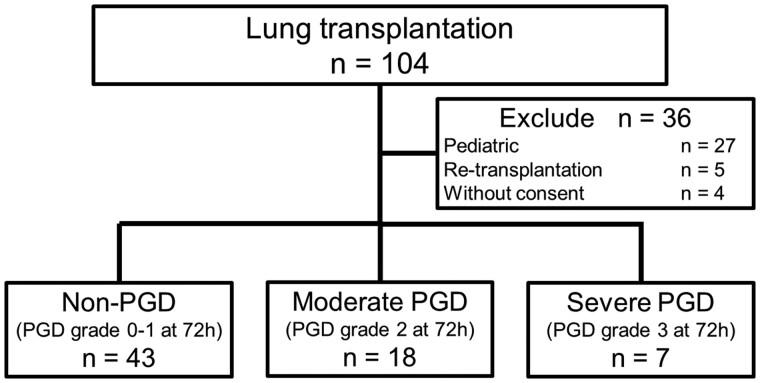
According to the primary graft dysfunction grade at post-transplant 72 h, patients who underwent lung transplantation were divided into three groups: non-primary graft dysfunction group (grade 0-1), moderate primary graft dysfunction group (grade 2), and severe primary graft dysfunction group (grade 3). The plasma concentrations of histidine-rich glycoprotein measured daily during the first post-transplant 7 days were compared among the three groups. Appropriate cutoff values of the concentrations were set for survival analyses after lung transplantation.
RESULTS
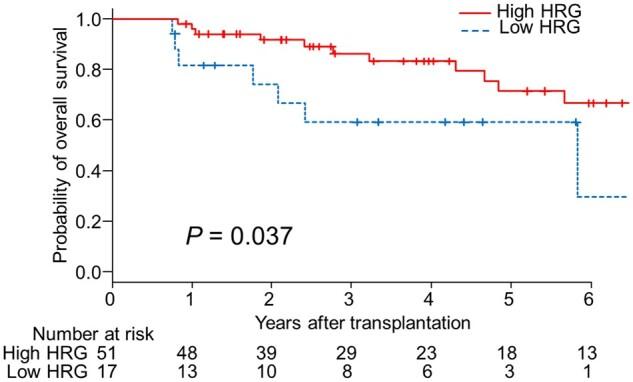
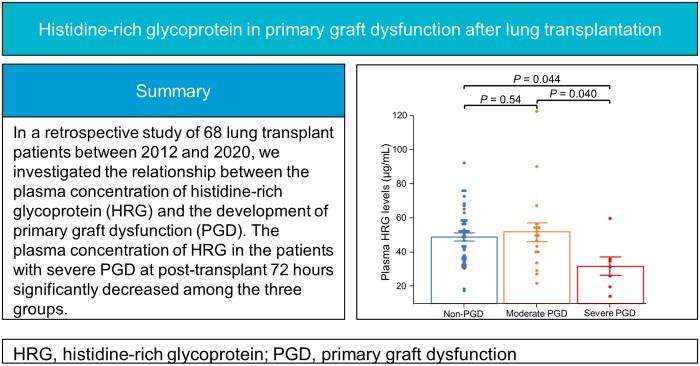
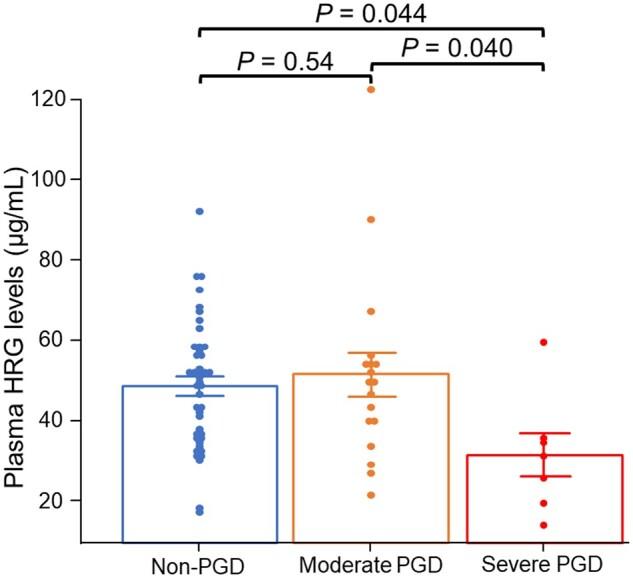
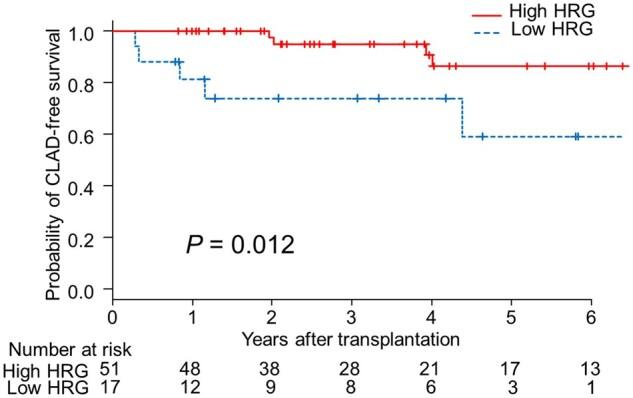
A total of 68 patients were included. The plasma histidine-rich glycoprotein concentration at post-transplant 72 h was significantly lower in the severe primary graft dysfunction group (n = 7) than in the other two groups [non-primary graft dysfunction group (n = 43), P = 0.042; moderate primary graft dysfunction group (n = 18), P = 0.040]. Patients with plasma histidine-rich glycoprotein concentration ≥34.4 µg/ml at post-transplant 72 h had significantly better chronic lung allograft dysfunction-free survival (P = 0.012) and overall survival (P = 0.037) than those with the concentration <34.4 µg/ml.
CONCLUSIONS
Plasma histidine-rich glycoprotein concentrations at post-transplant 72 h might be associated with the risk of development of primary graft dysfunction.
目的
富含组氨酸糖蛋白已被报道为一种抗炎糖蛋白,可抑制脓毒症小鼠的急性肺损伤,也是脓毒症患者的一种预后生物标志物。我们研究了富含组氨酸糖蛋白的血浆浓度与原发性移植肺功能障碍发生风险之间的关系。
方法
根据移植后72小时的原发性移植肺功能障碍分级,将接受肺移植的患者分为三组:非原发性移植肺功能障碍组(0 - 1级)、中度原发性移植肺功能障碍组(2级)和重度原发性移植肺功能障碍组(3级)。比较三组在移植后第1个7天内每日测量的富含组氨酸糖蛋白的血浆浓度。设定浓度的合适截断值用于肺移植后的生存分析。
结果
共纳入68例患者。重度原发性移植肺功能障碍组(n = 7)移植后72小时的血浆富含组氨酸糖蛋白浓度显著低于其他两组[非原发性移植肺功能障碍组(n = 43),P = 0.042;中度原发性移植肺功能障碍组(n = 18),P = 0.040]。移植后72小时血浆富含组氨酸糖蛋白浓度≥34.4μg/ml的患者,其无慢性移植肺功能障碍生存率(P = 0.012)和总生存率(P = 0.037)显著高于浓度<34.4μg/ml的患者。
结论
移植后72小时的血浆富含组氨酸糖蛋白浓度可能与原发性移植肺功能障碍的发生风险相关。

 Zotero 插件