
健康志愿者中 Arg-Gly-Asp 肽 99mTc-马卡瑞替肽的安全性、生物分布和辐射剂量学。
Safety, biodistribution and radiation dosimetry of the Arg-Gly-Asp peptide 99m Tc-maraciclatide in healthy volunteers.
机构信息
Nuffield Department of Women's and Reproductive Health, University of Oxford, John Radcliffe Hospital, Oxford, .
Radiological Sciences, School of Medicine, University of Nottingham, Nottingham and .
出版信息
Nucl Med Commun. 2024 Apr 1;45(4):295-303. doi: 10.1097/MNM.0000000000001814. Epub 2024 Feb 5.
BACKGROUND
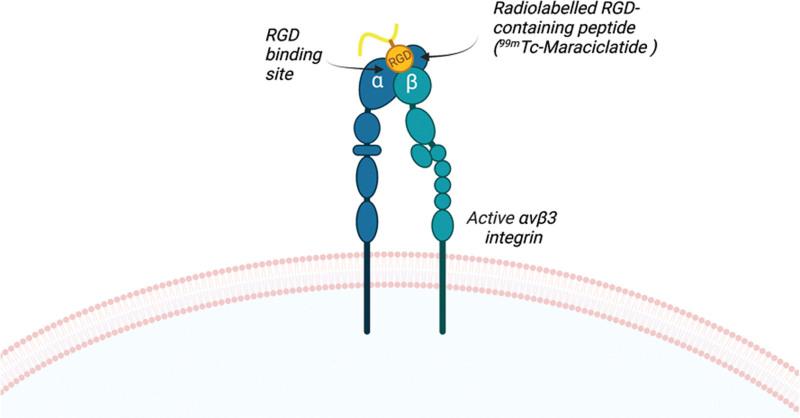
99m Tc-Maraciclatide is a radiolabelled RGD (Arg-Gly-Asp) peptide that binds with high affinity to α v β 3 and α v β 5 integrins, common receptors upregulated in disease states involving angiogenesis and inflammation. As such, it holds promise as a novel diagnostic imaging agent for a range of pathological conditions. The present study provides the safety, biodistribution and radiation dosimetry of 99m Tc-maraciclatide in healthy volunteers.
METHODS
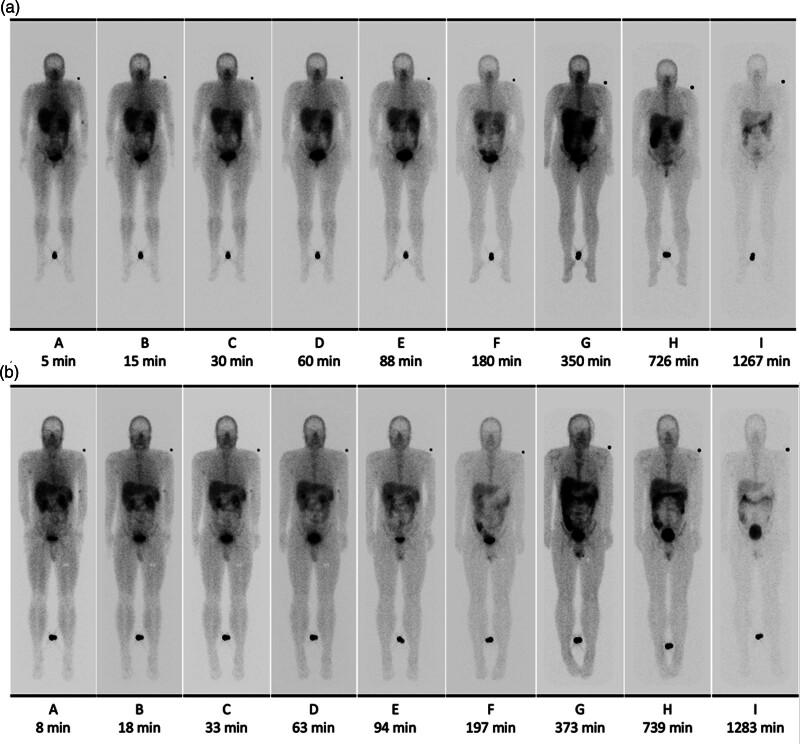
A phase 1, randomised, placebo-controlled study assessed the safety, biodistribution and radiation dosimetry of 99m Tc-maraciclatide in healthy volunteers. Participants were randomised into three groups receiving 99m Tc-maraciclatide and three chemical amounts of maraciclatide in an escalating dose protocol. Eight participants in each group received the required amount of maraciclatide via intravenous injection, with the remaining two receiving a placebo. Biodistribution was assessed by acquiring scintigraphic images at time points up to 24 h after a bolus injection of 99m Tc-maraciclatide. 99m Tc-maraciclatide activity in plasma and urine was measured up to 7 days post-administration.
RESULTS
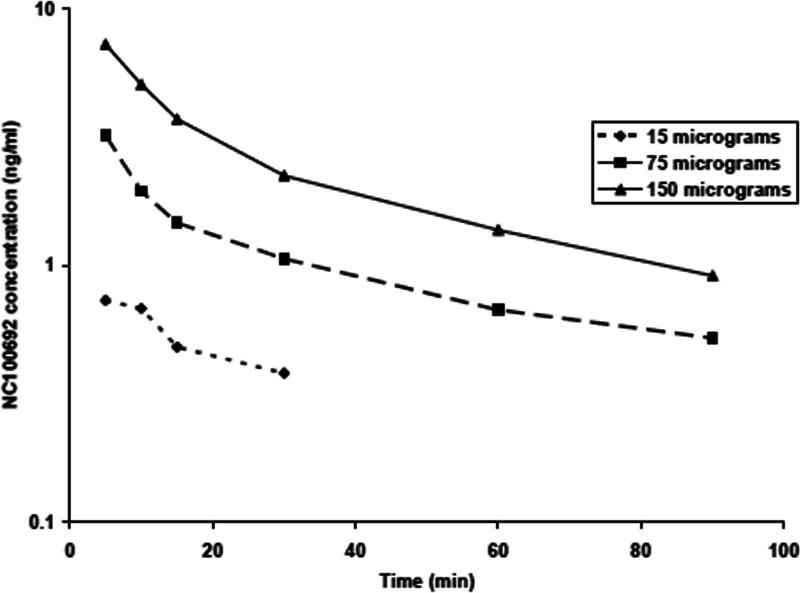
99m Tc-maraciclatide was safe and well tolerated, with no serious adverse events reported. Initial uptakes of 99m Tc were highest in the gastrointestinal tract (20%), liver (15%), and lungs (9%). Similarly, the regions with the highest normalised cumulated activities were the contents of the urinary bladder and voided urine (3.4 ± 0.4 MBqh/MBq), the combined walls of the small intestine and upper and lower large intestine (0.9 ± 0.2 MBqh/MBq), liver (0.8 ± 0.2 MBqh/MBq), lung (0.4 ± 0.1 MBqh/MBq). The main route of 99m Tc excretion was renal (55%), with a systemic urinary clearance of approximately 6.7 ml/min/kg. The pharmacokinetic analysis gave a mean apparent terminal elimination half-life of the unlabelled molecular maraciclatide of approximately 1 h, independent of dose. The mean ED per unit injected activity was 7.8 ± 0.8 µSv/MBq.
CONCLUSION
99m Tc-maraciclatide is a safe radiopharmaceutical formulation with a dosimetry profile similar to other 99m Tc-based imaging agents.
背景
99mTc-Maraciclatide 是一种放射性标记的 RGD(精氨酸-甘氨酸-天冬氨酸)肽,与血管生成和炎症涉及的疾病状态中上调的αvβ3 和αvβ5 整合素具有高亲和力结合。因此,它有望成为一种新型的诊断成像剂,用于治疗多种病理状况。本研究提供了 99mTc-Maraciclatide 在健康志愿者中的安全性、生物分布和辐射剂量学数据。
方法
一项 1 期、随机、安慰剂对照研究评估了 99mTc-Maraciclatide 在健康志愿者中的安全性、生物分布和辐射剂量学。参与者按递增剂量方案随机分为三组,分别接受 99mTc-Maraciclatide 和三种化学剂量的 Maraciclatide。每组 8 名参与者通过静脉注射接受所需剂量的 Maraciclatide,其余 2 名接受安慰剂。通过在静脉注射 99mTc-Maraciclatide 后长达 24 小时的时间点采集闪烁成像图像来评估生物分布。在给药后 7 天内测量血浆和尿液中的 99mTc-Maraciclatide 活性。
结果
99mTc-Maraciclatide 安全且耐受性良好,无严重不良事件报告。99mTc 的初始摄取量在胃肠道(20%)、肝脏(15%)和肺部(9%)最高。同样,正常化累积活性最高的区域是膀胱内容物和尿液(3.4±0.4 MBqh/MBq)、小肠和上下大肠壁(0.9±0.2 MBqh/MBq)、肝脏(0.8±0.2 MBqh/MBq)、肺(0.4±0.1 MBqh/MBq)。99mTc 的主要排泄途径是肾脏(55%),系统清除率约为 6.7ml/min/kg。药代动力学分析得出,未标记的 Maraciclatide 的平均表观末端消除半衰期约为 1 小时,与剂量无关。每单位注入活性的平均 ED 为 7.8±0.8µSv/MBq。
结论
99mTc-Maraciclatide 是一种安全的放射性药物制剂,其剂量学特征与其他 99mTc 成像剂相似。
 Zotero 插件