
维度神经影像学内表型:通过机器学习实现的疾病异质性的神经生物学表征
Dimensional Neuroimaging Endophenotypes: Neurobiological Representations of Disease Heterogeneity Through Machine Learning.
作者信息
Wen Junhao, Antoniades Mathilde, Yang Zhijian, Hwang Gyujoon, Skampardoni Ioanna, Wang Rongguang, Davatzikos Christos
机构信息
Laboratory of AI and Biomedical Science (LABS), Stevens Neuroimaging and Informatics Institute, Keck School of Medicine of USC, University of Southern California, Los Angeles, CA, USA.
Artificial Intelligence in Biomedical Imaging Laboratory (AIBIL), Center for AI and Data Science for Integrated Diagnostics (AID), Perelman School of Medicine, University of Pennsylvania, Philadelphia, PA, USA.
出版信息
ArXiv. 2024 Jan 17:arXiv:2401.09517v1.
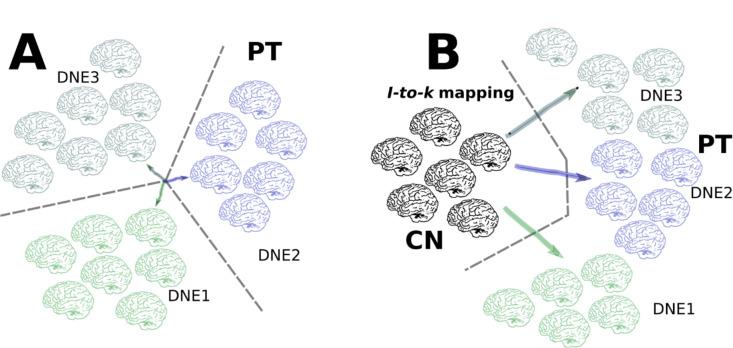
Machine learning has been increasingly used to obtain individualized neuroimaging signatures for disease diagnosis, prognosis, and response to treatment in neuropsychiatric and neurodegenerative disorders. Therefore, it has contributed to a better understanding of disease heterogeneity by identifying disease subtypes that present significant differences in various brain phenotypic measures. In this review, we first present a systematic literature overview of studies using machine learning and multimodal MRI to unravel disease heterogeneity in various neuropsychiatric and neurodegenerative disorders, including Alzheimer's disease, schizophrenia, major depressive disorder, autism spectrum disorder, multiple sclerosis, as well as their potential in transdiagnostic settings. Subsequently, we summarize relevant machine learning methodologies and discuss an emerging paradigm which we call dimensional neuroimaging endophenotype (DNE). DNE dissects the neurobiological heterogeneity of neuropsychiatric and neurodegenerative disorders into a low-dimensional yet informative, quantitative brain phenotypic representation, serving as a robust intermediate phenotype (i.e., endophenotype) largely reflecting underlying genetics and etiology. Finally, we discuss the potential clinical implications of the current findings and envision future research avenues.
机器学习已越来越多地用于获取个性化神经影像特征,以用于神经精神疾病和神经退行性疾病的诊断、预后评估及治疗反应预测。因此,通过识别在各种脑表型测量中存在显著差异的疾病亚型,它有助于更好地理解疾病异质性。在本综述中,我们首先对使用机器学习和多模态磁共振成像(MRI)来揭示各种神经精神疾病和神经退行性疾病(包括阿尔茨海默病、精神分裂症、重度抑郁症、自闭症谱系障碍、多发性硬化症)中的疾病异质性及其在跨诊断环境中的潜力的研究进行系统的文献综述。随后,我们总结相关的机器学习方法,并讨论一种新兴的范式,即维度神经影像内表型(DNE)。DNE将神经精神疾病和神经退行性疾病的神经生物学异质性解析为低维度但信息丰富的定量脑表型表示,作为一种强大的中间表型(即内表型),很大程度上反映了潜在的遗传学和病因。最后,我们讨论当前研究结果的潜在临床意义,并展望未来的研究方向。

 Zotero 插件