
利用综合基线CT影像组学、剂量学和临床特征预测头颈部癌患者严重放射性口腔黏膜炎:一种机器学习方法。
Predicting severe radiation-induced oral mucositis in head and neck cancer patients using integrated baseline CT radiomic, dosimetry, and clinical features: A machine learning approach.
作者信息
Agheli Razieh, Siavashpour Zahra, Reiazi Reza, Azghandi Samira, Cheraghi Susan, Paydar Reza
机构信息
Radiation Sciences Department, Faculty of Allied Medicine, Iran University of Medical Sciences, Tehran, Iran.
Department of Radiation Oncology, Shohada-e Tajrish Educational Hospital, Shahid Beheshti University of Medical Sciences, Tehran, Iran.
出版信息
Heliyon. 2024 Jan 24;10(3):e24866. doi: 10.1016/j.heliyon.2024.e24866. eCollection 2024 Feb 15.
PURPOSE
To establish the early prediction models of radiation-induced oral mucositis (RIOM) based on baseline CT-based radiomic features (RFs), dosimetric data, and clinical features by machine learning models for head and neck cancer (HNC) patients.
METHODS
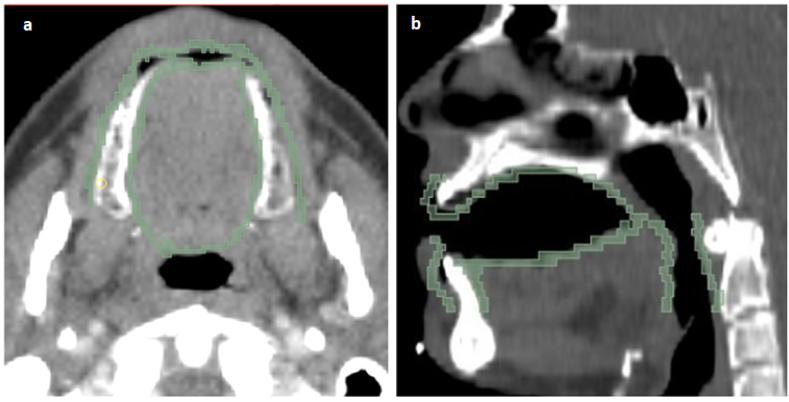
In this single-center prospective study, 49 HNCs treated with curative intensity modulated radiotherapy (IMRT) were enrolled. Baseline CT images ( CT simulation), dosimetric, and clinical features were collected. RIOM was assessed using CTCAE v.5.0. RFs were extracted from manually-contoured oral mucosa structures. Minimum-redundancy-maximum-relevance (mRMR) method was applied to select the most informative radiomics, dosimetric, and clinical features. Then, binary prediction models were constructed for predicting acute RIOM based on the top mRMR-ranked radiomics, dosimetric, and clinical features alone or in combination, using random forest classifier algorithm. The predictive performance of models was assessed using the area under the receiver operating curve (AUC), accuracy, weighted-average based sensitivity, precision, and F1-measure.
RESULTS
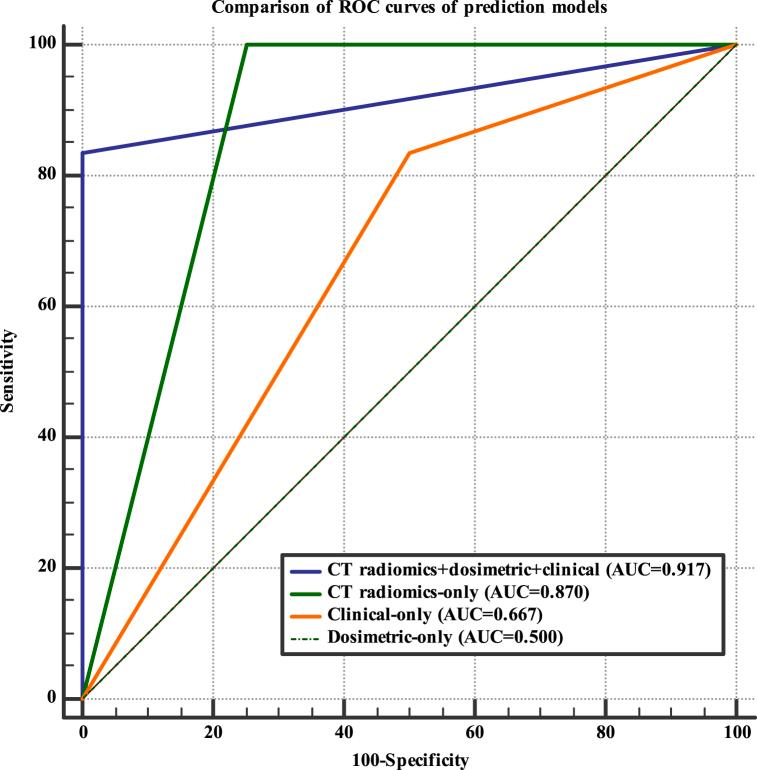
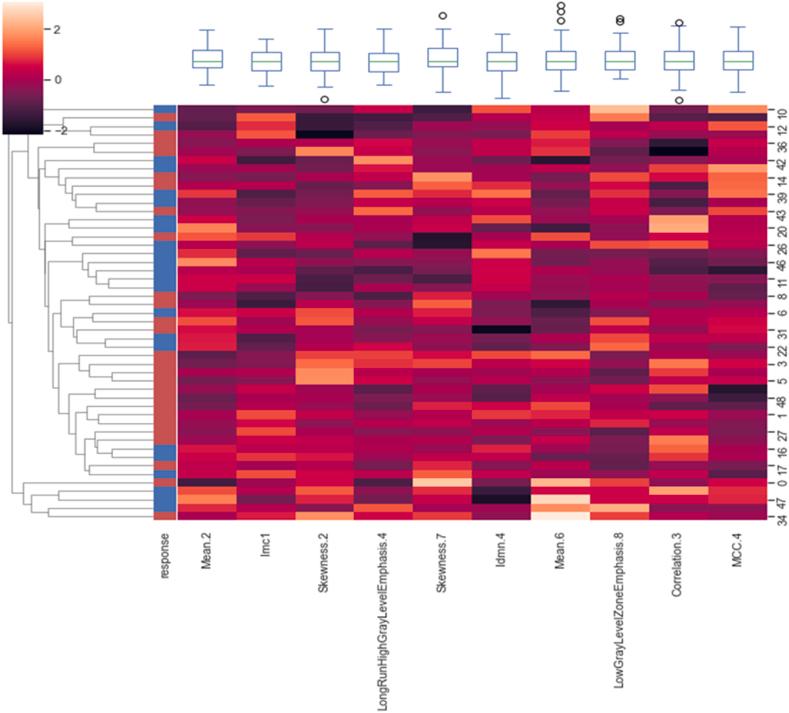
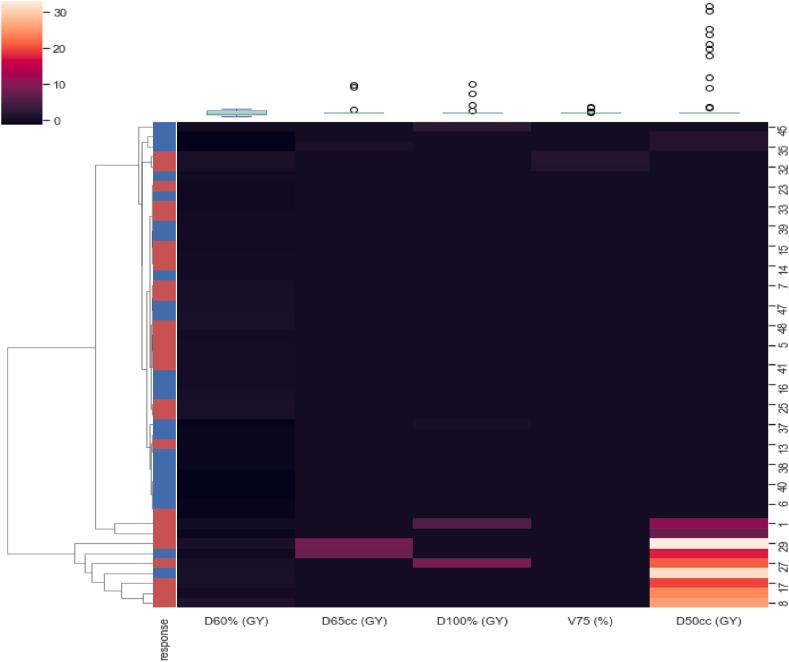
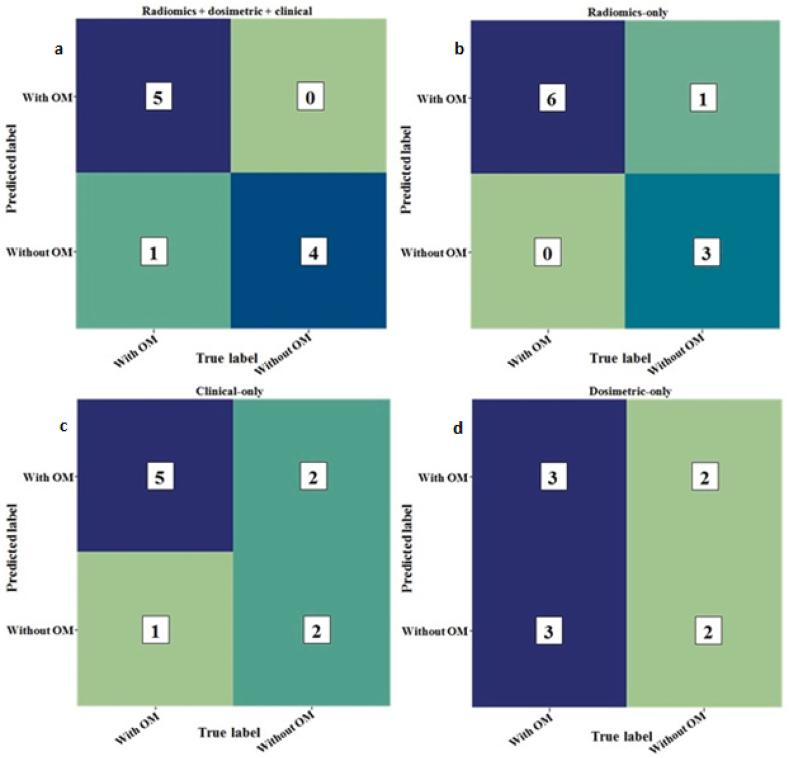
Among extracted features, the top 10 RFs, the top 5 dose-volume features, and the top 5 clinical features were selected using mRMR method. The model exploiting the integrated features (10-radiomics + 5-dosimetric + 5-clinical) achieved the best prediction with AUC, accuracy, sensitivity, precision, and F1-measure values of 91.7 %, 90.0 %, 83.0 % 100.0 %, and 91.0 %, respectively. The model developed using baseline CT RFs alone provided the best performance compared to dose-volume features or clinical features alone, with an AUC of 87.0 %.
CONCLUSION
Our results suggest that the integration of baseline CT radiomic features with dosimetric and clinical features showed promising potential to improve the performance of machine learning models in early prediction of RIOM. The ultimate goal is to personalize radiotherapy for HNC patients.
目的
通过机器学习模型,基于头颈部癌(HNC)患者的基线CT影像组学特征(RFs)、剂量学数据和临床特征,建立放射性口腔黏膜炎(RIOM)的早期预测模型。
方法
在这项单中心前瞻性研究中,纳入了49例接受根治性调强放疗(IMRT)的HNC患者。收集基线CT图像(CT模拟)、剂量学和临床特征。使用CTCAE v.5.0评估RIOM。从手动勾勒的口腔黏膜结构中提取RFs。应用最小冗余最大相关(mRMR)方法选择最具信息量的影像组学、剂量学和临床特征。然后,使用随机森林分类器算法,基于仅mRMR排名靠前的影像组学、剂量学和临床特征单独或联合构建二元预测模型,以预测急性RIOM。使用受试者操作特征曲线下面积(AUC)、准确性、基于加权平均的敏感性、精确性和F1值评估模型的预测性能。
结果
在提取的特征中,使用mRMR方法选择了前10个RFs、前5个剂量体积特征和前5个临床特征。利用综合特征(10个影像组学 + 5个剂量学 + 5个临床)的模型实现了最佳预测,AUC、准确性、敏感性、精确性和F1值分别为91.7%、90.0%、83.0%、100.0%和91.0%。与单独使用剂量体积特征或临床特征相比,仅使用基线CT RFs开发的模型性能最佳,AUC为87.0%。
结论
我们的结果表明,基线CT影像组学特征与剂量学和临床特征的整合在早期预测RIOM方面显示出改善机器学习模型性能的潜在前景。最终目标是实现HNC患者的放疗个体化。



 Zotero 插件