
使用机器学习进行接受度和情感研究:生态瞬时评估和可穿戴感应研究。
Investigating Receptivity and Affect Using Machine Learning: Ecological Momentary Assessment and Wearable Sensing Study.
机构信息
Department of Electrical and Computer Engineering, Rice University, Houston, TX, United States.
Center For Contextual Psychiatry, Katholieke Universiteit Leuven, Leuven, Belgium.
出版信息
JMIR Mhealth Uhealth. 2024 Feb 7;12:e46347. doi: 10.2196/46347.
BACKGROUND
As mobile health (mHealth) studies become increasingly productive owing to the advancements in wearable and mobile sensor technology, our ability to monitor and model human behavior will be constrained by participant receptivity. Many health constructs are dependent on subjective responses, and without such responses, researchers are left with little to no ground truth to accompany our ever-growing biobehavioral data. This issue can significantly impact the quality of a study, particularly for populations known to exhibit lower compliance rates. To address this challenge, researchers have proposed innovative approaches that use machine learning (ML) and sensor data to modify the timing and delivery of surveys. However, an overarching concern is the potential introduction of biases or unintended influences on participants' responses when implementing new survey delivery methods.
OBJECTIVE
This study aims to demonstrate the potential impact of an ML-based ecological momentary assessment (EMA) delivery system (using receptivity as the predictor variable) on the participants' reported emotional state. We examine the factors that affect participants' receptivity to EMAs in a 10-day wearable and EMA-based emotional state-sensing mHealth study. We study the physiological relationships indicative of receptivity and affect while also analyzing the interaction between the 2 constructs.
METHODS
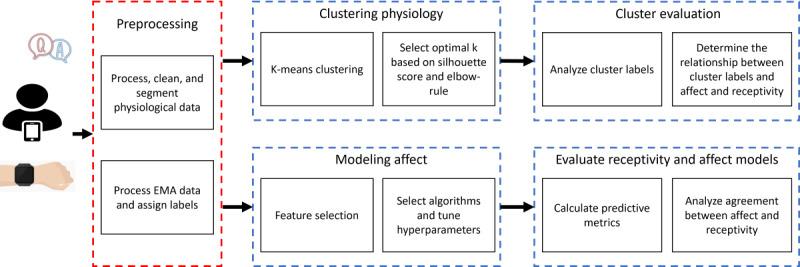
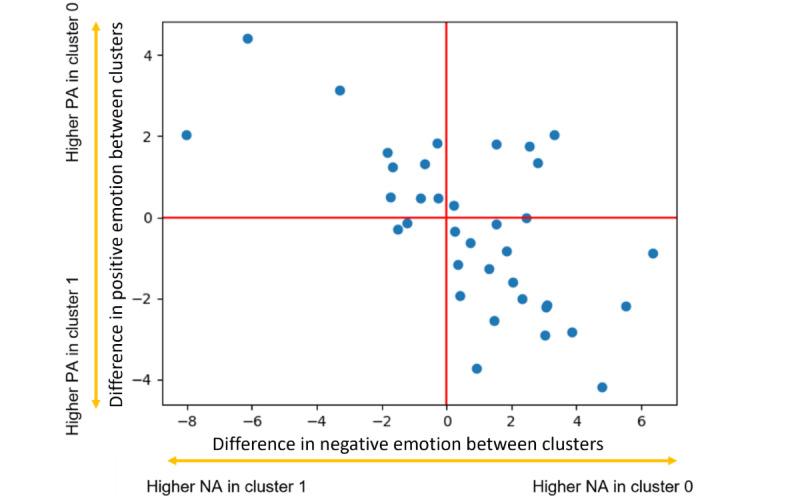
We collected data from 45 healthy participants wearing 2 devices measuring electrodermal activity, accelerometer, electrocardiography, and skin temperature while answering 10 EMAs daily, containing questions about perceived mood. Owing to the nature of our constructs, we can only obtain ground truth measures for both affect and receptivity during responses. Therefore, we used unsupervised and supervised ML methods to infer affect when a participant did not respond. Our unsupervised method used k-means clustering to determine the relationship between physiology and receptivity and then inferred the emotional state during nonresponses. For the supervised learning method, we primarily used random forest and neural networks to predict the affect of unlabeled data points as well as receptivity.
RESULTS
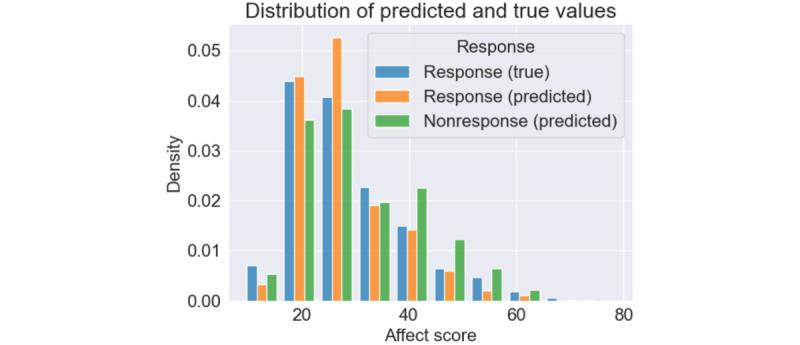
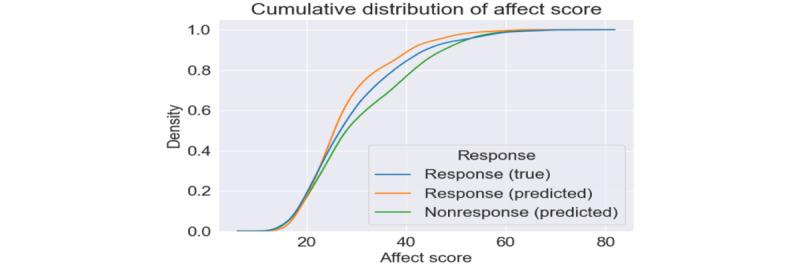
Our findings showed that using a receptivity model to trigger EMAs decreased the reported negative affect by >3 points or 0.29 SDs in our self-reported affect measure, scored between 13 and 91. The findings also showed a bimodal distribution of our predicted affect during nonresponses. This indicates that this system initiates EMAs more commonly during states of higher positive emotions.
CONCLUSIONS
Our results showed a clear relationship between affect and receptivity. This relationship can affect the efficacy of an mHealth study, particularly those that use an ML algorithm to trigger EMAs. Therefore, we propose that future work should focus on a smart trigger that promotes EMA receptivity without influencing affect during sampled time points.
背景
随着可穿戴设备和移动传感器技术的进步,移动健康(mHealth)研究的成果日益丰富,我们监测和建模人类行为的能力将受到参与者接受度的限制。许多健康结构都依赖于主观反应,如果没有这些反应,研究人员除了不断增长的生物行为数据外,几乎没有任何真实数据可供参考。这个问题会极大地影响研究的质量,特别是对于那些依从性较低的人群。为了解决这个挑战,研究人员提出了使用机器学习(ML)和传感器数据来修改调查的时间和交付方式的创新方法。然而,人们普遍担心在实施新的调查交付方法时,可能会对参与者的反应引入偏差或意外影响。
目的
本研究旨在展示基于机器学习的生态瞬时评估(EMA)交付系统(使用接受度作为预测变量)对参与者报告的情绪状态的潜在影响。我们在一项为期 10 天的可穿戴设备和基于 EMA 的情绪感应 mHealth 研究中,研究了影响参与者对 EMA 接受度的因素。我们研究了生理关系对接受度的影响,并分析了这两个结构之间的相互作用。
方法
我们从 45 名健康参与者那里收集数据,这些参与者佩戴了两台设备,分别测量皮肤电活动、加速度计、心电图和皮肤温度,同时每天回答 10 次 EMA,包含关于感知情绪的问题。由于我们的结构性质,我们只能在参与者做出反应时获得对接受度和情感的真实测量值。因此,我们使用无监督和有监督的机器学习方法来推断参与者未做出响应时的情感状态。我们的无监督方法使用 k-均值聚类来确定生理和接受度之间的关系,然后推断非响应期间的情绪状态。对于有监督学习方法,我们主要使用随机森林和神经网络来预测未标记数据点的情感状态和接受度。
结果
我们的研究结果表明,使用接受度模型来触发 EMA 可以使我们自我报告的情感测量值中的负面情感降低 3 分或 0.29 个标准差,得分在 13 到 91 之间。研究结果还表明,在非响应期间,我们预测的情感呈现双峰分布。这表明该系统在更高的积极情绪状态下更频繁地启动 EMA。
结论
我们的研究结果表明情感和接受度之间存在明显的关系。这种关系可能会影响 mHealth 研究的效果,特别是那些使用机器学习算法来触发 EMA 的研究。因此,我们建议未来的工作应该专注于开发一种智能触发机制,在采样点不影响情感的情况下促进 EMA 的接受度。



 Zotero 插件