
运动干预与医院相关性残疾:一项非随机对照临床试验。
Exercise Intervention and Hospital-Associated Disability: A Nonrandomized Controlled Clinical Trial.
机构信息
Centro de Investigación Biomédica en Red de Fragilidad y Envejecimiento Saludable, Instituto de Salud Carlos III, Madrid, Spain.
Department of Geriatrics, Hospital General Universitario Gregorio Marañón, Health Research Institute Gregorio Marañón, Madrid, Spain.
出版信息
JAMA Netw Open. 2024 Feb 5;7(2):e2355103. doi: 10.1001/jamanetworkopen.2023.55103.
IMPORTANCE
Inpatient exercise interventions may prevent, at least partly, hospital-associated disability (HAD) in older adults, but whether they also confer clinical benefits in the months following discharge is unclear.
OBJECTIVE
To examine the association of exercise and health education with HAD incidence in hospitalized older adults receiving acute hospital care at discharge and 3 months later.
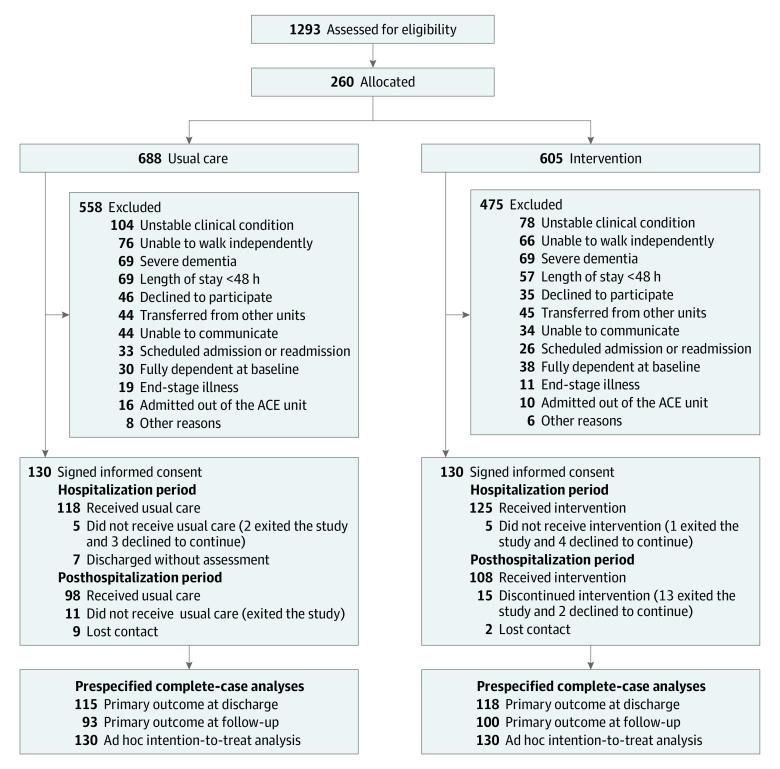
DESIGN, SETTING, AND PARTICIPANTS: This single-center open-label, nonrandomized controlled clinical trial included patients aged 75 years or older seen at an acute care for elders unit at a tertiary public hospital in Madrid, Spain, from May 1, 2018, to June 30, 2022.
INTERVENTIONS
Patients were allocated to an intervention or control group. Both groups received usual care, but the intervention group also performed a supervised multicomponent exercise program (daily strength, balance, and walking exercises along with inspiratory muscle training) during hospitalization and received health education on how to exercise at home and telephone counseling during follow-up.
MAIN OUTCOMES AND MEASURES
The primary outcome was HAD incidence (determined by the Katz Index of Independence in Activities of Daily Living [hereafter, Katz Index]) at discharge and after 3 months compared with baseline (ie, 2 weeks before admission). Secondary outcomes included HAD incidence determined by the Barthel Index for Activities of Daily Living, ambulatory capacity decline at discharge and follow-up, changes in physical performance at discharge, and incidence of falls, readmissions, and mortality during the follow-up period.
RESULTS
The study included 260 patients (134 women [51.5%]; mean [SD] age, 87.4 [4.9] years [range, 75-105 years]; median hospital length of stay, 7 days [IQR, 5-10 days]), of whom 130 received the intervention and 130 were in the control group. Differences in HAD incidence did not reach statistical significance at discharge (odds ratio [OR], 0.62; 95% CI, 0.37-1.05; P = .08) or follow-up (OR, 0.65; 95% CI, 0.36-1.17; P = .15) when using the Katz Index. A lower HAD incidence was observed in the intervention group at discharge (OR, 0.47; 95% CI, 0.27-0.81; P = .01) and at follow-up (OR, 0.36; 95% CI, 0.20-0.66; P = .001) when using the Barthel Index for Activities of Daily Living. The intervention was also associated with a lesser decline in ambulatory capacity (OR, 0.55; 95% CI, 0.32-0.96; P = .03) and improved physical performance at discharge (Cohen d, 0.39; 95% CI, 0.12-0.65; P = .004). No significant associations were observed for readmissions, falls, or mortality.
CONCLUSIONS AND RELEVANCE
In this nonrandomized controlled clinical trial, an exercise and health education intervention was not significantly associated with reduced HAD incidence when measured by the Katz Index. However, the benefits found for several secondary outcomes might support the implementation of in-hospital exercise programs for older patients.
TRIAL REGISTRATION
ClinicalTrials.gov Identifier: NCT03604640.
重要性
住院患者运动干预可能预防老年人至少部分医院相关性失能(HAD),但出院后是否也具有临床益处尚不清楚。
目的
检查运动和健康教育与在接受急性住院治疗的老年患者出院和 3 个月后 HAD 发生率的关系。
设计、地点和参与者:这是一项单中心、开放标签、非随机对照临床试验,纳入了 2018 年 5 月 1 日至 2022 年 6 月 30 日在西班牙马德里一家三级公立医院急性老年病房就诊的年龄 75 岁或以上的患者。
干预措施
患者被分配到干预组或对照组。两组均接受常规护理,但干预组还在住院期间进行了监督多成分运动计划(每日力量、平衡和步行锻炼以及吸气肌训练),并在随访期间接受了有关如何在家中锻炼和电话咨询的健康教育。
主要结局和测量指标
主要结局是与基线(即入院前 2 周)相比,出院时和 3 个月时的 HAD 发生率(通过 Katz 日常生活活动独立性指数[以下简称 Katz 指数]确定)。次要结局包括通过日常生活活动 Barthel 指数确定的 HAD 发生率、出院和随访时的步行能力下降、出院时的身体表现变化,以及随访期间的跌倒、再入院和死亡率。
结果
研究纳入了 260 名患者(134 名女性[51.5%];平均[SD]年龄 87.4 [4.9]岁[范围 75-105 岁];中位住院时间 7 天[IQR 5-10 天]),其中 130 名接受了干预,130 名处于对照组。使用 Katz 指数时,出院时(比值比[OR],0.62;95%CI,0.37-1.05;P=0.08)或随访时(OR,0.65;95%CI,0.36-1.17;P=0.15)HAD 发生率差异无统计学意义。在干预组中,出院时(OR,0.47;95%CI,0.27-0.81;P=0.01)和随访时(OR,0.36;95%CI,0.20-0.66;P=0.001)的 HAD 发生率较低。干预组还与较低的步行能力下降(OR,0.55;95%CI,0.32-0.96;P=0.03)和出院时的身体表现改善(Cohen d,0.39;95%CI,0.12-0.65;P=0.004)相关。未观察到再入院、跌倒或死亡率的显著相关性。
结论和相关性
在这项非随机对照临床试验中,使用 Katz 指数测量时,运动和健康教育干预与 HAD 发生率降低无显著相关性。然而,对几个次要结局的益处可能支持为老年患者实施住院期间的运动计划。
试验注册
ClinicalTrials.gov 标识符:NCT03604640。
 Zotero 插件