
儿童期虐待与内分泌疾病风险:采用序贯中介分析探索中介途径。
Childhood maltreatment and risk of endocrine diseases: an exploration of mediating pathways using sequential mediation analysis.
机构信息
Mental Health Center and West China Biomedical Big Data Center West China Hospital, Sichuan University, Guo Xue Lane 37, Chengdu, China.
Med-X Center for Informatics, Sichuan University, Chengdu, China.
出版信息
BMC Med. 2024 Feb 8;22(1):59. doi: 10.1186/s12916-024-03271-9.
BACKGROUND
Adverse childhood experiences (ACEs), including childhood maltreatment, have been linked with increased risk of diabetes and obesity during adulthood. A comprehensive assessment on the associations between childhood maltreatment and all major endocrine diseases, as well as the relative importance of different proposed mechanistic pathways on these associations, is currently lacking.
METHODS
Based on the UK Biobank, we constructed a cohort including 151,659 participants with self-reported data on childhood maltreatment who were 30 years of age or older on/after January 1, 1985. All participants were followed from the index date (i.e., January 1, 1985, or their 30th birthday, whichever came later) until the first diagnosis of any or specific (12 individual diagnoses and 9 subtypes) endocrine diseases, death, or the end of follow-up (December 31, 2019), whichever occurred first. We used Cox models to examine the association of childhood maltreatment, treated as continuous (i.e., the cumulative number of experienced childhood maltreatment), ordinal (i.e., 0, 1 and ≥ 2), or binary (< 2 and ≥ 2) variable, with any and specific endocrine diseases, adjusted for multiple covariates. We further examined the risk of having multiple endocrine diseases using Linear or Logistic Regression models. Then, sequential mediation analyses were performed to assess the contribution of four possible mechanisms (i.e., suboptimal socioeconomic status (SES), psychological adversities, unfavorable lifestyle, and biological alterations) on the observed associations.
RESULTS
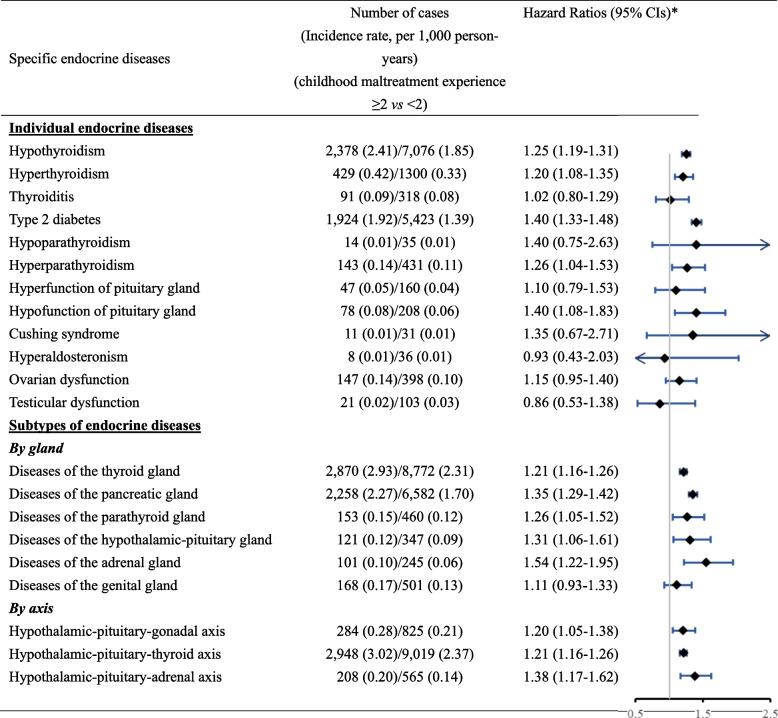
During an average follow-up of 30.8 years, 20,885 participants received a diagnosis of endocrine diseases. We observed an association between the cumulative number of experienced childhood maltreatment and increased risk of being diagnosed with any endocrine disease (adjusted hazard ratio (HR) = 1.10, 95% confidence interval 1.09-1.12). The HR was 1.26 (1.22-1.30) when comparing individuals ≥ 2 with those with < 2 experienced childhood maltreatment. We further noted the most pronounced associations for type 2 diabetes (1.40 (1.33-1.48)) and hypothalamic-pituitary-adrenal (HPA)-axis-related endocrine diseases (1.38 (1.17-1.62)), and the association was stronger for having multiple endocrine diseases, compared to having one (odds ratio (95% CI) = 1.24 (1.19-1.30), 1.35 (1.27-1.44), and 1.52 (1.52-1.53) for 1, 2, and ≥ 3, respectively). Sequential mediation analyses showed that the association between childhood maltreatment and endocrine diseases was consistently and most distinctly mediated by psychological adversities (15.38 ~ 44.97%), while unfavorable lifestyle (10.86 ~ 25.32%) was additionally noted for type 2 diabetes whereas suboptimal SES (14.42 ~ 39.33%) for HPA-axis-related endocrine diseases.
CONCLUSIONS
Our study demonstrates that adverse psychological sequel of childhood maltreatment constitutes the main pathway to multiple endocrine diseases, particularly type 2 diabetes and HPA-axis-related endocrine diseases. Therefore, increased access to evidence-based mental health services may also be pivotal in reducing the risk of endocrine diseases among childhood maltreatment-exposed individuals.
背景
不良的童年经历(ACEs),包括儿童期虐待,与成年后患糖尿病和肥胖的风险增加有关。目前缺乏对儿童虐待与所有主要内分泌疾病之间的关联以及不同提出的机制途径对这些关联的相对重要性进行全面评估。
方法
基于英国生物库,我们构建了一个队列,其中包括 151659 名参与者,他们有自我报告的儿童期虐待数据,年龄在 30 岁或以上,年龄在 1985 年 1 月 1 日或之后。所有参与者从索引日期(即 1985 年 1 月 1 日或他们 30 岁生日,以较晚者为准)开始随访,直到任何或特定(12 种单独的诊断和 9 种亚型)内分泌疾病的首次诊断、死亡或随访结束(2019 年 12 月 31 日),以先发生者为准。我们使用 Cox 模型来研究儿童虐待与任何和特定内分泌疾病的关联,将儿童虐待视为连续(即经历的儿童虐待的累积数量)、有序(即 0、1 和≥2)或二分类(<2 和≥2)变量,同时调整了多个协变量。我们进一步使用线性或逻辑回归模型研究了患有多种内分泌疾病的风险。然后,进行了顺序中介分析,以评估四个可能的机制(即次优的社会经济地位(SES)、心理逆境、不良生活方式和生物学改变)对观察到的关联的贡献。
结果
在平均 30.8 年的随访中,有 20885 名参与者被诊断为内分泌疾病。我们观察到经历的儿童虐待累积数量与被诊断为任何内分泌疾病的风险增加之间存在关联(调整后的危险比(HR)=1.10,95%置信区间 1.09-1.12)。与经历<2 次儿童虐待的个体相比,经历≥2 次儿童虐待的个体的 HR 为 1.26(1.22-1.30)。我们进一步注意到,2 型糖尿病(1.40(1.33-1.48))和下丘脑-垂体-肾上腺(HPA)轴相关内分泌疾病(1.38(1.17-1.62))的关联最为明显,与患有一种内分泌疾病相比,患有多种内分泌疾病的关联更强(比值比(95%CI)=1.24(1.19-1.30)、1.35(1.27-1.44)和 1.52(1.52-1.53),分别用于 1、2 和≥3)。顺序中介分析表明,儿童虐待与内分泌疾病之间的关联一致且最明显地通过心理逆境(15.3844.97%)来介导,而不良生活方式(10.8625.32%)另外注意到 2 型糖尿病,而次优 SES(14.42~39.33%)则注意到 HPA 轴相关的内分泌疾病。
结论
我们的研究表明,儿童虐待的不良心理后果构成了多种内分泌疾病的主要途径,特别是 2 型糖尿病和 HPA 轴相关的内分泌疾病。因此,增加获得循证心理健康服务的机会也可能是减少儿童虐待暴露者内分泌疾病风险的关键。


 Zotero 插件