
驾驶员高血压/血压与听力敏感度之间的关系:一项相关性分析。
Relationship between hypertension/blood pressure and hearing sensitivity among drivers: A correlation analysis.
作者信息
Edwin Daisy, Samuel Sugaraj, Chandrasekar R Madhan
机构信息
Sri Ramachandra Faculty of Audiology and Speech Language Pathology, SRIHER - DU, Porur, Chennai, Tamil Nadu, India, India and Research Scholar, The New College (Affiliated to University of Madras), Royapettah, Chennai, Tamil Nadu, India.
The New College (Affiliated to University of Madras), Royapettah, Chennai, Tamil Nadu, India.
出版信息
J Educ Health Promot. 2023 Nov 27;12:409. doi: 10.4103/jehp.jehp_468_23. eCollection 2023.
BACKGROUND
One of the most common chronic diseases is hypertension. The majority of research has linked hearing loss to hypertension. However, the relationship between hypertension and hearing is still unknown. The primary goal of the study is to investigate the effect of hypertension on hearing and to find out the association between blood pressure levels and auditory health in auto-rickshaw drivers.
MATERIALS AND METHODS
The study utilized 121 healthy professional auto-drivers between the age range of 25 and 55 years. Pure-tone audiometry (PTA) and extended high-frequency audiometry (EHFA) were used to determine the participants' hearing thresholds from 0.25 to 16 kHz. The cochlear hair cell functioning was evaluated using distortion-product otoacoustic emission (DPOAE) testing. Blood pressure (mmHg) measurements were categorized under hypertension stage (normal (120; <80); elevated (120-129; <80); hypertension - stage 1 (130-139; 80-89); hypertension - stage 2 (≥140; ≥90)).
RESULTS
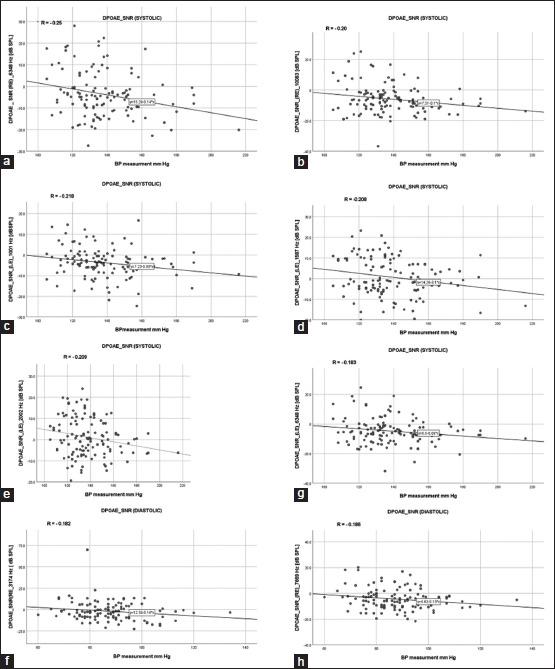
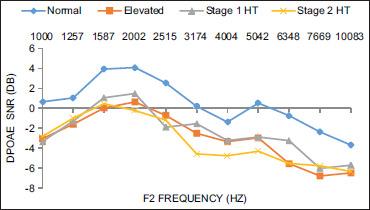
The mean age of the study participants was 42.17 ± 9.03 years. The mean systolic and diastolic BP of all the study participants were 138.24 ± 19.73 (105-216) mmHg and 87.69 ± 12.14 (60-134) mmHg, respectively. BP levels were normal for 17.4% ( = 21) of the study participants, 21.5% ( = 26) had elevated blood pressure, 21.5% ( = 26) of the population falls under stage 1 hypertension, and 39.7% ( = 48) had stage 2 hypertension. Our study discovered a significant difference between main group effects and no significant difference between group interaction effects. Hearing thresholds were significantly higher in hypertensive participants compared to non-hypertensive participants. However, there was no statistically significant relationship between the two variables hypertension and hearing loss.
CONCLUSION
Implementing health promotion initiatives and raising awareness about hearing health could improve the quality of life for a high-risk occupational group of drivers.
背景
高血压是最常见的慢性病之一。大多数研究已将听力损失与高血压联系起来。然而,高血压与听力之间的关系仍不清楚。本研究的主要目的是调查高血压对听力的影响,并找出自动人力车司机的血压水平与听觉健康之间的关联。
材料与方法
本研究采用了121名年龄在25至55岁之间的健康职业自动人力车司机。使用纯音听力测定法(PTA)和扩展高频听力测定法(EHFA)来确定参与者在0.25至16千赫兹之间的听力阈值。使用畸变产物耳声发射(DPOAE)测试评估耳蜗毛细胞功能。血压(毫米汞柱)测量结果分为高血压阶段(正常(120;<80);血压升高(120 - 129;<80);高血压1期(130 - 139;80 - 89);高血压2期(≥140;≥90))。
结果
研究参与者的平均年龄为42.17±9.03岁。所有研究参与者的平均收缩压和舒张压分别为138.24±19.73(105 - 216)毫米汞柱和87.69±12.14(60 - 134)毫米汞柱。17.4%( = 21)的研究参与者血压水平正常,21.5%( = 26)血压升高,21.5%( = 26)的人群属于高血压1期,39.7%( = 48)患有高血压2期。我们的研究发现主要组效应之间存在显著差异,而组间交互效应之间无显著差异。与非高血压参与者相比,高血压参与者的听力阈值显著更高。然而,高血压与听力损失这两个变量之间没有统计学上的显著关系。
结论
实施健康促进举措并提高对听力健康的认识,可以改善高风险职业群体司机的生活质量。



 Zotero 插件