
爱尔兰共和国非小细胞肺癌的基因组格局
Genomic Landscape of NSCLC in the Republic of Ireland.
作者信息
Keogh Rachel J, Barr Martin P, Keogh Anna, McMahon David, O'Brien Cathal, Finn Stephen P, Naidoo Jarushka
机构信息
Department of Medical Oncology, Beaumont RCSI Cancer Centre, Dublin, Ireland.
Thoracic Oncology Research Group, Trinity St James's Cancer Institute, St James's Hospital, Dublin, Ireland.
出版信息
JTO Clin Res Rep. 2023 Dec 27;5(2):100627. doi: 10.1016/j.jtocrr.2023.100627. eCollection 2024 Feb.
INTRODUCTION
The identification of genomic "targets" through next-generation sequencing (NGS) of patient's NSCLC tumors has resulted in a rapid expansion of targeted treatment options for selected patients. This retrospective study aims to identify the proportion of patients with advanced NSCLC in the Republic of Ireland whose tumors harbor actionable genomic alterations through broad NGS panel testing.
METHODS
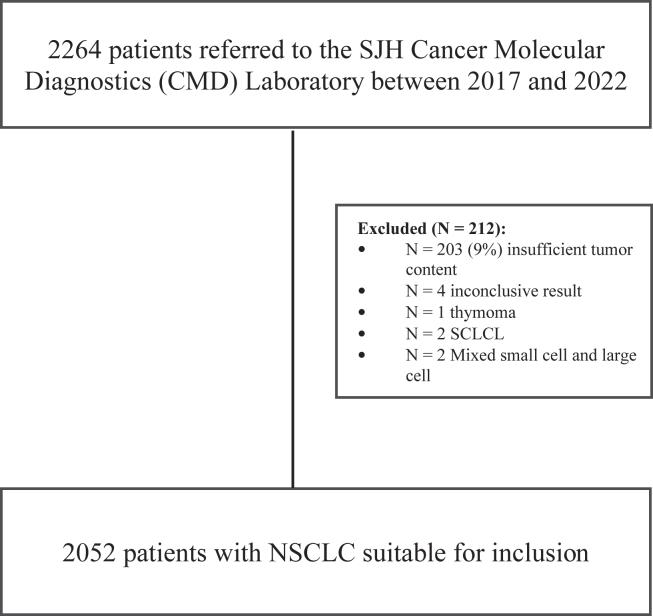
Institutional review board approval was obtained before study initiation. Patients with NSCLC whose tumors underwent genomic testing through the largest available NGS panel at a nationally funded Cancer Molecular Diagnostics laboratory (St. James's Hospital) between June 2017 and June 2022 were identified. Patient demographics and tumor-related data were collected by retrospective review from all cancer centers in Ireland, referring to the Cancer Molecular Diagnostics laboratory. A total of 203 (9%) tumor samples were excluded due to insufficient neoplastic cell content. Genomic data were collected through retrospective search of Ion Reporter software. The spectrum and proportion of patients with oncogenic driver mutations were evaluated using descriptive statistics (SPSS version 29.0).
RESULTS
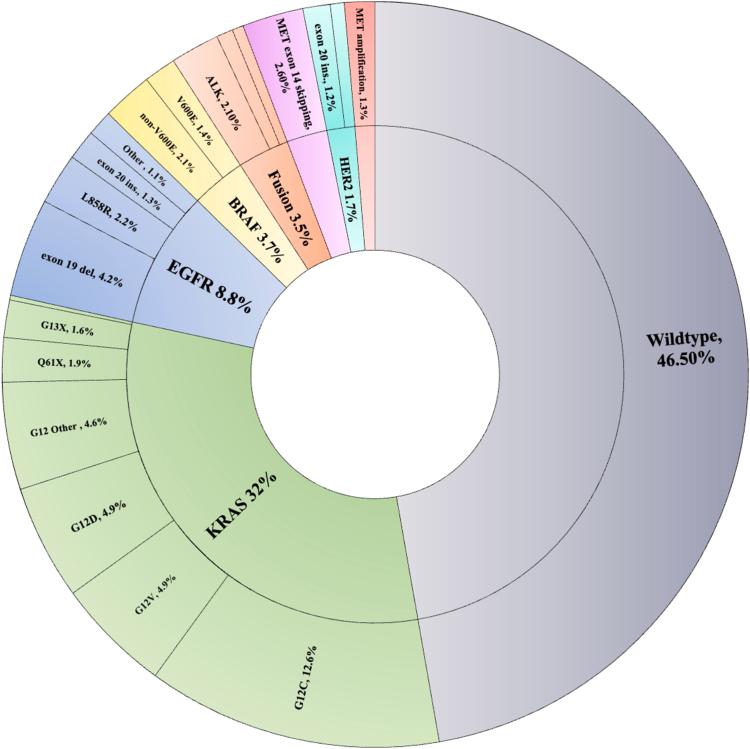
In total, 2052 patients were identified. Patients were referred from 23 different hospital sites and all four geographic regions (Leinster = 1091, 53%; Munster = 763, 37.2%; Connacht = 191, 9.3%; Ulster = 7, 0.3%). Median age was 69 (range: 26-94) years; 53% were male. The most common tumor histologic subtype was adenocarcinoma (77%, n = 1577). An actionable genomic alteration was identified in 1099 cases (53%), the most common of which was (n = 657, 32%). Less frequently, NSCLC tumors harbored the following: exon 14 skipping (n = 53, 2.6%), amplification (n = 26, 1.3%), (n = 181, 8.8%), (n = 35, 1.7%), and (n = 72, 3.5%) mutations. Fusions were detected in 76 patients (3.7%) including (n = 44, 58%), (n = 11, 14.5%), (n = 16, 21%), and (n = 5, 6.6%), whereas no fusion was identified. Co-alterations were detected in 114 patients (5.6%), the most common of which was / (n = 19, 17%), (n = 10, 8.5%), and (n = 9, 8%). Other co-alterations of interest identified included fusion (n = 1) and (n = 2).
CONCLUSIONS
This is the first retrospective study to comprehensively characterize the genomic landscape of NSCLC in Ireland, using the broadest available NGS panel. Actionable alterations were identified in 53.4% of the patients, and was the most common oncogenic driver alteration. Our study revealed a lower prevalence of patients whose tumor harbors , , and fusions, compared with similar data sets.
引言
通过对患者的非小细胞肺癌(NSCLC)肿瘤进行下一代测序(NGS)来鉴定基因组“靶点”,使得针对特定患者的靶向治疗选择迅速增加。这项回顾性研究旨在确定爱尔兰共和国晚期NSCLC患者中,通过广泛的NGS panel检测发现其肿瘤具有可操作基因组改变的患者比例。
方法
在研究开始前获得了机构审查委员会的批准。确定了2017年6月至2022年6月期间在一家国家资助的癌症分子诊断实验室(圣詹姆斯医院)通过最大可用NGS panel对肿瘤进行基因组检测的NSCLC患者。通过回顾性审查从爱尔兰所有癌症中心收集患者人口统计学和肿瘤相关数据,这些数据来自癌症分子诊断实验室。由于肿瘤细胞含量不足,共排除203份(9%)肿瘤样本。通过对Ion Reporter软件进行回顾性搜索收集基因组数据。使用描述性统计(SPSS 29.0版)评估致癌驱动基因突变患者的谱和比例。
结果
共确定了2052例患者。患者来自23个不同的医院地点以及所有四个地理区域(伦斯特 = 1091例,53%;芒斯特 = 763例,37.2%;康诺特 = 191例,9.3%;阿尔斯特 = 7例,0.3%)。中位年龄为69岁(范围:26 - 94岁);53%为男性。最常见的肿瘤组织学亚型是腺癌(77%,n = 1577)。在1099例(53%)病例中鉴定出可操作的基因组改变,其中最常见的是(n = 657,32%)。较少见的情况是,NSCLC肿瘤存在以下改变:外显子14跳跃(n = 53,2.6%)、扩增(n = 26,1.3%)、(n = 181,8.8%)、(n = 35,1.7%)和(n = 72,3.5%)突变。在76例患者(3.7%)中检测到融合,包括(n = 44,58%)、(n = 11,14.5%)、(n = 16,21%)和(n = 5,6.%),而未鉴定到融合。在114例患者(5.6%)中检测到共改变,其中最常见的是/(n = 19,17%)、(n = 10,8.5%)和(n = 9,8%)。鉴定出的其他感兴趣的共改变包括融合(n = 1)和(n = 2)。
结论
这是第一项使用最广泛可用的NGS panel全面描述爱尔兰NSCLC基因组格局的回顾性研究。在53.4%的患者中鉴定出可操作的改变,并且是最常见的致癌驱动改变。我们的研究显示,与类似数据集相比,肿瘤存在、和融合的患者患病率较低。

 Zotero 插件