
给感染艾滋病毒的孕妇接种疫苗的安全性和免疫原性:一项系统评价和荟萃分析。
The safety and immunogenicity of vaccines administered to pregnant women living with HIV: a systematic review and meta-analysis.
作者信息
Nakabembe Eve, Cooper Jo, Amaral Kyle, Tusubira Valerie, Hsia Yingfen, Abu-Raya Bahaa, Sekikubo Musa, Nakimuli Annettee, Sadarangani Manish, Le Doare Kirsty
机构信息
Department of Obstetrics and Gynaecology, School of Medicine, Makerere University College of Health Sciences, Upper Mulago Hill Road, P.O. Box 7072, Kampala, Uganda.
Centre for Neonatal and Pediatric Infection, St George's University of London, Cranmer Terrace, London SW170RE, United Kingdom.
出版信息
EClinicalMedicine. 2024 Feb 2;69:102448. doi: 10.1016/j.eclinm.2024.102448. eCollection 2024 Mar.
BACKGROUND
Human Immunodeficiency Virus (HIV)-exposed uninfected (HEU) infants have a higher burden of infectious diseases related morbidity and mortality compared with HIV-unexposed uninfected (HUU). Immunization of pregnant women living with HIV (PWLWH) could reduce the severity and burden of infectious diseases for HEU in early infancy.
METHODS
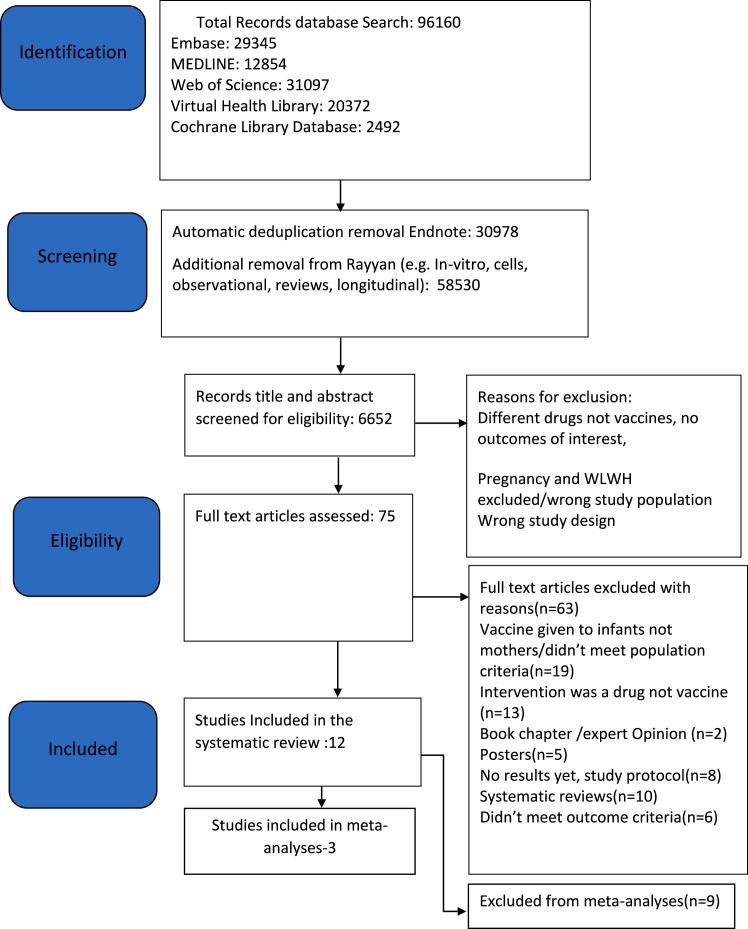
We conducted a systematic review of safety and immunogenicity of vaccines administered to PWLWH and meta-analyses to test the overall effect of immunogenicity comparing pregnant women without HIV (PWWH) to PWLWH. We searched MEDLINE, Embase, Web of Science, Virtual Health Library and Cochrane databases in accordance with PRISMA guidelines for randomized controlled trials and observational studies. Review articles, case series, conference abstracts, and animal studies were excluded. Studies were included from inception to 6th September 2023, with no language restrictions. Random effects meta-analyses were performed for immunogenicity using Review manager (RevMan) analysis software version 5.4.1, Geometric Mean Titer (GMT) values were transformed to obtain the mean and standard deviation within RevMan, the effect size was computed and reported as mean difference with respective 95% confidence intervals. The review was registered with PROSPERO CRD42021289081.
FINDINGS
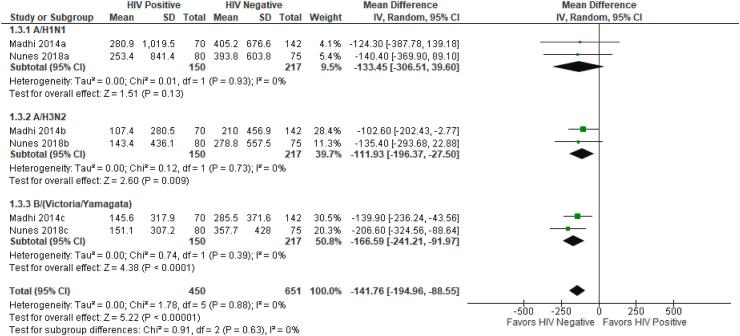
We included 12 articles, comprising 3744 pregnant women, 1714 were PWLWH given either influenza, pneumococcal or an investigational Group B (GBS) vaccine. Five studies described safety outcomes, and no increase in adverse events was reported in PWLWH compared to PWWH. The GMT increase from baseline to 28-35 weeks post vaccination in HA units ranged from 12.4 (95% CI: 9.84-14.9) to 238.8 (95% CI: 0.35-477.9). Meta-analyses of influenza vaccines showed the pooled geometric mean difference in Hemagglutination Inhibition (HAI) titers post vaccination was 56.01 (95% CI: 45.01-67.01), p < 0.001. The increase was less in PWLWH when compared with PWWH: -141.76 (95% CI: -194.96, -88.55), p < 0.001.
INTERPRETATION
There are limited data on the safety and immunogenicity of vaccines given to PWLWH making policy consideration in this group difficult when new vaccines are introduced. With new vaccines on the horizon, PWLWH need to be included in studies to promote vaccine confidence for this special population.
FUNDING
This work was funded by Medical Research Council Joint Clinical Trials Round 9 [MR/T004983/1].
背景
与未接触过人类免疫缺陷病毒(HIV)的未感染婴儿(HUU)相比,暴露于HIV但未感染(HEU)的婴儿因传染病导致的发病和死亡负担更高。感染HIV的孕妇(PWLWH)接种疫苗可降低HEU婴儿早期传染病的严重程度和负担。
方法
我们对PWLWH接种疫苗的安全性和免疫原性进行了系统评价,并进行荟萃分析,以测试免疫原性的总体效果,比较未感染HIV的孕妇(PWWH)和PWLWH。我们按照PRISMA指南在MEDLINE、Embase、科学网、虚拟健康图书馆和Cochrane数据库中检索随机对照试验和观察性研究。排除综述文章、病例系列、会议摘要和动物研究。纳入从研究开始至2023年9月6日的研究,无语言限制。使用Review manager(RevMan)分析软件5.4.1版对免疫原性进行随机效应荟萃分析,将几何平均滴度(GMT)值进行转换,以获得RevMan内的均值和标准差,计算效应量并报告为平均差异及相应的95%置信区间。该综述已在PROSPERO注册,注册号为CRD42021289081。
结果
我们纳入了12篇文章,共3744名孕妇,其中1714名是接受流感、肺炎球菌或B组链球菌(GBS)研究性疫苗接种的PWLWH。五项研究描述了安全性结果,与PWWH相比,PWLWH未报告不良事件增加。接种疫苗后28 - 35周,HA单位的GMT从基线增加的范围为12.4(95%CI:9.84 - 14.9)至238.8(95%CI:0.35 - 477.9)。流感疫苗的荟萃分析显示,接种疫苗后血凝抑制(HAI)滴度的合并几何平均差异为56.01(95%CI:45.01 - 67.01),p < 0.001。与PWWH相比,PWLWH的增加较少:-141.76(95%CI:-194.96,-88.55),p < 0.001。
解读
关于PWLWH接种疫苗的安全性和免疫原性的数据有限,这使得在引入新疫苗时难以对该群体进行政策考量。随着新疫苗的出现,PWLWH需要纳入研究,以增强该特殊人群对疫苗的信心。
资金
本研究由医学研究理事会联合临床试验第9轮[MR/T004983/1]资助。

 Zotero 插件