
染色体加倍提高了……中的生物量和类胡萝卜素含量。
Chromosome Doubling Enhances Biomass and Carotenoid Content in .
作者信息
Zhang Runan, Rao Shupei, Wang Yuchang, Qin Yingzhi, Qin Ken, Chen Jinhuan
机构信息
State Key Laboratory of Efficient Production of Forest Resources, National Engineering Research Center of Tree Breeding and Ecological Restoration, College of Biological Sciences and Technology, Beijing Forestry University, Beijing 100083, China.
National Wolfberry Engineering Research Center, Ningxia Academy of Agriculture and Forestry Sciences, Yinchuan 750002, China.
出版信息
Plants (Basel). 2024 Feb 2;13(3):439. doi: 10.3390/plants13030439.
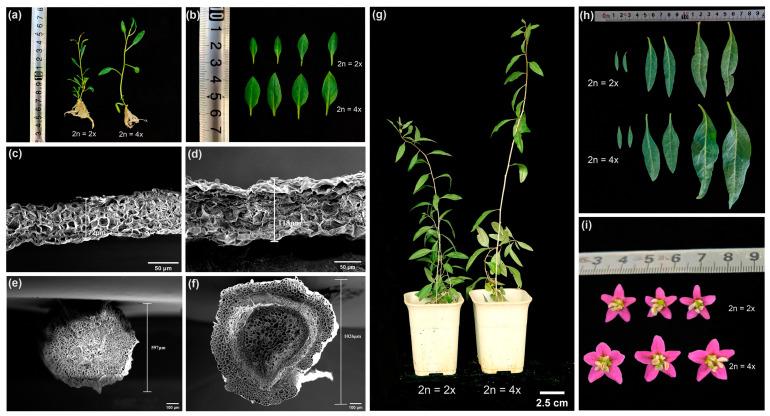
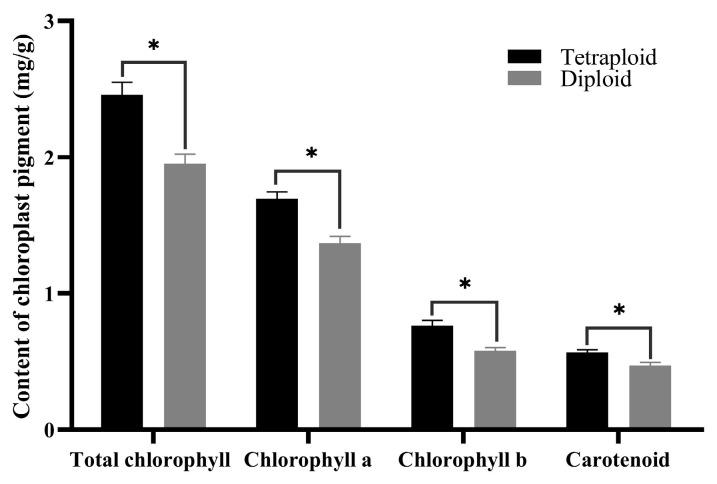
, a type of medicinal and edible plant, is rich in bioactive compounds beneficial to human health. In order to meet the market requirements for the yield and quality of , polyploid induction is usually an effective way to increase plant biomass and improve the content of bioactive components. This study established the most effective tetraploid induction protocol by assessing various preculture durations, colchicine concentrations, and exposure times. The peak tetraploid induction efficacy, 18.2%, was achieved with a 12-day preculture and 24-h exposure to 50 mg L colchicine. Compared to diploids, tetraploids exhibited potentially advantageous characteristics such as larger leaves, more robust stems, and faster growth rates. Physiologically, tetraploids demonstrated increased stomatal size and chloroplast count in stomata but reduced stomatal density. Nutrient analysis revealed a substantial increase in polysaccharides, calcium, iron, and zinc in tetraploid leaves. In addition, seventeen carotenoids were identified in the leaves of . Compared to the diploid, lutein, -carotene, neoxanthin, violaxanthin, and (E/Z)-phytoene exhibited higher levels in tetraploid strains T39 and T1, with T39 demonstrating a greater accumulation than T1. The findings suggest that the generated tetraploids harbor potential for further exploitation and lay the foundation for the selection and breeding of novel genetic resources of .
[植物名称]是一种药食两用植物,富含对人体健康有益的生物活性化合物。为了满足市场对[植物名称]产量和品质的要求,多倍体诱导通常是增加植物生物量和提高生物活性成分含量的有效途径。本研究通过评估不同的预培养时间、秋水仙碱浓度和处理时间,建立了最有效的四倍体诱导方案。预培养12天并暴露于50 mg/L秋水仙碱24小时,四倍体诱导效率达到峰值18.2%。与二倍体相比,四倍体表现出潜在的优势特征,如叶片更大、茎更粗壮、生长速度更快。在生理方面,四倍体的气孔尺寸增大,气孔中的叶绿体数量增加,但气孔密度降低。营养成分分析表明,四倍体叶片中的多糖、钙、铁和锌含量大幅增加。此外,在[植物名称]的叶片中鉴定出了17种类胡萝卜素。与二倍体相比,叶黄素、β-胡萝卜素、新黄质、紫黄质和(E/Z)-八氢番茄红素在四倍体菌株T39和T1中的含量更高,其中T39的积累量大于T1。研究结果表明,所产生的四倍体具有进一步开发利用的潜力,为[植物名称]新基因资源的选育奠定了基础。




 Zotero 插件