
伊朗的癌症模式:2014-2017 年癌症发病率的性别特异性空间建模。
Cancer patterns in Iran: a gender-specific spatial modelling of cancer incidence during 2014-2017.
机构信息
Department of Medical Informatics, School of Medicine, Mashhad University of Medical Sciences, Mashhad, Iran.
UQ Centre for Clinical Research, Faculty of Medicine, The University of Queensland, Brisbane, QLD, Australia.
出版信息
BMC Cancer. 2024 Feb 12;24(1):191. doi: 10.1186/s12885-024-11940-4.
BACKGROUND
Cancer is a significant public health concern and the second leading cause of death. This study aims to visualize spatial patterns of top common cancer types and identify high-risk and low-risk counties for these cancers in Iran from 2014 to 2017.
METHODS
In this study, we analyzed 482,229 newly diagnosed cancer cases recorded by the Iranian National Population-Based Cancer Registry from 2014 to 2017. We employed a purely spatial scanning model and local Moran I analysis to explore spatial patterns across Iran.
RESULTS
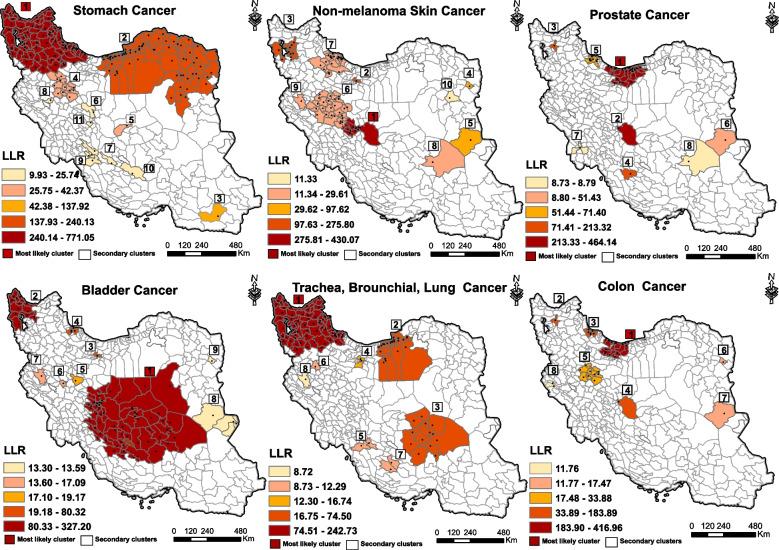
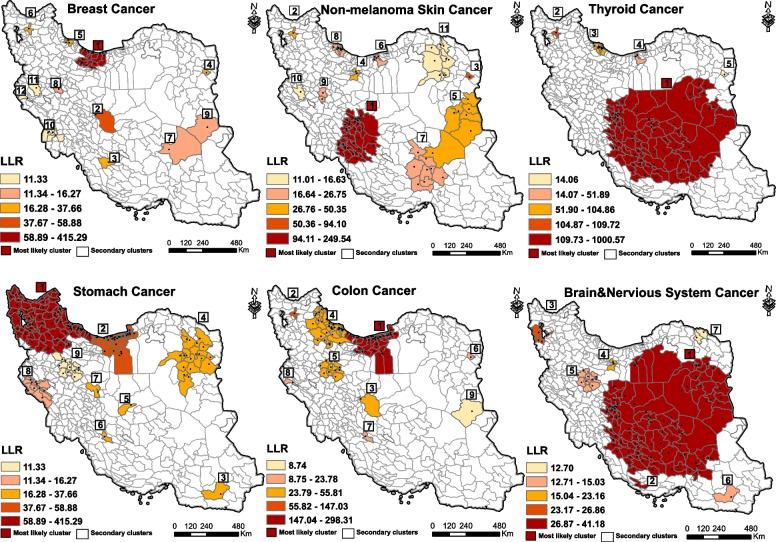
Approximately 53% of all cases were male. The average age of cancer diagnosis was 62.58 ± 17.42 years for males and 56.11 ± 17.33years for females. Stomach cancer was the most common cancer in men. The northern and northwestern regions of Iran were identified as high-risk areas for stomach cancer in both genders, with a relative risk (RR) ranging from 1.26 to 2.64 in males and 1.19 to 3.32 in females. These areas recognized as high-risk areas for trachea, bronchus, and lung (TBL) cancer specifically in males (RR:1.15-2.02). Central regions of Iran were identified as high-risk areas for non-melanoma skin cancers in both genders, ranking as the second most common cancer (RR:1.18-5.93 in males and 1.24-5.38 in females). Furthermore, bladder cancer in males (RR:1.32-2.77) and thyroid cancer in females (RR:1.88-3.10) showed concentration in the central part of Iran. Breast cancer, being the most common cancer among women (RR:1.23-5.54), exhibited concentration in the northern regions of the country. Also, northern regions of Iran were identified as high-risk clusters for colon cancer (RR:1.31-3.31 in males and 1.33-4.13 in females), and prostate cancer in males (RR:1.22-2.31). Brain, nervous system cancer, ranked sixth among women (RR:1.26-5.25) in central areas.
CONCLUSIONS
The study's revelations on the spatial patterns of common cancer incidence in Iran provide crucial insights into the distribution and trends of these diseases. The identification of high-risk areas equips policymakers with valuable information to tailor targeted screening programs, facilitating early diagnosis and effective disease control strategies.
背景
癌症是一个重大的公共卫生问题,也是导致死亡的第二大主要原因。本研究旨在通过可视化 2014 年至 2017 年伊朗最常见癌症类型的空间分布模式,确定这些癌症的高风险和低风险县。
方法
本研究分析了 2014 年至 2017 年伊朗国家基于人群的癌症登记处记录的 482229 例新发癌症病例。我们采用纯粹的空间扫描模型和局部 Moran I 分析来探索伊朗各地的空间模式。
结果
大约 53%的病例为男性。癌症诊断的平均年龄为男性 62.58 ± 17.42 岁,女性 56.11 ± 17.33 岁。男性中胃癌最常见,男女两性的北部和西北部地区均被确定为胃癌的高风险地区,男性的相对风险(RR)范围为 1.26 至 2.64,女性为 1.19 至 3.32。这些地区被认为是男性气管、支气管和肺癌(TBL)的高风险地区(RR:1.15-2.02)。伊朗中部地区被确定为男女非黑素瘤皮肤癌的高风险地区,是第二大常见癌症(RR:男性 1.18-5.93,女性 1.24-5.38)。此外,男性膀胱癌(RR:1.32-2.77)和女性甲状腺癌(RR:1.88-3.10)在伊朗中部集中。女性中最常见的癌症乳腺癌(RR:1.23-5.54)在该国北部集中。此外,伊朗北部地区被确定为结肠癌(男性 RR:1.31-3.31,女性 RR:1.33-4.13)和男性前列腺癌(RR:1.22-2.31)的高风险聚集区。在女性中,脑和神经系统癌症排名第六(RR:1.26-5.25),位于中心地带。
结论
本研究揭示了伊朗常见癌症发病率的空间模式,为这些疾病的分布和趋势提供了重要的见解。高风险地区的确定为政策制定者提供了有价值的信息,以制定有针对性的筛查计划,促进早期诊断和有效的疾病控制策略。



 Zotero 插件