
从红树林(白骨壤)叶片中制备银纳米颗粒及其部分表征,以及它们对口腔细菌的抗菌效果
Fabrication and Partial Characterization of Silver Nanoparticles From Mangrove (Avicennia marina) Leaves and Their Antibacterial Efficacy Against Oral Bacteria.
作者信息
Soni Muskan, Pitchiah Sivaperumal, Suresh Vasugi, Ramasamy Pasiyappazham
机构信息
Department of Physiology, Saveetha Dental College & Hospitals, Basic Medical Sciences, Saveetha Institute of Medical and Technical Sciences (SIMATS) Saveetha University, Chennai, IND.
Department of Prosthodontics, Saveetha Dental College & Hospitals, Saveetha Institute of Medical and Technical Sciences (SIMATS) Saveetha University, Chennai, IND.
出版信息
Cureus. 2024 Jan 11;16(1):e52131. doi: 10.7759/cureus.52131. eCollection 2024 Jan.
BACKGROUND
Scientists are currently investigating ecologically sound and enduring techniques for nanoparticle production. Utilizing natural sources such as plant extracts provides an environmentally friendly and economically efficient method. , also referred to as the gray mangrove, is predominantly located in coastal regions. The leaves of this plant may contain bioactive metabolites that can be used to synthesize nanoparticles.
OBJECTIVES
This study aimed to synthesize silver nanoparticles (AgNPs) using leaf extract and subsequently assess their antibacterial properties against oral pathogens.
MATERIALS AND METHODS
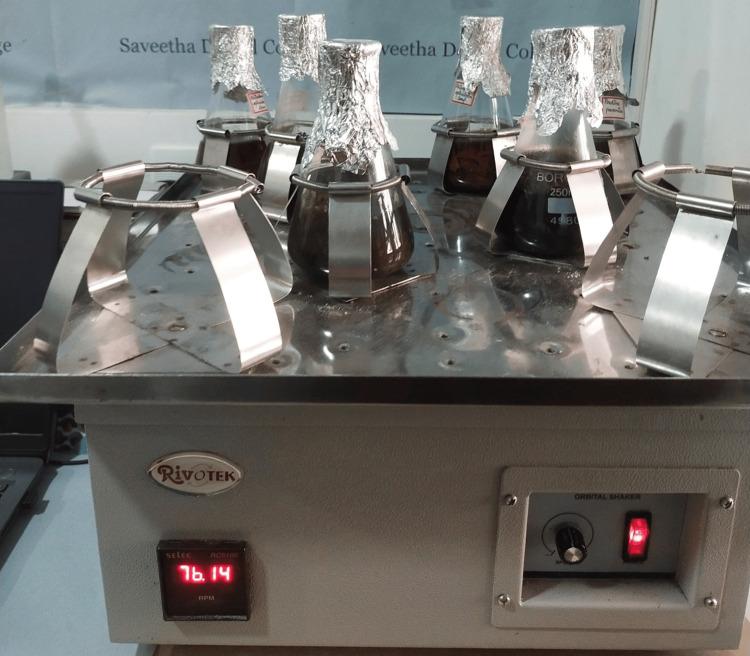
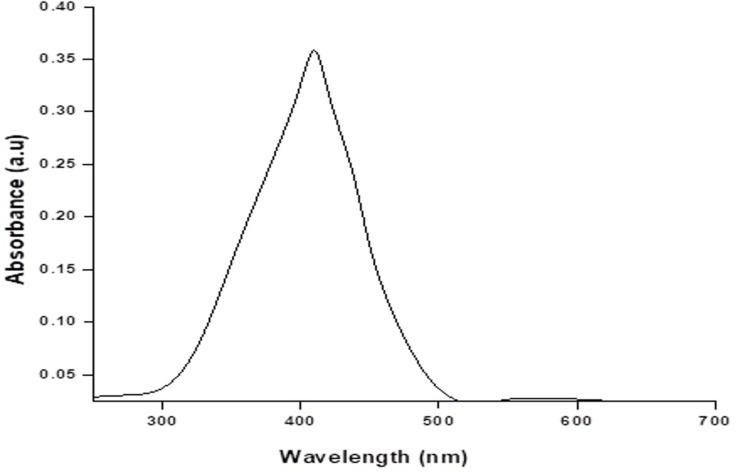
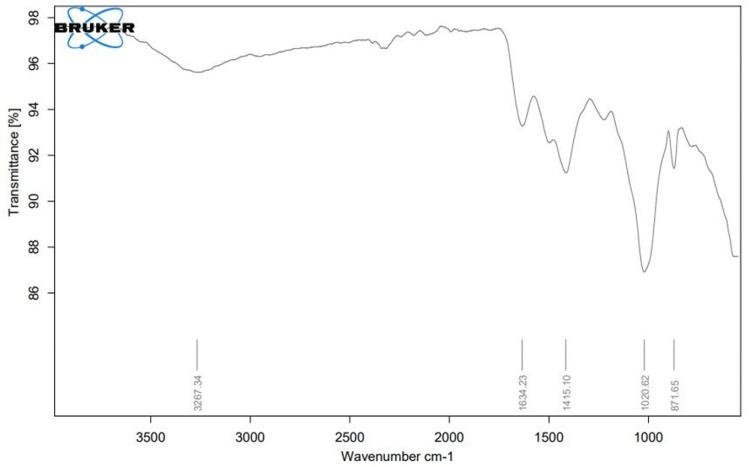
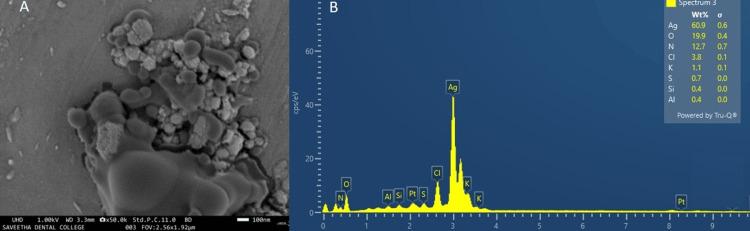
The present research involved the successful synthesis of AgNPs using an environmentally sustainable method employing the leaf extract of The reduction of Ag ions to AgNPs was confirmed using UV-visible spectroscopy. This analytical technique revealed the presence of a distinct surface plasmon resonance peak at approximately 420 nm, which is indicative of the formation of AgNPs. Fourier transform infrared spectroscopy (FTIR) operating within the frequency range of 500-3500 cm and scanning electron microscopy (SEM) morphology of the image indicated agglomeration of the nanoparticles, with distinct particles ranging from 10 to 20 nm and dense rod-shape, which was carried out from Saveetha Dental College and Hospitals, Saveetha Institute of Medical and Technical Sciences (SIMATS), Chennai, Tamil Nadu, India. In energy-dispersive spectroscopy (EDS), a strong signal and maximum formation percentage were received at 42.7%, assigned to the element silver.
RESULTS
AgNPs showed significant antibacterial efficacy against both gram-positive bacteria, including and , and gram-negative bacteria, such as sp. In general, the use of leaf extract for the green synthesis of AgNPs is a viable and environmentally friendly approach for producing nanoparticles that exhibit favorable biological properties. Consequently, these nanoparticles hold considerable appeal as potential candidates for a range of biomedical applications, particularly as antibacterial agents.
CONCLUSION
The synthesis of AgNPs using leaf extract shows great potential in the field of creating nanomaterials that are compatible with biological systems and is promising for a wide range of clinical applications. Nevertheless, it is imperative to conduct comprehensive scientific research and rigorous clinical trials to effectively apply these discoveries to real-world medical interventions, while prioritizing patient safety and therapeutic effectiveness.
背景
科学家目前正在研究纳米颗粒生产的生态友好且持久的技术。利用植物提取物等天然来源提供了一种环境友好且经济高效的方法。 ,也被称为灰红树林,主要分布在沿海地区。这种植物的叶子可能含有可用于合成纳米颗粒的生物活性代谢物。
目的
本研究旨在使用 叶提取物合成银纳米颗粒(AgNPs),并随后评估其对口腔病原体的抗菌性能。
材料与方法
本研究采用环境可持续的方法,利用 叶提取物成功合成了AgNPs。使用紫外可见光谱法确认了Ag离子还原为AgNPs。该分析技术显示在约420nm处存在明显的表面等离子体共振峰,这表明形成了AgNPs。傅里叶变换红外光谱(FTIR)在500 - 3500cm的频率范围内运行,图像的扫描电子显微镜(SEM)形态表明纳米颗粒发生团聚,颗粒直径从10到20nm不等,呈密集的棒状,该研究由印度泰米尔纳德邦金奈的萨维塔牙科学院和医院、萨维塔医学与技术科学研究所(SIMATS)进行。在能量色散光谱(EDS)中,在42.7%处接收到强信号和最大形成百分比,归属于银元素。
结果
AgNPs对革兰氏阳性菌,包括 和 ,以及革兰氏阴性菌,如 菌属,均显示出显著的抗菌效果。一般来说,使用 叶提取物进行AgNPs的绿色合成是一种可行且环境友好的方法,可生产出具有良好生物学特性的纳米颗粒。因此,这些纳米颗粒作为一系列生物医学应用的潜在候选物具有相当大的吸引力,特别是作为抗菌剂。
结论
使用 叶提取物合成AgNPs在创建与生物系统兼容的纳米材料领域显示出巨大潜力,并且有望用于广泛的临床应用。然而,必须进行全面的科学研究和严格的临床试验,以有效地将这些发现应用于实际医疗干预,同时优先考虑患者安全和治疗效果。


 Zotero 插件