
中国北京奥密克戎疫情期间,奈玛特韦-利托那韦治疗与住院 COVID-19 患者死亡和临床改善的关联:一项多中心、回顾性队列研究。
Associations of nirmatrelvir-ritonavir treatment with death and clinical improvement in hospitalized patients with COVID-19 during the Omicron wave in Beijing, China: a multicentre, retrospective cohort study.
机构信息
College of Pulmonary and Critical Care Medicine, The Eighth Medical Center, Chinese PLA General Hospital, Beijing, China.
Chinese PLA Medical School, Beijing, China.
出版信息
Ann Med. 2024 Dec;56(1):2313062. doi: 10.1080/07853890.2024.2313062. Epub 2024 Feb 14.
BACKGROUND
The effectiveness of nirmatrelvir-ritonavir has mainly been shown in non-hospitalized patients with mild-to-moderate coronavirus disease 2019 (COVID-19). The real-world effectiveness of nirmatrelvir-ritonavir urgently needs to be determined using representative in-hospital patients with COVID-19 during the Omicron wave of the pandemic.
METHODS
We performed a multicentre, retrospective study in five Chinese PLA General Hospital medical centers in Beijing, China. Patients hospitalized with COVID-19 from 10 December 2022 to 20 February 2023 were eligible for inclusion. A 1:1 propensity score matching was performed between the nirmatrelvir-ritonavir group and the control group.
RESULTS
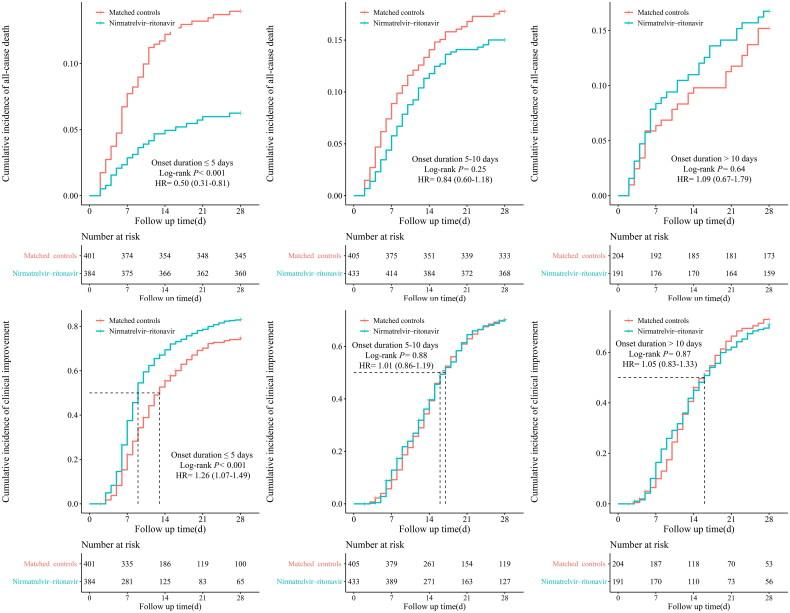
1010 recipients of nirmatrelvir-ritonavir and 1010 matched controls were finally analyzed after matching. Compared with matched controls, the nirmatrelvir-ritonavir group had a lower incidence rate of all-cause death (4.6/1000 vs. 6.3/1000 person-days, = 0.013) and a higher incidence rate of clinical improvement (47.6/1000 vs. 45.8/1000 person-days, = 0.012). Nirmatrelvir-ritonavir was associated with a 22% lower all-cause mortality and a 14% higher incidence of clinical improvement. Initiation of nirmatrelvir-ritonavir within 5 days after symptom onset was associated with a 50% lower mortality and a 26% higher clinical improvement rate. By contrast, no significant associations were identified among patients receiving nirmatrelvir-ritonavir treatment more than 5 days after symptom onset. Nirmatrelvir-ritonavir was also associated with a 50% increase in survival days and a 12% decrease in days to clinical improvement.
CONCLUSION
Among hospitalized patients with COVID-19 during the Omicron wave in Beijing, China, the early initiation of nirmatrelvir-ritonavir was associated with clinical benefits of lowering mortality and improving clinical recovery.
背景
奈玛特韦/利托那韦主要在轻症至中度 2019 冠状病毒病(COVID-19)的非住院患者中显示出有效性。奥密克戎流行期间,迫切需要使用具有代表性的住院 COVID-19 患者来确定奈玛特韦/利托那韦的真实世界疗效。
方法
我们在中国北京的五家解放军总医院医学中心进行了一项多中心、回顾性研究。符合条件的患者为 2022 年 12 月 10 日至 2023 年 2 月 20 日期间住院的 COVID-19 患者。奈玛特韦/利托那韦组与对照组进行了 1:1 倾向评分匹配。
结果
匹配后最终分析了 1010 例奈玛特韦/利托那韦组和 1010 例匹配对照组患者。与匹配对照组相比,奈玛特韦/利托那韦组全因死亡率(4.6/1000 与 6.3/1000 人天, = 0.013)较低,临床改善发生率(47.6/1000 与 45.8/1000 人天, = 0.012)较高。奈玛特韦/利托那韦与全因死亡率降低 22%和临床改善发生率提高 14%相关。症状出现后 5 天内开始使用奈玛特韦/利托那韦与死亡率降低 50%和临床改善率提高 26%相关。相比之下,在症状出现后 5 天以上开始接受奈玛特韦/利托那韦治疗的患者中未发现显著相关性。奈玛特韦/利托那韦还与生存天数增加 50%和临床改善天数减少 12%相关。
结论
在中国北京奥密克戎流行期间,住院 COVID-19 患者早期使用奈玛特韦/利托那韦与降低死亡率和改善临床康复相关。


 Zotero 插件