
靶向Clp蛋白酶的细菌蛋白酶体靶向嵌合体:抗分枝杆菌药物发现的一种有前景的策略。
BacPROTACs targeting Clp protease: a promising strategy for anti-mycobacterial drug discovery.
作者信息
Bonjorno Andressa Francielli, Pavan Aline Renata, Fernandes Guilherme F S, Scarim Cauê Benito, Castagnolo Daniele, Dos Santos Jean Leandro
机构信息
School of Pharmaceutical Sciences, São Paulo State University (UNESP), Araraquara, Brazil.
Institute of Chemistry, São Paulo State University (UNESP), Araraquara, Brazil.
出版信息
Front Chem. 2024 Jan 31;12:1358539. doi: 10.3389/fchem.2024.1358539. eCollection 2024.
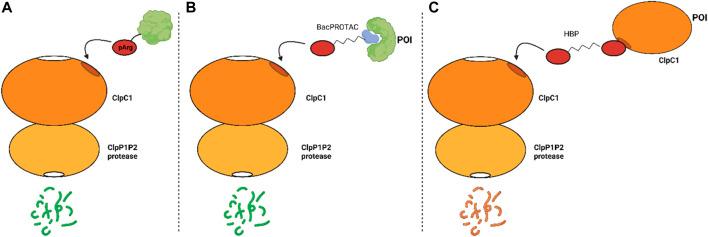
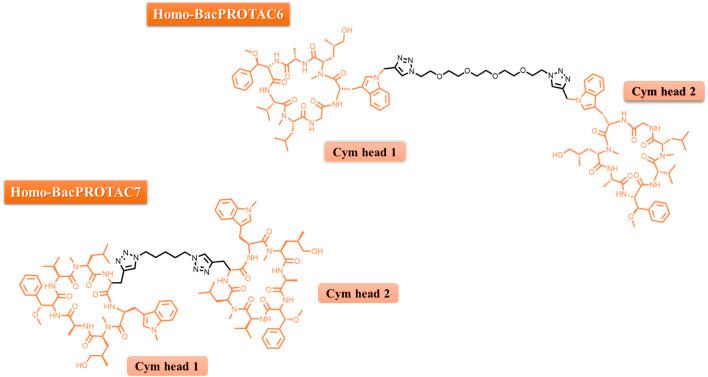
Tuberculosis (TB) has claimed more lives over the course of two millennia than any other infectious disease worldwide. In 2021, the World Health Organization (WHO) estimated that 10.6 million people were diagnosed with TB, resulting in the deaths of 1.4 million HIV-negative individuals. The emergence of multidrug-resistant TB (MDR-TB), defined as resistance to at least rifampicin (RIF) and isoniazid (INH), and extensively drug-resistant TB (XDR-TB), poses the primary challenge to overcome in the coming years. We have recently conducted an extensive analysis of investments and research endeavours in the field, with the overarching objective of achieving the established milestone of TB eradication by the year 2030. Over the past several years, there has been notable progress in advancing a multitude of promising compounds, each possessing distinct mechanisms of action, into clinical phases of development. However, it is worth noting that strains of mycobacteria resistant to current antitubercular drugs have already emerged for some of these compounds The exploration of the innovative Proteolytic Target Chimeras (PROTACs) protein degradation approach has emerged as a viable avenue for the discovery of novel antimicrobials. While the ubiquitin system is exclusive to eukaryotic cells, certain bacteria use a similar degradation system that relies on the recognition of phosphorylated arginine residues (pArg) by the ClpC:ClpP (ClpCP) protease, thereby leading to protein degradation. In this opinion article, we have described and analized the advances in the use of PROTACs that leverage bacterial proteolytic machinery (BacPROTACs) to design new antitubercular agents. Scope Statement. The development of novel pharmaceuticals for tuberculosis treatment is deemed urgently necessary due to the emergence of resistant strains. In this context, the introduction of new technologies capable of alleviating the disease and attaining the objectives outlined by the World Health Organization is imperative. Among the innovative strategies, the degradation of proteins that are crucial for the survival of the holds promise for generating new medications, particularly those that are effective at treating latent (non-replicating) . Within this perspective, we present the advancements and obstacles encountered in the exploration of new BacPROTAC compounds, with the intention of encouraging research and illuminating challenges associated with the implementation of BacPROTACs to address to the global tuberculosis crisis.
在两千年的时间里,结核病在全球范围内造成的死亡人数超过了任何其他传染病。2021年,世界卫生组织(WHO)估计有1060万人被诊断出患有结核病,导致140万HIV阴性个体死亡。耐多药结核病(MDR-TB,定义为对至少利福平(RIF)和异烟肼(INH)耐药)和广泛耐药结核病(XDR-TB)的出现,是未来几年需要克服的主要挑战。我们最近对该领域的投资和研究工作进行了广泛分析,总体目标是到2030年实现根除结核病这一既定里程碑。在过去几年中,多种具有不同作用机制的有前景的化合物在推进到临床开发阶段方面取得了显著进展。然而,值得注意 的是,其中一些化合物已经出现了对当前抗结核药物耐药的分枝杆菌菌株。对创新的蛋白酶靶向嵌合体(PROTACs)蛋白质降解方法的探索已成为发现新型抗菌药物的一条可行途径。虽然泛素系统是真核细胞所特有的,但某些细菌使用一种类似的降解系统,该系统依赖于ClpC:ClpP(ClpCP)蛋白酶对磷酸化精氨酸残基(pArg)的识别,从而导致蛋白质降解。在这篇观点文章中,我们描述并分析了利用细菌蛋白水解机制(BacPROTACs)设计新型抗结核药物的PROTACs应用进展。范围声明。由于耐药菌株的出现,开发用于治疗结核病的新型药物被认为是迫切必要的。在这种背景下,引入能够缓解该疾病并实现世界卫生组织所概述目标的新技术势在必行。在创新策略中,降解对结核分枝杆菌生存至关重要的蛋白质有望产生新的药物,特别是那些对治疗潜伏(非复制)感染有效的药物。从这个角度出发,我们介绍了探索新型BacPROTAC化合物过程中取得的进展和遇到的障碍,旨在鼓励研究并阐明与实施BacPROTACs以应对全球结核病危机相关的挑战。

 Zotero 插件