
阻断核因子-κB 配体治疗侵蚀性手骨关节炎:一项随机安慰剂对照 2a 期试验。
RANKL blockade for erosive hand osteoarthritis: a randomized placebo-controlled phase 2a trial.
机构信息
Department of Rheumatology, Ghent University Hospital, Ghent University, Ghent, Belgium.
VIB Center for Inflammation Research, Ghent University, Ghent, Belgium.
出版信息
Nat Med. 2024 Mar;30(3):829-836. doi: 10.1038/s41591-024-02822-0. Epub 2024 Feb 15.
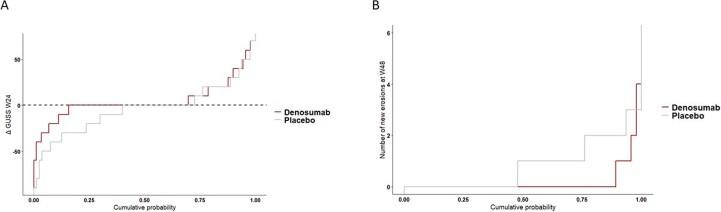
Erosive hand osteoarthritis (OA) is a prevalent and disabling disease with limited treatment options. Here we present the results of a monocentric, placebo-controlled, double-blind, randomized phase 2a clinical trial with denosumab, a receptor activator of nuclear factor-κB ligand inhibitor, evaluating the effects on structure modification in erosive hand OA. Patients were randomized to 48 weeks treatment with denosumab 60 mg every 3 months (n = 51, 41 females) or placebo (n = 49, 37 females). The primary (radiographic) endpoint was the change in the total Ghent University Scoring System (GUSS) at week 24, where positive changes correspond to remodeling and negative changes to erosive progression. Secondary endpoints were the change in the GUSS at week 48 and the number of new erosive joints at week 48 by the anatomical phase scoring system. Baseline mean GUSS (standard deviation) of target joints was 155.9 (69.3) in the denosumab group and 158.7 (46.8) in the placebo group. The primary endpoint was met with an estimated difference between groups of 8.9 (95% confidence interval (CI) 1.0 to 16.9; P = 0.024) at week 24. This effect was confirmed at week 48 (baseline adjusted GUSS (standard error of the mean) denosumab and placebo were 163.5 (2.9) and 149.2 (3.9), respectively; with an estimated difference between groups of 14.3 (95% CI 4.6 to 24.0; P = 0.003)). At patient level, more new erosive joints were developed in the placebo group compared with denosumab at week 48 (odds ratio 0.24 (95% CI 0.08 to 0.72); P = 0.009). More adverse events occurred in the placebo group (125 events in 44 patients (90%)) compared with the denosumab group (97 events in 41 patients (80%)). These results demonstrate that denosumab has structure modifying effects in erosive hand OA by inducing remodeling and preventing new erosive joints. EU Clinical Trials Register identifier 2015-003223-53 .
侵蚀性手骨关节炎(OA)是一种普遍且致残的疾病,其治疗选择有限。在这里,我们介绍了一项单中心、安慰剂对照、双盲、随机 2a 期临床试验的结果,该试验使用 denosumab(一种核因子-κB 配体激活剂抑制剂)评估其对侵蚀性手 OA 结构改变的影响。患者被随机分配接受 48 周的治疗,分别接受 denosumab 60mg 每 3 个月(n=51,41 名女性)或安慰剂(n=49,37 名女性)。主要(影像学)终点是第 24 周时总根特大学评分系统(GUSS)的变化,其中阳性变化对应于重塑,阴性变化对应于侵蚀进展。次要终点是第 48 周时 GUSS 的变化和第 48 周时解剖相评分系统中新的侵蚀性关节数。目标关节的基线平均 GUSS(标准差)在 denosumab 组为 155.9(69.3),在安慰剂组为 158.7(46.8)。第 24 周时,两组之间的主要终点估计差异为 8.9(95%置信区间(CI)为 1.0 至 16.9;P=0.024)。这一效果在第 48 周时得到了证实(经基线调整后的 GUSS(均数的标准误差)denosumab 和安慰剂分别为 163.5(2.9)和 149.2(3.9);两组之间的估计差异为 14.3(95%CI 为 4.6 至 24.0;P=0.003))。在患者水平上,与 denosumab 相比,安慰剂组在第 48 周时出现更多新的侵蚀性关节(比值比为 0.24(95%CI 为 0.08 至 0.72);P=0.009)。安慰剂组发生的不良事件多于 denosumab 组(44 名患者中发生 125 例事件(90%),而 41 名患者中发生 97 例事件(80%))。这些结果表明,denosumab 通过诱导重塑和预防新的侵蚀性关节来治疗侵蚀性手 OA,具有结构修饰作用。欧盟临床试验注册处标识符 2015-003223-53。


 Zotero 插件