
多组学质谱技术在化学暴露组学研究中的应用
[Application of multiomics mass spectrometry in the research of chemical exposome].
作者信息
Song Yuan-Yuan, Qi Zeng-Hua, Cai Zong-Wei
机构信息
State Key Laboratory of Environmental and Biological Analysis, Department of Chemistry, Hong Kong Baptist University, Hong Kong 999077, China.
School of Environmental Science and Engineering, Guangdong University of Technology, Guangzhou 510006, China.
出版信息
Se Pu. 2024 Feb;42(2):120-130. doi: 10.3724/SP.J.1123.2023.10001.
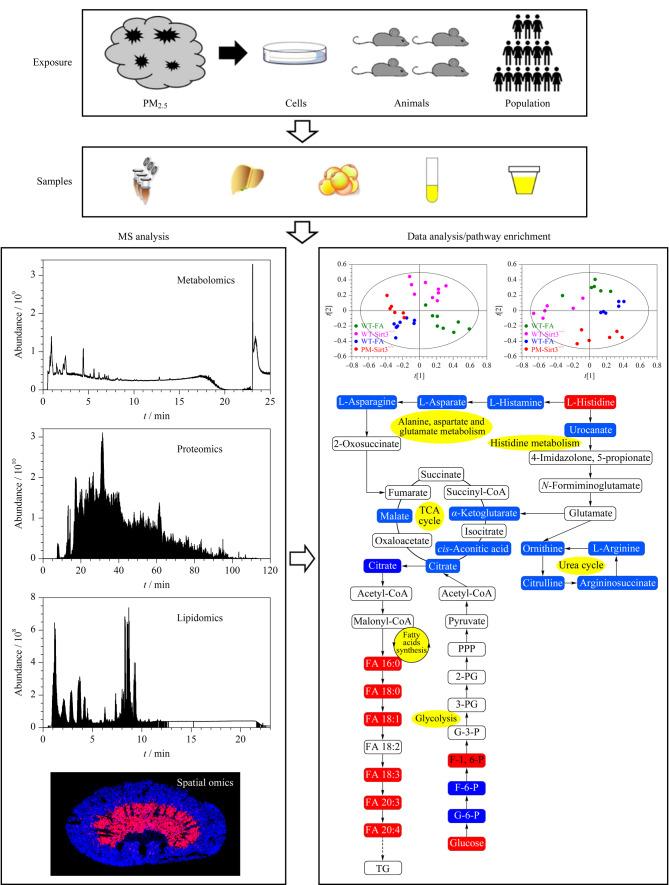
Environmental factors, such as environmental pollutants, behaviors, and lifestyles, are the leading causes of chronic noncommunicable diseases. Estimates indicate that approximately 50% of all deaths worldwide can be attributed to environmental factors. The exposome is defined as the totality of human environmental (i.e., all nongenetic) exposures from conception, including general external exposure (e.g., climate, education, and urban environment), specific external exposure (e.g., pollution, physical activity, and diet), and internal exposure (e.g., metabolic factors, oxidative stress, inflammation, and protein modification). As a new paradigm, this concept aims to comprehensively understand the link between human health and environmental factors. Therefore, a comprehensive measurement of the exposome, including accurate and reliable measurements of exposure to the external environment and a wide range of biological responses to the internal environment, is of great significance. The measurement of the general external exposome depends on advances in environmental sensors, personal-sensing technologies, and geographical information systems. The determination of exogenous chemicals to which individuals are exposed and endogenous chemicals that are produced or modified by external stressors relies on improvements in methodology and the development of instrumental approaches, including colorimetric, chromatographic, spectral, and mass-spectrometric methods. This article reviews the research strategies for chemical exposomes and summarizes existing exposome-measurement methods, focusing on mass spectrometry (MS)-based methods. The top-down and bottom-up approaches are commonly used in exposome studies. The bottom-up approach focuses on the identification of chemicals in the external environment (e.g., soil, water, diet, and air), whereas the top-down approach focuses on the evaluation of endogenous chemicals and biological processes in biological samples (e.g., blood, urine, and serum). Low- and high-resolution MS (LRMS and HRMS, respectively) have become the most popular methods for the direct measurement of exogenous and endogenous chemicals owing to their superior sensitivity, specificity, and dynamic range. LRMS has been widely applied in the targeted analysis of expected chemicals, whereas HRMS is a promising technique for the suspect and unknown screening of unexpected chemicals. The development of MS-based multiomics, including proteomics, metabolomics, epigenomics, and spatial omics, provides new opportunities to understand the effects of environmental exposure on human health. Metabolomics involves the sum of all low-molecular-weight metabolites in a living system. Nontargeted metabolomics can measure both endogenous and exogenous chemicals, which would directly link exposure to biological effects, internal dose, and disease pathobiology, whereas proteomics could play an important role in predicting potential adverse health outcomes and uncovering molecular mechanisms. MS imaging (MSI) is an emerging technique that provides unlabeled in-depth measurements of endogenous and exogenous molecules directly from tissue and cell sections without changing their spatial information. MSI-based spatial omics, which has been widely applied in biomarker discovery for clinical diagnosis, as well as drug and pollutant monitoring, is expected to become an effective method for exposome measurement. Integrating these response measurements from metabolomics, proteomics, spatial omics, and epigenomics will enable the generation of new hypotheses to discover the etiology of diseases caused by chemical exposure. Finally, we highlight the major challenges in achieving chemical exposome measurements.
环境因素,如环境污染物、行为和生活方式,是慢性非传染性疾病的主要成因。据估计,全球约50%的死亡可归因于环境因素。暴露组被定义为从受孕开始的人类环境(即所有非遗传)暴露的总和,包括一般外部暴露(如气候、教育和城市环境)、特定外部暴露(如污染、体育活动和饮食)以及内部暴露(如代谢因素、氧化应激、炎症和蛋白质修饰)。作为一种新的范式,这一概念旨在全面理解人类健康与环境因素之间的联系。因此,对暴露组进行全面测量,包括准确可靠地测量外部环境暴露以及对内部环境的广泛生物学反应,具有重要意义。一般外部暴露组的测量依赖于环境传感器、个人传感技术和地理信息系统的进展。确定个体接触的外源性化学物质以及由外部应激源产生或修饰的内源性化学物质,依赖于方法学的改进和仪器分析方法的发展,包括比色法、色谱法、光谱法和质谱法。本文综述了化学暴露组的研究策略,并总结了现有的暴露组测量方法,重点介绍基于质谱(MS)的方法。自上而下和自下而上的方法常用于暴露组研究。自下而上的方法侧重于识别外部环境(如土壤、水、饮食和空气)中的化学物质,而自上而下的方法侧重于评估生物样本(如血液、尿液和血清)中的内源性化学物质和生物过程。低分辨率和高分辨率质谱(分别为LRMS和HRMS)因其卓越的灵敏度、特异性和动态范围,已成为直接测量外源性和内源性化学物质最受欢迎的方法。LRMS已广泛应用于预期化学物质的靶向分析,而HRMS是一种用于可疑和意外化学物质未知筛选的有前景的技术。基于质谱的多组学技术的发展,包括蛋白质组学、代谢组学、表观基因组学和空间组学,为理解环境暴露对人类健康的影响提供了新的机会。代谢组学涉及生命系统中所有低分子量代谢物的总和。非靶向代谢组学可以测量内源性和外源性化学物质,这将直接将暴露与生物效应、内部剂量和疾病病理生物学联系起来,而蛋白质组学在预测潜在的不良健康结果和揭示分子机制方面可以发挥重要作用。质谱成像(MSI)是一种新兴技术,可直接从组织和细胞切片中对内源性和外源性分子进行无标记的深度测量,而不改变其空间信息。基于MSI的空间组学已广泛应用于临床诊断的生物标志物发现以及药物和污染物监测,有望成为一种有效的暴露组测量方法。整合来自代谢组学、蛋白质组学、空间组学和表观基因组学的这些反应测量结果,将能够产生新的假设,以发现化学暴露引起的疾病的病因。最后,我们强调了实现化学暴露组测量的主要挑战。


 Zotero 插件