
血管生成性NOTCH信号通路中的时空有序-无序转变控制细胞命运特化。
Spatial-temporal order-disorder transition in angiogenic NOTCH signaling controls cell fate specification.
作者信息
Kang Tae-Yun, Bocci Federico, Nie Qing, Onuchic José N, Levchenko Andre
机构信息
Department of Biomedical Engineering, Yale University, New Haven, United States.
Systems Biology Institute, Yale University, West Haven, United States.
出版信息
Elife. 2024 Feb 20;12:RP89262. doi: 10.7554/eLife.89262.
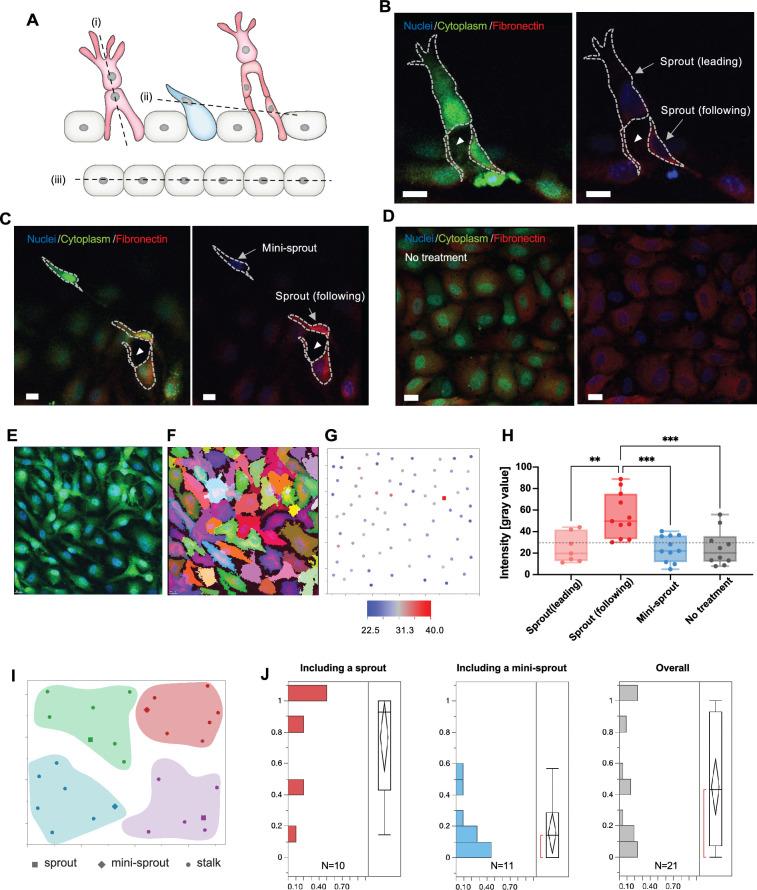
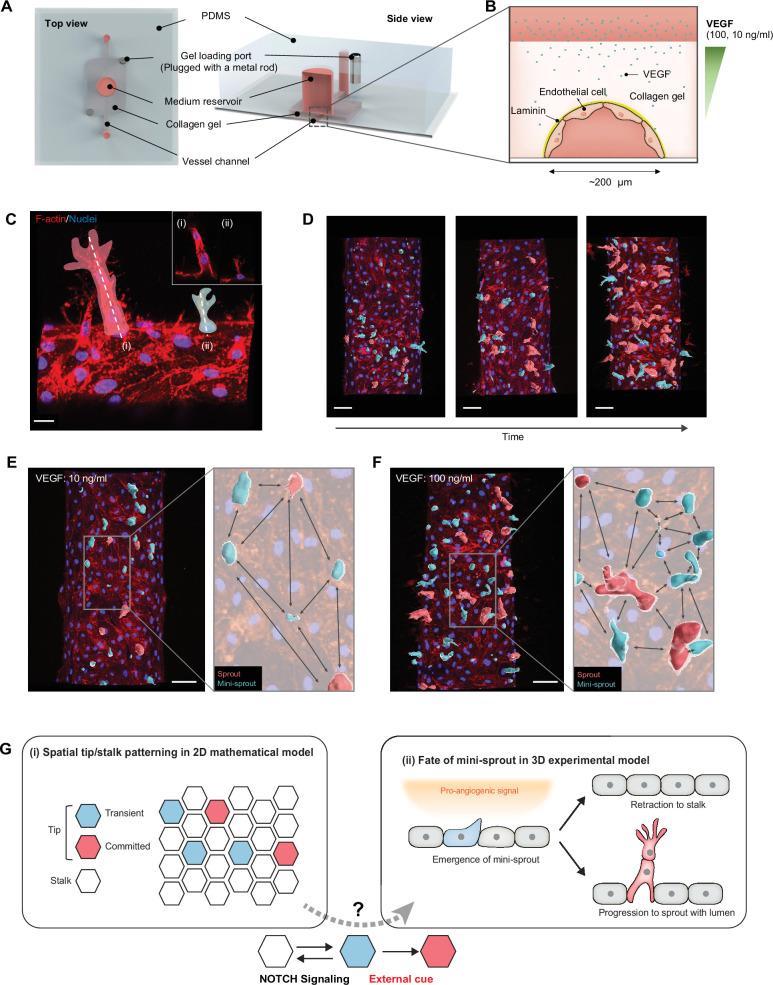
Angiogenesis is a morphogenic process resulting in the formation of new blood vessels from pre-existing ones, usually in hypoxic micro-environments. The initial steps of angiogenesis depend on robust differentiation of oligopotent endothelial cells into the Tip and Stalk phenotypic cell fates, controlled by NOTCH-dependent cell-cell communication. The dynamics of spatial patterning of this cell fate specification are only partially understood. Here, by combining a controlled experimental angiogenesis model with mathematical and computational analyses, we find that the regular spatial Tip-Stalk cell patterning can undergo an order-disorder transition at a relatively high input level of a pro-angiogenic factor VEGF. The resulting differentiation is robust but temporally unstable for most cells, with only a subset of presumptive Tip cells leading sprout extensions. We further find that sprouts form in a manner maximizing their mutual distance, consistent with a Turing-like model that may depend on local enrichment and depletion of fibronectin. Together, our data suggest that NOTCH signaling mediates a robust way of cell differentiation enabling but not instructing subsequent steps in angiogenic morphogenesis, which may require additional cues and self-organization mechanisms. This analysis can assist in further understanding of cell plasticity underlying angiogenesis and other complex morphogenic processes.
血管生成是一种形态发生过程,通常在缺氧微环境中由已有的血管形成新的血管。血管生成的初始步骤依赖于多能内皮细胞向Tip和Stalk表型细胞命运的强烈分化,这由NOTCH依赖的细胞间通讯控制。这种细胞命运特化的空间模式形成动态仅得到部分理解。在这里,通过将一个可控的实验性血管生成模型与数学和计算分析相结合,我们发现,在促血管生成因子VEGF相对较高的输入水平下,规则的空间Tip-Stalk细胞模式会经历从有序到无序的转变。由此产生的分化对大多数细胞来说是稳健的,但在时间上是不稳定的,只有一部分假定的Tip细胞会引导芽的延伸。我们进一步发现,芽以最大化它们相互距离的方式形成,这与一个可能依赖于纤连蛋白局部富集和消耗的类图灵模型一致。总之,我们的数据表明,NOTCH信号介导了一种稳健的细胞分化方式,它促成但不指导血管生成形态发生的后续步骤,而这可能需要额外的线索和自组织机制。该分析有助于进一步理解血管生成及其他复杂形态发生过程中潜在的细胞可塑性。


 Zotero 插件