
高 S100A9 水平预示着不良预后,S100A9 抑制剂帕奎莫德是治疗特发性肺纤维化的候选药物。
High S100A9 level predicts poor survival, and the S100A9 inhibitor paquinimod is a candidate for treating idiopathic pulmonary fibrosis.
机构信息
Department of Molecular and Internal Medicine, Graduate School of Biomedical and Health Sciences, Hiroshima University, Hiroshima, Japan.
Department of Molecular and Internal Medicine, Graduate School of Biomedical and Health Sciences, Hiroshima University, Hiroshima, Japan
出版信息
BMJ Open Respir Res. 2024 Feb 20;11(1):e001803. doi: 10.1136/bmjresp-2023-001803.
BACKGROUND
S100A9 is a damage-associated molecular pattern protein that may play an important role in the inflammatory response and fibrotic processes. Paquinimod is an immunomodulatory compound that prevents S100A9 activity. Its safety and pharmacokinetics have been confirmed in human clinical trials. In this study, we investigated the effects of paquinimod in preventing the development of lung fibrosis in vivo and examined the prognostic values of circulatory and lung S100A9 levels in patients with idiopathic pulmonary fibrosis (IPF).
METHODS
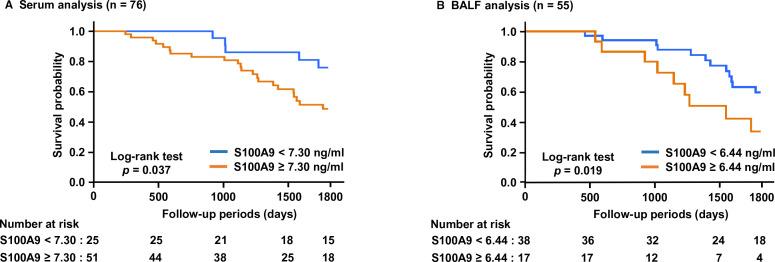
The expression and localisation of S100A9 and the preventive effect of S100A9 inhibition on fibrosis development were investigated in a mouse model of bleomycin-induced pulmonary fibrosis. In this retrospective cohort study, the S100A9 levels in the serum and bronchoalveolar lavage fluid (BALF) samples from 76 and 55 patients with IPF, respectively, were examined for associations with patient survival.
RESULTS
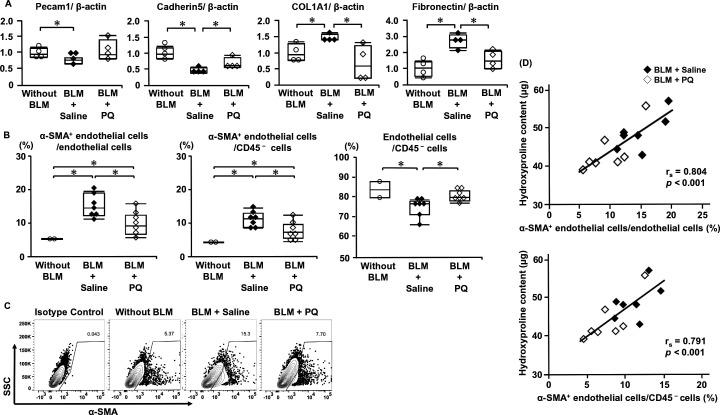
S100A9 expression was increased in the mouse lungs, especially in the inflammatory cells and fibrotic interstitium, after bleomycin administration. Treatment with paquinimod ameliorated fibrotic pathological changes and significantly reduced hydroxyproline content in the lung tissues of mice with bleomycin-induced pulmonary fibrosis. Additionally, we found that paquinimod reduced the number of lymphocytes and neutrophils in BALF and suppressed endothelial-mesenchymal transition in vivo. Kaplan-Meier curve analysis and univariate and multivariate Cox hazard proportion analyses revealed that high levels of S100A9 in the serum and BALF were significantly associated with poor prognoses in patients with IPF (Kaplan-Meier curve analysis: p=0.037 (serum) and 0.019 (BALF); multivariate Cox hazard proportion analysis: HR=3.88, 95% CI=1.06 to 14.21, p=0.041 (serum); HR=2.73, 95% CI=1.05 to 7.10, p=0.039 (BALF)).
CONCLUSIONS
The present results indicate that increased S100A9 expression is associated with IPF progression and that the S100A9 inhibitor paquinimod is a potential treatment for IPF.
背景
S100A9 是一种损伤相关分子模式蛋白,可能在炎症反应和纤维化过程中发挥重要作用。帕奎莫德是一种免疫调节化合物,可阻止 S100A9 活性。其在人体临床试验中的安全性和药代动力学已得到证实。在这项研究中,我们研究了帕奎莫德在体内预防肺纤维化发展中的作用,并检查了特发性肺纤维化(IPF)患者循环和肺 S100A9 水平的预后价值。
方法
在博来霉素诱导的肺纤维化小鼠模型中研究了 S100A9 的表达和定位以及 S100A9 抑制对纤维化发展的预防作用。在这项回顾性队列研究中,分别检查了 76 名和 55 名 IPF 患者的血清和支气管肺泡灌洗液(BALF)样本中的 S100A9 水平与患者生存的相关性。
结果
博来霉素给药后,小鼠肺部 S100A9 表达增加,尤其是在炎症细胞和纤维化间质中。帕奎莫德治疗可改善纤维化病理变化,并显著降低博来霉素诱导的肺纤维化小鼠肺组织羟脯氨酸含量。此外,我们发现帕奎莫德减少了 BALF 中的淋巴细胞和中性粒细胞数量,并抑制了体内内皮-间充质转化。Kaplan-Meier 曲线分析和单变量和多变量 Cox 风险比例分析表明,血清和 BALF 中 S100A9 水平高与 IPF 患者预后不良显著相关(Kaplan-Meier 曲线分析:p=0.037(血清)和 0.019(BALF);多变量 Cox 风险比例分析:HR=3.88,95%CI=1.06 至 14.21,p=0.041(血清);HR=2.73,95%CI=1.05 至 7.10,p=0.039(BALF))。
结论
本研究结果表明,S100A9 表达增加与 IPF 进展相关,S100A9 抑制剂帕奎莫德可能是治疗 IPF 的一种潜在方法。

 Zotero 插件