
新辅助化疗的年轻乳腺癌患者免疫炎症生物标志物与病理完全缓解及临床预后的相关性
Association of immune inflammatory biomarkers with pathological complete response and clinical prognosis in young breast cancer patients undergoing neoadjuvant chemotherapy.
作者信息
Li Fucheng, Wang Youyu, Dou He, Chen Xingyan, Wang Jianan, Xiao Min
机构信息
Department of Breast Surgery, Harbin Medical University Cancer Hospital, Harbin, China.
出版信息
Front Oncol. 2024 Feb 6;14:1349021. doi: 10.3389/fonc.2024.1349021. eCollection 2024.
BACKGROUND
The persistence of inflammatory stimulus has a tight relationship with the development of age-related diseases, ultimately resulting in a gradual escalation in the prevalence of tumors, but this phenomenon is rare in young cancer patients. Breast cancer arising in young women is characterized by larger tumor diameters and more aggressive subtypes, so neoadjuvant chemotherapy (NACT) can be especially appropriate for this population. Immune inflammatory biomarkers have been reportedly linked to the prognosis of some malignant tumor types, with varying results. In this study, we investigated the possible predictive value of blood-based markers in young breast cancer patients undergoing NACT, in addition to the association between the clinicopathological features and prognosis.
METHODS
From December 2011 to October 2018, a total of 215 young breast cancer patients referred to Harbin Medical University Cancer Hospital received NACT and surgery were registered in this retrospective study. The pretreatment complete blood counts were used to calculate the neutrophil-to-lymphocyte ratio (NLR), platelet-to-lymphocyte ratio (PLR), monocyte-to-lymphocyte ratio (MLR), and pan-immune-inflammation value (PIV).
RESULTS
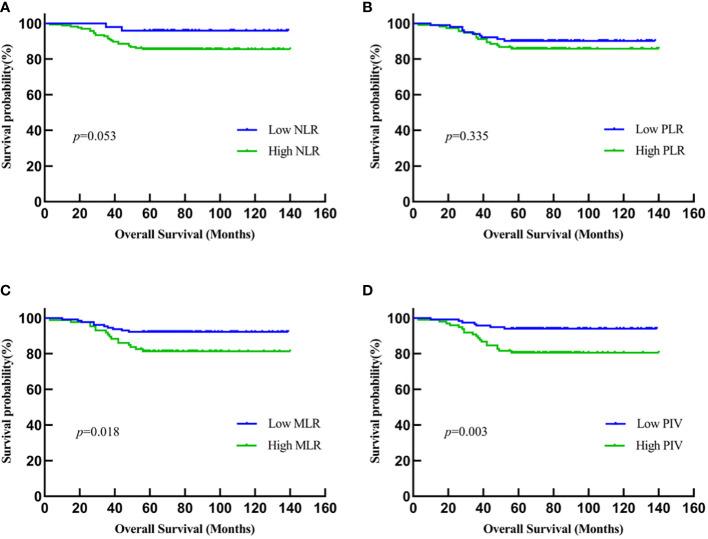
NLR, PLR, MLR, and PIV optimal cut-off values were 1.55, 130.66, 0.24, and 243.19, as determined by receiver operating characteristic analysis. Multivariate analysis revealed that PIV, HR status, HER-2 status, and Ki-67 index were all independent predictive factors for pathological complete response. Subgroup analysis revealed that young breast cancer patients in the population characterized by low PIV and HR negative group were more likely to get pCR (P=0.001). The five-year overall survival (OS) rate was 87.9%, and Cox regression models identified PIV as independently related to OS.
CONCLUSION
In the present study, the pretreatment PIV was found to be a useful prognostic indicator for pCR and long-term survival in young breast cancer patients undergoing NACT. High immune and inflammation levels, MLR and PIV were connected to poor clinical prognosis in young breast cancer patients. PIV is a promising biomarker to guide strategic decisions in treating young breast cancer.
背景
炎症刺激的持续存在与年龄相关疾病的发展密切相关,最终导致肿瘤患病率逐渐上升,但这种现象在年轻癌症患者中很少见。年轻女性患乳腺癌的特点是肿瘤直径较大且亚型更具侵袭性,因此新辅助化疗(NACT)对这一人群可能特别适用。据报道,免疫炎症生物标志物与某些恶性肿瘤类型的预后有关,结果各不相同。在本研究中,我们调查了血液标志物对接受NACT的年轻乳腺癌患者的可能预测价值,以及临床病理特征与预后之间的关联。
方法
2011年12月至2018年10月,共有215例转诊至哈尔滨医科大学附属肿瘤医院接受NACT和手术的年轻乳腺癌患者被纳入本回顾性研究。采用预处理全血细胞计数计算中性粒细胞与淋巴细胞比值(NLR)、血小板与淋巴细胞比值(PLR)、单核细胞与淋巴细胞比值(MLR)和全免疫炎症值(PIV)。
结果
通过受试者工作特征分析确定,NLR、PLR、MLR和PIV的最佳截断值分别为1.55、130.66、0.24和243.19。多因素分析显示,PIV、HR状态、HER-2状态和Ki-67指数均为病理完全缓解的独立预测因素。亚组分析显示,PIV低且HR阴性组的年轻乳腺癌患者更有可能获得pCR(P=0.001)。五年总生存率(OS)为87.9%,Cox回归模型确定PIV与OS独立相关。
结论
在本研究中,发现预处理PIV是接受NACT的年轻乳腺癌患者pCR和长期生存的有用预后指标。年轻乳腺癌患者的高免疫和炎症水平、MLR和PIV与不良临床预后相关。PIV是指导年轻乳腺癌治疗策略决策的有前景的生物标志物。
 Zotero 插件