
通过整合网络药理学分析和深度学习技术探索血根碱治疗骨质疏松症的机制
Exploring the Mechanisms of Sanguinarine in the Treatment of Osteoporosis by Integrating Network Pharmacology Analysis and Deep Learning Technology.
作者信息
Tang Yonghong, Zhou Daoqing, Gan Fengping, Yao Zhicheng, Zeng Yuqing
机构信息
Department of Orthopedics, The Sixth People's Hospital of Zhuji, Zhuji, Zhejiang, China.
Department of Orthopedics, Pan'an Hospital of Traditional Chinese Medicine, Jinhua, Zhejiang, China.
出版信息
Curr Comput Aided Drug Des. 2025;21(1):83-93. doi: 10.2174/0115734099282231240214095025.
BACKGROUND
Sanguinarine (SAN) has been reported to have antioxidant, antiinflammatory, and antimicrobial activities with potential for the treatment of osteoporosis (OP).
OBJECTIVE
This work purposed to unravel the molecular mechanisms of SAN in the treatment of OP.
METHODS
OP-related genes and SAN-related targets were predicted from public databases. Differential expression analysis and VennDiagram were adopted to detect SAN-related targets against OP. Protein-protein interaction (PPI) network was served for core target identification. Molecular docking and DeepPurpose algorithm were further adopted to investigate the binding ability between core targets and SAN. Gene pathway scoring of these targets was calculated utilizing gene set variation analysis (GSVA). Finally, we explored the effect of SAN on the expressions of core targets in preosteoblastic MC3T3-E1 cells.
RESULTS
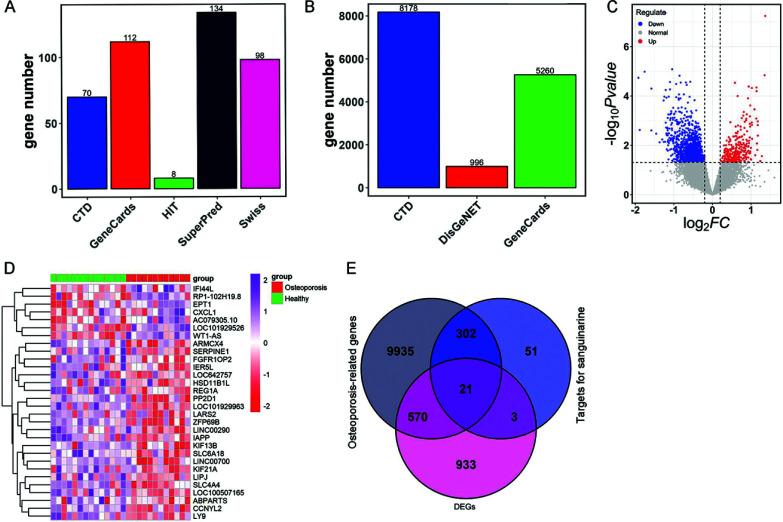
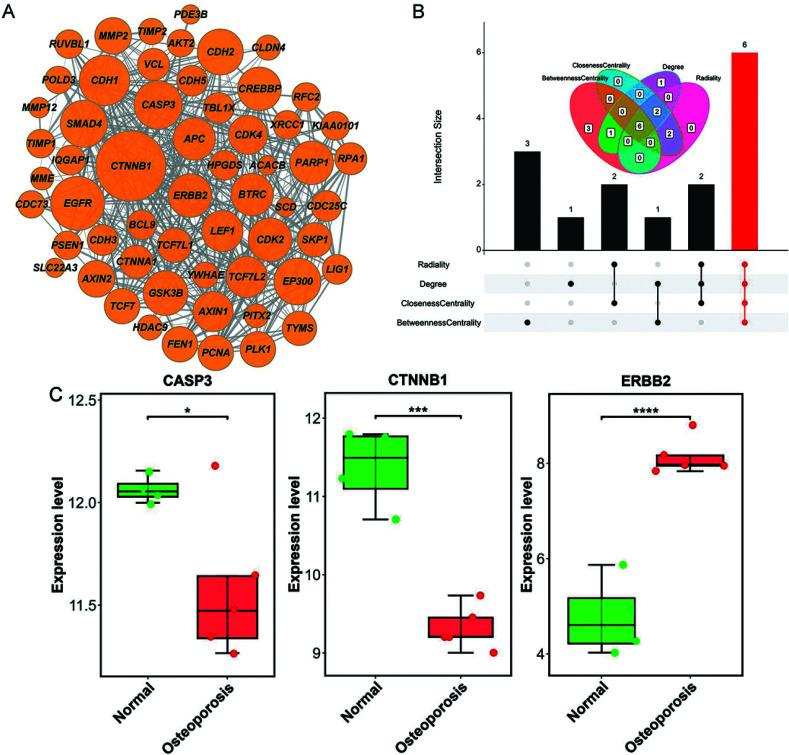
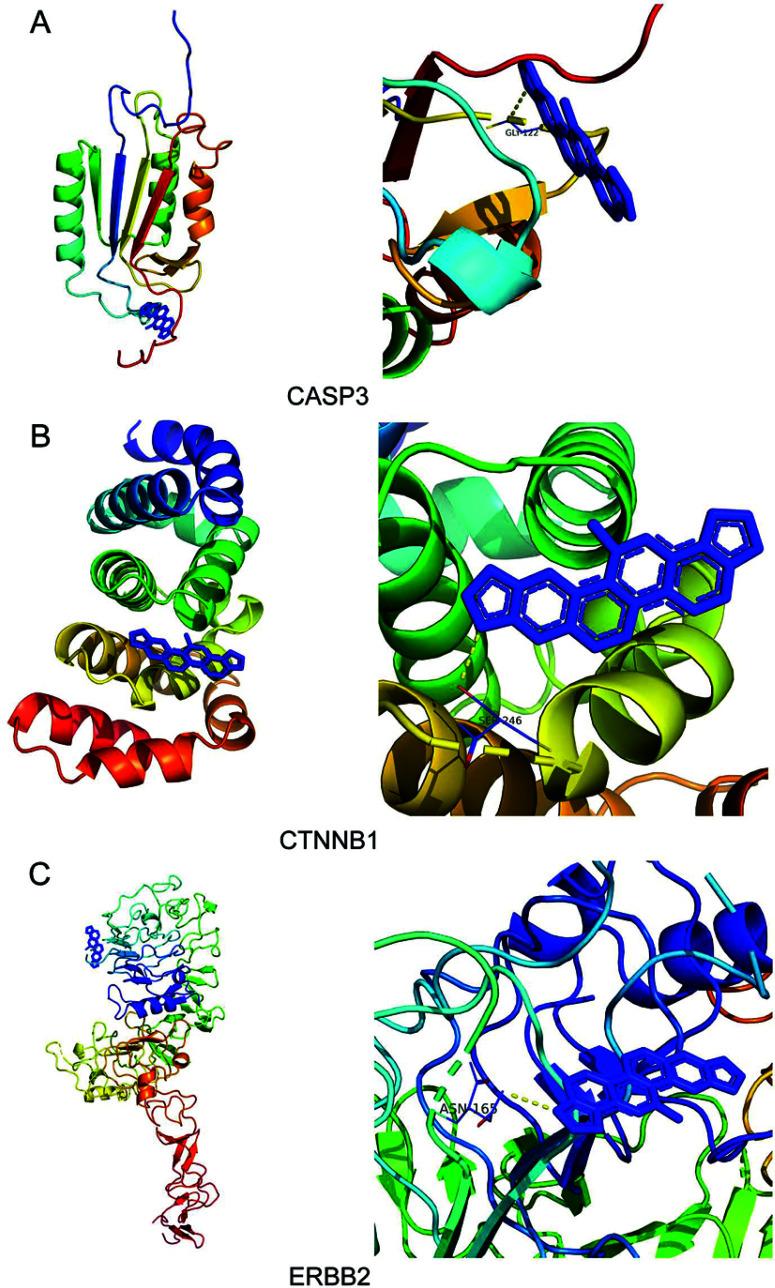
A total of 21 candidate targets of SAN against OP were acquired. Furthermore, six core targets were identified, among which CASP3, CTNNB1, and ERBB2 were remarkably differentially expressed in OP and healthy individuals. The binding energies of SAN with CASP3, CTNNB1, and ERBB2 were -6, -6.731, and -7.162 kcal/mol, respectively. Moreover, the GSVA scores of the Wnt/calcium signaling pathway were significantly lower in OP cases than in healthy individuals. In addition, the expression of CASP3 was positively associated with Wnt/calcium signaling pathway. CASP3 and ERBB2 were significantly lower expressed in SAN group than in DMSO group, whereas the expression of CTNNB1 was in contrast.
CONCLUSION
CASP3, CTNNB1, and ERBB2 emerge as potential targets of SAN in OP prevention and treatment.
背景
据报道,血根碱(SAN)具有抗氧化、抗炎和抗菌活性,具有治疗骨质疏松症(OP)的潜力。
目的
本研究旨在揭示SAN治疗OP的分子机制。
方法
从公共数据库中预测与OP相关的基因和与SAN相关的靶点。采用差异表达分析和维恩图检测SAN针对OP的相关靶点。利用蛋白质-蛋白质相互作用(PPI)网络鉴定核心靶点。进一步采用分子对接和深度目的算法研究核心靶点与SAN之间的结合能力。利用基因集变异分析(GSVA)计算这些靶点的基因通路评分。最后,我们探讨了SAN对前成骨细胞MC3T3-E1中核心靶点表达的影响。
结果
共获得21个SAN针对OP的候选靶点。此外,鉴定出6个核心靶点,其中CASP3、CTNNB1和ERBB2在OP患者和健康个体中差异显著。SAN与CASP3、CTNNB1和ERBB2的结合能分别为-6、-6.731和-7.162 kcal/mol。此外,OP患者中Wnt/钙信号通路的GSVA评分显著低于健康个体。此外,CASP3的表达与Wnt/钙信号通路呈正相关。SAN组中CASP3和ERBB2的表达明显低于二甲基亚砜(DMSO)组,而CTNNB1的表达则相反。
结论
CASP3、CTNNB1和ERBB2是SAN预防和治疗OP的潜在靶点。


 Zotero 插件