
长期来看,温度和营养物质会改变沿海大型无脊椎动物生物多样性组装过程中随机过程和确定性过程的相对重要性。
Temperature and nutrients alter the relative importance of stochastic and deterministic processes in the coastal macroinvertebrates biodiversity assembly on long-time scales.
作者信息
Wan Xuhao, Fang Yuan, Jiang Yueming, Lu Xueqiang, Zhu Lin, Feng Jianfeng
机构信息
College of Environmental Science and Engineering Nankai University Tianjin China.
出版信息
Ecol Evol. 2024 Feb 22;14(2):e11062. doi: 10.1002/ece3.11062. eCollection 2024 Feb.
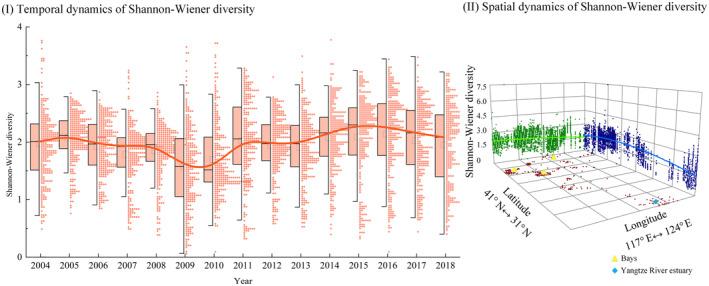
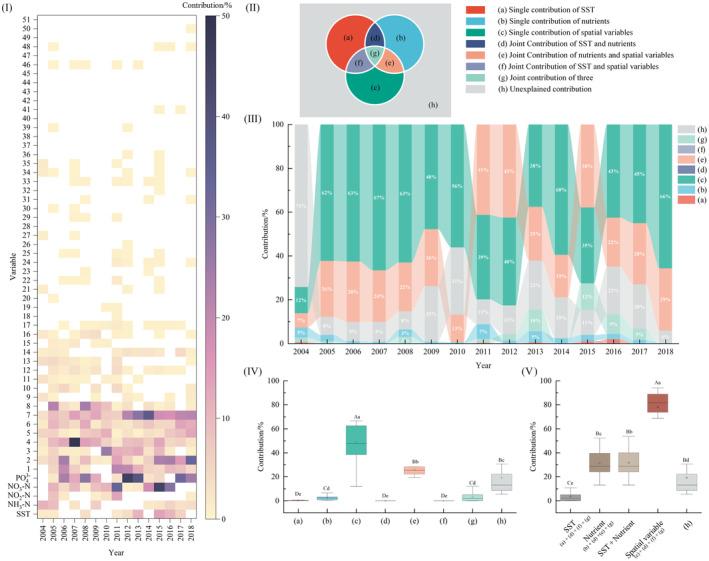
Macroinvertebrates play a vital role in coastal ecosystems and are an important indicator of ecosystem quality. Both anthropogenic activity and environmental changes may lead to significant changes in the marine macroinvertebrate community. However, the assembly process of benthic biodiversity and its mechanism driven by environmental factors at large scales remains unclear. Here, using the benthic field survey data of 15 years at large spatial and temporal scales from the Yellow Sea Large Marine Ecosystem, we investigated the relative importance of environmental selection, dispersal processes, random-deterministic processes of macroinvertebrates community diversity assembly, and the responses of this relative importance driven by temperature and nutrients. Results showed that the macroinvertebrates community diversity is mainly affected by dispersal. Nitrogen and phosphorus are the most important negative factors among environmental variables, while geographical distance is the main limiting factor of β diversity. Within the range of 0.35-0.70 mg/L of nutrients, increasing nutrient concentration can significantly facilitate the contribution of the decay effect to β diversity. Within the temperature range studied (15.0-18.0°C), both warming and cooling can lead to a greater tendency for species diversity assembly processes to be dominated by deterministic processes. The analysis contributes to a better understanding of the assembly process of the diversity of coastal marine macroinvertebrates communities and how they adapt to global biogeochemical processes.
大型无脊椎动物在沿海生态系统中发挥着至关重要的作用,是生态系统质量的重要指标。人为活动和环境变化都可能导致海洋大型无脊椎动物群落发生显著变化。然而,大尺度下底栖生物多样性的组装过程及其受环境因素驱动的机制仍不清楚。在此,利用黄海大海洋生态系统15年大时空尺度的底栖生物实地调查数据,我们研究了环境选择、扩散过程、大型无脊椎动物群落多样性组装的随机-确定性过程的相对重要性,以及温度和营养物质驱动下这种相对重要性的响应。结果表明,大型无脊椎动物群落多样性主要受扩散影响。氮和磷是环境变量中最重要的负面因素,而地理距离是β多样性的主要限制因素。在营养物质浓度为0.35-0.70mg/L的范围内,增加营养物质浓度可显著促进衰减效应对β多样性的贡献。在所研究的温度范围内(15.0-18.0°C),升温或降温都可能导致物种多样性组装过程更倾向于由确定性过程主导。该分析有助于更好地理解沿海海洋大型无脊椎动物群落多样性的组装过程以及它们如何适应全球生物地球化学过程。




 Zotero 插件