
高脂饮食(HFD)诱导中华鳖肝脏组织核心时钟基因和脂质代谢基因的昼夜节律改变。
Circadian Rhythm Alteration of the Core Clock Genes and the Lipid Metabolism Genes Induced by High-Fat Diet (HFD) in the Liver Tissue of the Chinese Soft-Shelled Turtle ().
机构信息
School of Medical Technology, Shaoyang University, Shaoyang 422000, China.
Fisheries Research Institute of Hunan Province, Changsha 410153, China.
出版信息
Genes (Basel). 2024 Jan 25;15(2):157. doi: 10.3390/genes15020157.
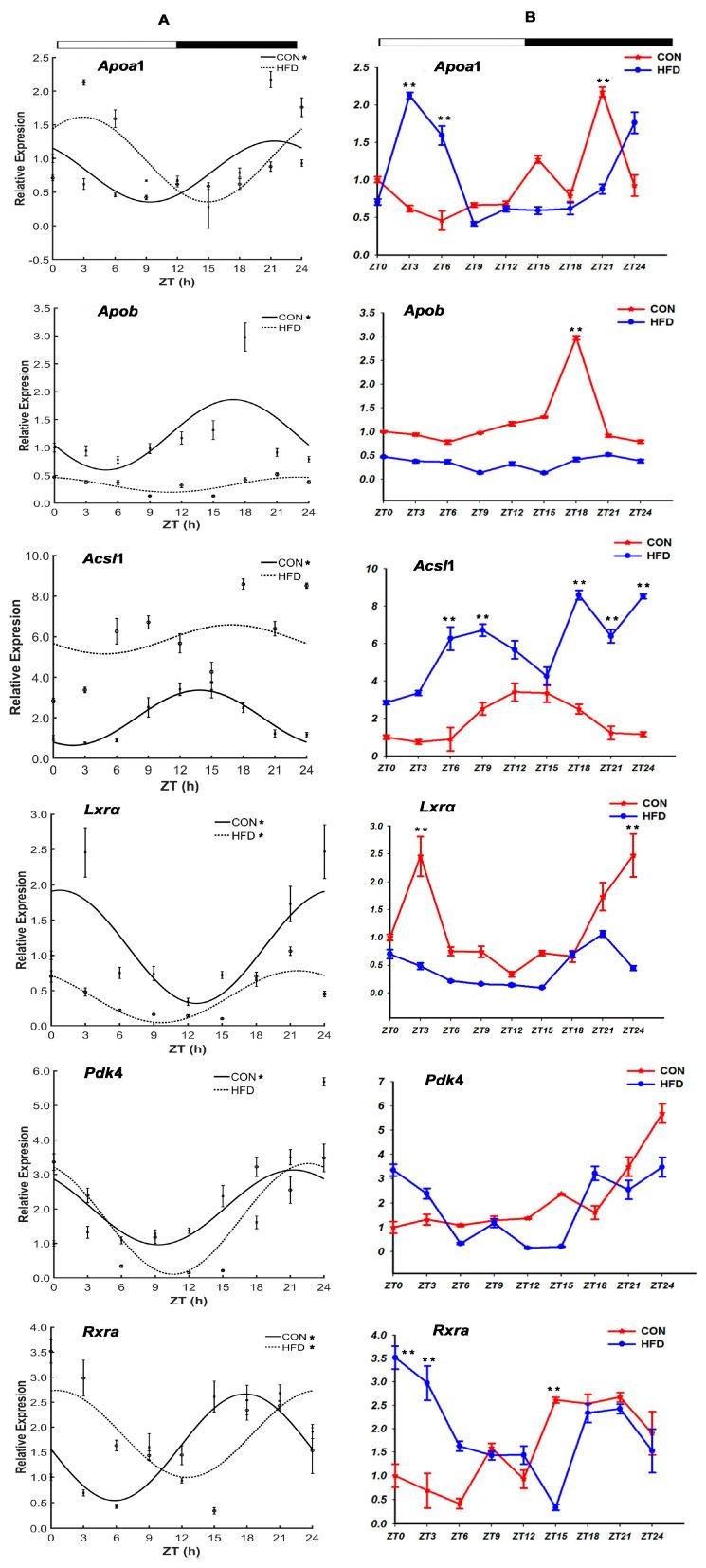
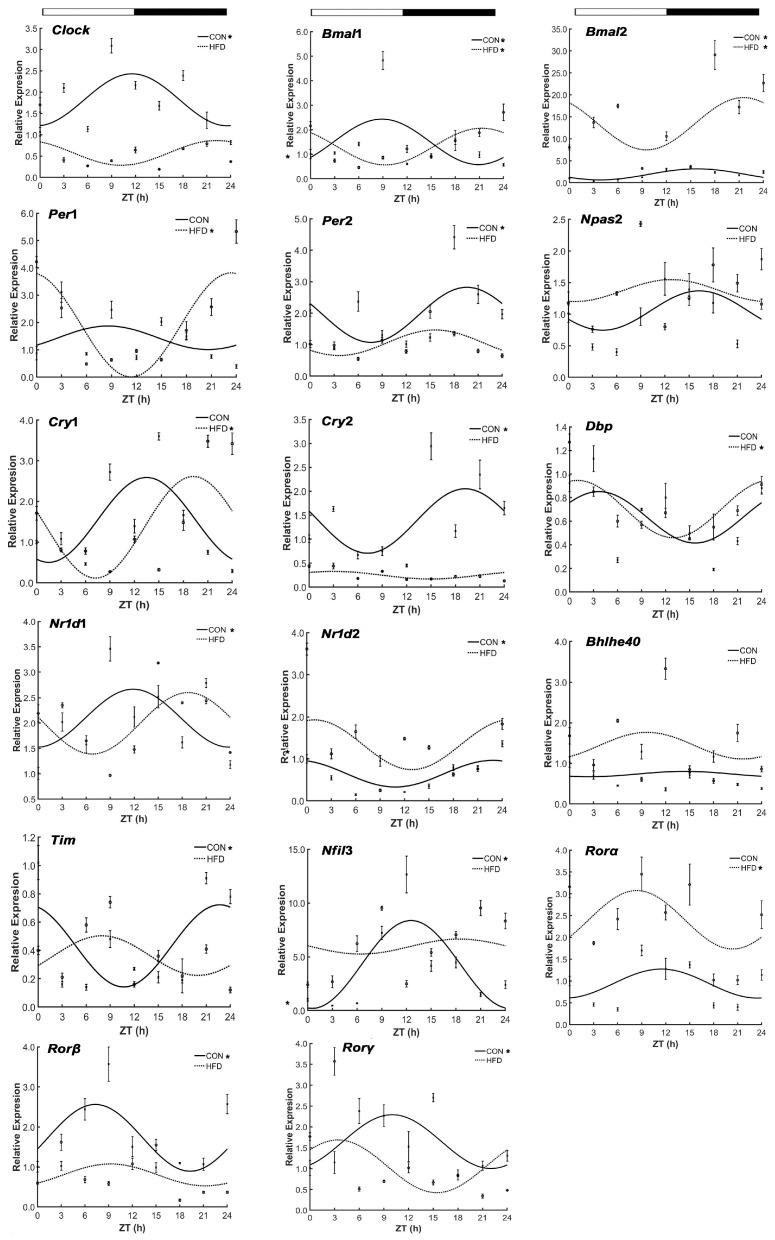
Physiology disorders of the liver, as it is an important tissue in lipid metabolism, can cause fatty liver disease. The mechanism might be regulated by 17 circadian clock genes and 18 fat metabolism genes, together with a high-fat diet (HFD). Due to their rich nutritional and medicinal value, Chinese soft-shelled turtles () are very popular among the Chinese people. In the study, we aimed to investigate the influence of an HFD on the daily expression of both the core clock genes and the lipid metabolism genes in the liver tissue of the turtles. The two diets were formulated with 7.98% lipid (the CON group) and 13.86% lipid (the HFD group) to feed 180 juvenile turtles, which were randomly divided into two groups with three replicates per group and 30 turtles in each replicate for six weeks, and the diet experiment was administrated with a photophase regimen of a 24 h light/dark (12L:12D) cycle. At the end of the experiment, the liver tissue samples were collected from nine turtles per group every 3 h (zeitgeber time: ZT 0, 3, 6, 9, 12, 15, 18, 21 and 24) for 24 h to investigate the daily expression and correlation analysis of these genes. The results showed that 11 core clock genes [i.e., circadian locomotor output cycles kaput (), brain and muscle arnt-like protein 1 and 2 (1/2), timeless (, cryptochrome 1 (2), period2 (2), nuclear factor IL-3 gene (3), nuclear receptor subfamily 1, treatment D, member 1 and 2 (1/2) and retinoic acid related orphan receptor α/β/γ (/)] exhibited circadian oscillation, but 6 genes did not, including neuronal PAS domain protein 2 (2), 1, 1, basic helix-loop-helix family, member E40 (40), and D-binding protein (), and 16 lipid metabolism genes including fatty acid synthase (), diacylglycerol acyltransferase 1 (1), 3-hydroxy-3-methylglutaryl-CoA reductase (), Low-density lipoprotein receptor-related protein 1-like (1), Lipin 1 (1), Carnitine palmitoyltransferase 1A (1a), Peroxisome proliferator activation receptor α, β and γ (//), Sirtuin 1 (1), (1), Apolipoprotein B (), Pyruvate Dehydrogenase kinase 4 (4), Acyl-CoA synthase long-chain1 (1), Liver X receptors α () and Retinoid X receptor, α () also demonstrated circadian oscillations, but 2 genes did not, and in the liver tissues of the CON group. However, in the HFD group, the circadian rhythms' expressional patterns were disrupted for the eight core clock genes, , 2, 2, 3, 11/2 and /, and the peak expression of 1/2 and showed delayed or advanced phases. Furthermore, four genes (1, 1, and ) displayed no diurnal rhythm in the CON group; instead, significant circadian rhythms appeared in the HFD group. Meanwhile, the HFD disrupted the circadian rhythm expressions of seven fat metabolism genes (, 1a, 1, 1, , 4 and 1). Meanwhile, the other nine genes in the HFD group also showed advanced or delayed expression peaks compared to the CON group. Most importantly of all, there were remarkably positive or negative correlations between the core clock genes and the lipid metabolism genes, and their correlation relationships were altered by the HFD. To sum up, circadian rhythm alterations of the core clock genes and the lipid metabolism genes were induced by the high-fat diet (HFD) in the liver tissues of . This result provides experimental and theoretical data for the mass breeding and production of in our country.
肝脏的生理学紊乱,因为它是脂质代谢的重要组织,可能导致脂肪肝疾病。其机制可能通过 17 个生物钟基因和 18 个脂肪代谢基因来调节,同时还有高脂肪饮食(HFD)。由于具有丰富的营养和药用价值,中华鳖()在中国非常受欢迎。在研究中,我们旨在研究 HFD 对鳖肝脏组织中核心生物钟基因和脂质代谢基因日常表达的影响。两种饮食分别用 7.98%的脂质(CON 组)和 13.86%的脂质(HFD 组)配制,喂养 180 只幼鳖,随机分为两组,每组三个重复,每个重复 30 只鳖,进行六周的饮食实验,并采用 24 小时光/暗(12L:12D)周期的光相方案。在实验结束时,从每组中采集 9 只鳖的肝组织样本,每隔 3 小时采集一次(时相时间:ZT 0、3、6、9、12、15、18、21 和 24),进行 24 小时,以研究这些基因的日常表达和相关性分析。结果表明,11 个核心生物钟基因(即 circadian locomotor output cycles kaput ()、brain and muscle arnt-like protein 1 and 2 (1/2)、 timeless ()、cryptochrome 1 (2)、period2 (2)、nuclear factor IL-3 gene (3)、nuclear receptor subfamily 1, treatment D, member 1 and 2 (1/2)、和 retinoic acid related orphan receptor α/β/γ ())表现出昼夜节律波动,但有 6 个基因没有,包括神经元 PAS 域蛋白 2 (2)、1、1、basic helix-loop-helix family, member E40 (40)、和 D-binding protein (),以及 16 个脂质代谢基因,包括脂肪酸合酶()、二酰甘油酰基转移酶 1 (1)、3-羟-3-甲基戊二酰基辅酶 A 还原酶()、低密度脂蛋白受体相关蛋白 1 样(1)、脂肪酰基辅酶 A 合成酶 1A (1a)、过氧化物酶体增殖物激活受体α、β和γ (//)、Sirtuin 1 (1)、(1)、载脂蛋白 B (1)、丙酮酸脱氢酶激酶 4 (4)、酰基辅酶 A 合成酶长链 1 (1)、肝 X 受体 α ()和视黄醇 X 受体,α (),也表现出昼夜节律波动,但 2 个基因没有,即和。然而,在 HFD 组中,八个核心生物钟基因、、2、2、3、11/2 和 /的昼夜节律表达模式被打乱,1/2 和的峰值表达出现延迟或提前相位。此外,在 CON 组中,有四个基因(1、1、和)没有昼夜节律;相反,在 HFD 组中出现了显著的昼夜节律。同时,HFD 打乱了七个脂肪代谢基因(、1a、1、1、、4 和 1)的昼夜节律表达。同时,HFD 组的其他九个基因的表达峰值也与 CON 组相比出现了提前或延迟。最重要的是,核心生物钟基因和脂质代谢基因之间存在显著的正相关或负相关关系,它们的相关关系被 HFD 改变。总之,高脂肪饮食(HFD)在中华鳖肝脏组织中诱导了核心生物钟基因和脂质代谢基因的昼夜节律改变。这一结果为我国中华鳖的大规模养殖和生产提供了实验和理论数据。



 Zotero 插件