
不同食物组野生蝙蝠不同器官中维生素E的分布与利用
Distribution and Utilization of Vitamin E in Different Organs of Wild Bats from Different Food Groups.
作者信息
Mena Canata Diego Antonio, Benfato Mara Silveira, Pereira Francielly Dias, Pereira María João Ramos, Rampelotto Pabulo Henrique
机构信息
Biophysics Department, Universidade Federal do Rio Grande do Sul, Porto Alegre 91501-970, RS, Brazil.
Graduate Program in Cellular and Molecular Biology, Universidade Federal do Rio Grande do Sul, Porto Alegre 91501-970, RS, Brazil.
出版信息
Life (Basel). 2024 Feb 17;14(2):266. doi: 10.3390/life14020266.
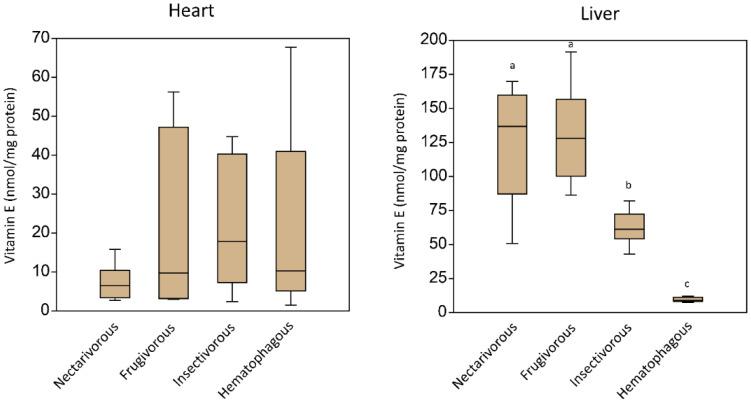
In this work, we examined the levels of vitamin E in the heart, liver, and kidneys of four species of adult male bats with distinct feeding habits. Our results indicate consistent vitamin E levels in the heart across all four bat species, suggesting the presence of regulatory mechanisms. Additionally, the liver displayed notably higher vitamin E levels in nectarivorous and frugivorous bats, while hematophagous bats exhibited lower levels, indicating a link between dietary intake and liver vitamin E levels. Furthermore, correlation analysis provided additional insights into the relationships between vitamin E and key antioxidant parameters in the livers of bats. On the other hand, no correlation was observed between vitamin E and key antioxidant parameters in the heart. Intriguingly, vitamin E was not detected in the kidneys, likely due to physiological factors and the prioritization of vitamin E mobilization in the heart, where it serves critical physiological functions. This unexpected absence of vitamin E in bat kidneys highlights the unique metabolic demands and prioritization of vitamin mobilization in wild animals like bats, compared to conventional animal models. These findings provide insight into the intricate distribution and utilization of vitamin E in bats, emphasizing the influence of dietary intake and metabolic adaptations on vitamin E levels in different organs.
在这项研究中,我们检测了四种具有不同食性的成年雄性蝙蝠的心脏、肝脏和肾脏中的维生素E水平。我们的结果表明,所有四种蝙蝠的心脏中维生素E水平一致,这表明存在调节机制。此外,食蜜和食果蝙蝠的肝脏中维生素E水平显著较高,而吸血蝙蝠的维生素E水平较低,这表明饮食摄入与肝脏维生素E水平之间存在联系。此外,相关性分析为蝙蝠肝脏中维生素E与关键抗氧化参数之间的关系提供了更多见解。另一方面,在心脏中未观察到维生素E与关键抗氧化参数之间的相关性。有趣的是,在肾脏中未检测到维生素E,这可能是由于生理因素以及维生素E在心脏中优先被调动,在心脏中它发挥着关键的生理功能。蝙蝠肾脏中维生素E的这种意外缺失凸显了与传统动物模型相比,蝙蝠等野生动物独特的代谢需求和维生素调动的优先级。这些发现为蝙蝠体内维生素E的复杂分布和利用提供了见解,强调了饮食摄入和代谢适应对不同器官中维生素E水平的影响。
 Zotero 插件