
甲胎蛋白预测免疫检查点抑制剂治疗胃癌患者的疗效。
Alpha-fetoprotein predicts the treatment efficacy of immune checkpoint inhibitors for gastric cancer patients.
机构信息
Department of Immunology and Rheumatology, The Fourth Hospital of Hebei Medical University, 12 Jiankang Road, 050011, Shijiazhuang, Hebei, P.R. China.
Department of Thoracic Surgery, The Fourth Hospital of Hebei Medical University, 050011, Shijiazhuang, Hebei, P.R. China.
出版信息
BMC Cancer. 2024 Feb 26;24(1):266. doi: 10.1186/s12885-024-11999-z.
BACKGROUND
Immune checkpoint inhibitors (ICIs) are commonly used in conjunction with chemotherapy to improve treatment outcomes for patients with gastric cancer. Since AFP could influence immunity by both inhibiting natural killer (NK) cells and regulating negatively the function of dendritic cells, we evaluated the influence of baseline serum alpha-fetoprotein (AFP) levels on the curative effect of ICIs in advanced gastric cancer (AGC) patients.
METHODS
A retrospective analysis was conducted on 158 AGC patients who underwent ICI treatment. The patients were divided into high and low groups based on the AFP threshold of 20 ng/ml. The efficacy of ICI treatment was assessed using objective response rate (ORR), disease control rate (DCR), progression-free survival (PFS), and overall survival (OS).
RESULTS
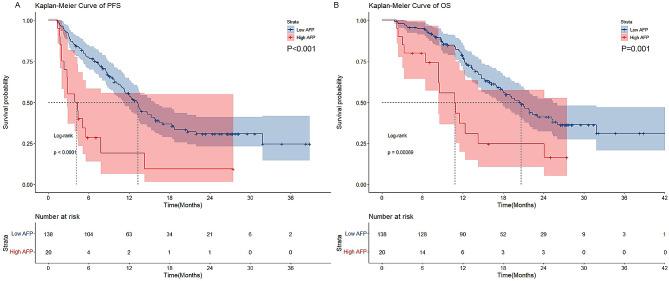
The higher levels of baseline AFP were found to be associated with a decrease in the effectiveness of ICIs, as evidenced by a DCR of 50.0% in the group with high AFP levels compared to 87.7% in the group with low AFP levels (P < 0.001). Further analysis using Kaplan-Meier survival techniques indicated that a high AFP level was linked to shorter progression-free survival (PFS) (P < 0.001) and overall survival (OS) (P = 0.001) in AGC individuals receiving ICIs. After propensity score matching, a log rank test revealed that the high AFP group had a decrease in median PFS (P = 0.011) and median OS (P = 0.036) compared to the low AFP group. The high AFP levels also showed its association with shorter PFS and OS in the subgroup analysis of ICI plus chemotherapy patients.
CONCLUSIONS
Baseline AFP levels may predict immune checkpoint inhibitor treatment efficacy in AGC patients.
背景
免疫检查点抑制剂(ICIs)常用于与化疗联合使用,以提高胃癌患者的治疗效果。由于 AFP 可以通过抑制自然杀伤(NK)细胞和负调控树突状细胞的功能来影响免疫,我们评估了基线血清甲胎蛋白(AFP)水平对晚期胃癌(AGC)患者接受 ICI 治疗效果的影响。
方法
对 158 例接受 ICI 治疗的 AGC 患者进行回顾性分析。根据 AFP 阈值 20ng/ml 将患者分为高和低两组。采用客观缓解率(ORR)、疾病控制率(DCR)、无进展生存期(PFS)和总生存期(OS)评估 ICI 治疗的疗效。
结果
较高的基线 AFP 水平与 ICI 疗效降低相关,高 AFP 组的 DCR 为 50.0%,而低 AFP 组为 87.7%(P<0.001)。Kaplan-Meier 生存分析进一步表明,高 AFP 水平与接受 ICI 的 AGC 个体较短的无进展生存期(PFS)(P<0.001)和总生存期(OS)(P=0.001)相关。在进行倾向评分匹配后,对数秩检验显示高 AFP 组的中位 PFS(P=0.011)和中位 OS(P=0.036)较低 AFP 组降低。亚组分析中,高 AFP 水平也与 ICI 联合化疗患者的较短 PFS 和 OS 相关。
结论
基线 AFP 水平可能预测 AGC 患者接受 ICI 治疗的疗效。
 Zotero 插件