
一项队列研究,旨在调查解剖性肺切除术后呼吸困难的演变情况及相关因素。
Cohort study investigating evolution and factors associated with dyspnoea after anatomic lung resection.
作者信息
Pompili Cecilia, Tariq Javeria, Dalmia Sanjush, Harle Amelie, Gilbert Alexandra, Valuckiene Laura, Brunelli Alessandro
机构信息
Section of Patient Centred Outcomes Research, Leeds Institute for Medical Research, St James's University Hospital, University of Leeds, Leeds, UK.
Thoracic Surgery Unit, University Hospital, Verona, Italy.
出版信息
J Thorac Dis. 2024 Jan 30;16(1):113-122. doi: 10.21037/jtd-23-835. Epub 2024 Jan 15.
BACKGROUND
Dyspnoea is common following surgical resection for non-small cell lung cancer (NSCLC). The effects range from reduced quality of life to impact on adjuvant therapy outcomes. Currently, dyspnoea beyond the immediate postoperative phase and risk factors are not well characterised. We hope to assess the evolution of patient-reported dyspnoea after anatomic lung resection and associated factors.
METHODS
Single-centre cohort study with analysis on data collected longitudinally of 131 patients undergoing anatomic lung resections for NSCLC between September 2014 and December 2018. The European Organization for Research and Treatment Lung Cancer-specific Quality of Life Questionnaire Dyspnoea Scale was used to measure dyspnoea before and after surgery. Multivariable regression analysis was used to identify factors associated with clinically meaningful perioperative changes in dyspnoea at 6-12 months.
RESULTS
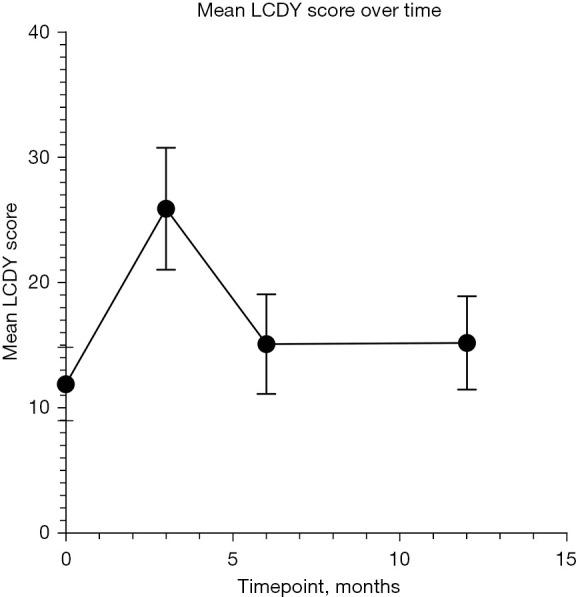
Mean Dyspnoea Scale scores preoperatively and 6-12 months after resection were 12.6 (standard deviation 17.4) and 17.9 (standard deviation 20.5), respectively. Of all patients 31% experienced a clinically meaningful increase in dyspnoea, defined as >10 points between Dyspnoea Scale scores preoperatively and at 6-12 months. Comparatively, 71% of patients without preoperative symptoms of dyspnoea developed a clinically meaningful increase of dyspnoea postoperatively. After adjusting the analysis for baseline factors and preoperative Dyspnoea Scale score, female sex remained the only patient factor associated with increased postoperative dyspnoea at 6-12 months after surgery (P=0.046). A total of 34% of patients reported increased dyspnoea after lobectomies and 9% after segmentectomies (P=0.014). Segmentectomy (as opposed to larger resections) was the only surgical factor associated with lower risk of increased dyspnoea (P=0.057).
CONCLUSIONS
A clinically meaningful increase in dyspnoea is frequent after lung resection. Postoperative evolution of dyspnoea is non-predictable using objective baseline factors highlighting the importance of patient reported symptoms and involvement in clinical consultation.
背景
非小细胞肺癌(NSCLC)手术切除后呼吸困难很常见。其影响范围从生活质量下降到影响辅助治疗效果。目前,术后即刻阶段以外的呼吸困难及其危险因素尚未得到充分描述。我们希望评估解剖性肺切除术后患者报告的呼吸困难的演变情况及相关因素。
方法
单中心队列研究,对2014年9月至2018年12月期间接受NSCLC解剖性肺切除的131例患者纵向收集的数据进行分析。使用欧洲癌症研究与治疗组织肺癌特异性生活质量问卷呼吸困难量表来测量手术前后的呼吸困难情况。多变量回归分析用于确定与术后6至12个月呼吸困难的临床有意义的围手术期变化相关的因素。
结果
术前和切除术后6至12个月的平均呼吸困难量表评分分别为12.6(标准差17.4)和17.9(标准差20.5)。在所有患者中,31%经历了临床上有意义的呼吸困难增加,定义为术前和术后6至12个月呼吸困难量表评分之间相差>10分。相比之下,71%术前无呼吸困难症状的患者术后出现了临床上有意义的呼吸困难增加。在对基线因素和术前呼吸困难量表评分进行分析调整后,女性仍然是术后6至12个月与术后呼吸困难增加相关的唯一患者因素(P = 0·046)。共有34%的患者报告肺叶切除术后呼吸困难增加,肺段切除术后为9%(P = 0·014)。肺段切除术(与更大范围的切除术相比)是与呼吸困难增加风险较低相关的唯一手术因素(P = 0·057)。
结论
肺切除术后临床上有意义的呼吸困难增加很常见。使用客观基线因素无法预测呼吸困难的术后演变情况,这突出了患者报告症状及参与临床咨询的重要性。
 Zotero 插件