
将线粒体表观遗传学整合到情绪障碍研究中:最新综述
Integrating mitoepigenetics into research in mood disorders: a state-of-the-art review.
作者信息
Ceylan Deniz, Arat-Çelik Hidayet Ece, Aksahin Izel Cemre
机构信息
Department of Psychiatry, School of Medicine, Koç University, Istanbul, Türkiye.
Koç University Research Center for Translational Medicine (KUTTAM), Affective Laboratory, Istanbul, Türkiye.
出版信息
Front Physiol. 2024 Feb 8;15:1338544. doi: 10.3389/fphys.2024.1338544. eCollection 2024.
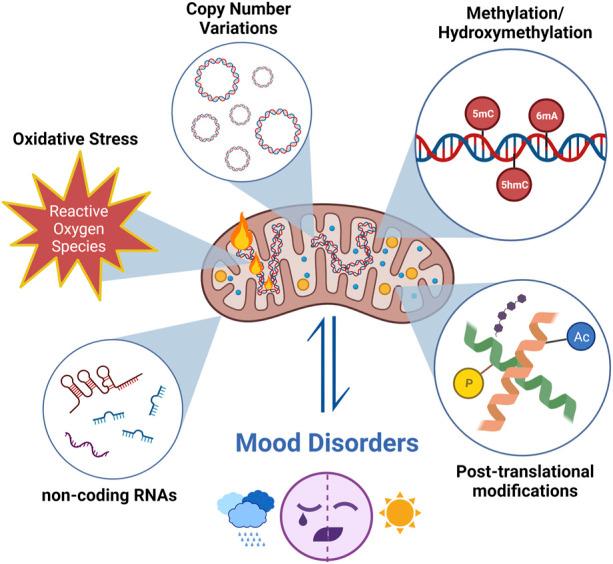
Mood disorders, including major depressive disorder and bipolar disorder, are highly prevalent and stand among the leading causes of disability. Despite the largely elusive nature of the molecular mechanisms underpinning these disorders, two pivotal contributors-mitochondrial dysfunctions and epigenetic alterations-have emerged as significant players in their pathogenesis. This state-of-the-art review aims to present existing data on epigenetic alterations in the mitochondrial genome in mood disorders, laying the groundwork for future research into their pathogenesis. Associations between abnormalities in mitochondrial function and mood disorders have been observed, with evidence pointing to notable changes in mitochondrial DNA (mtDNA). These changes encompass variations in copy number and oxidative damage. However, information on additional epigenetic alterations in the mitochondrial genome remains limited. Recent studies have delved into alterations in mtDNA and regulations in the mitochondrial genome, giving rise to the burgeoning field of mitochondrial epigenetics. Mitochondrial epigenetics encompasses three main categories of modifications: mtDNA methylation/hydroxymethylation, modifications of mitochondrial nucleoids, and mitochondrial RNA alterations. The epigenetic modulation of mitochondrial nucleoids, lacking histones, may impact mtDNA function. Additionally, mitochondrial RNAs, including non-coding RNAs, present a complex landscape influencing interactions between the mitochondria and the nucleus. The exploration of mitochondrial epigenetics offers valuable perspectives on how these alterations impact neurodegenerative diseases, presenting an intriguing avenue for research on mood disorders. Investigations into post-translational modifications and the role of mitochondrial non-coding RNAs hold promise to unravel the dynamics of mitoepigenetics in mood disorders, providing crucial insights for future therapeutic interventions.
情绪障碍,包括重度抑郁症和双相情感障碍,极为普遍,是导致残疾的主要原因之一。尽管这些障碍背后的分子机制在很大程度上难以捉摸,但两个关键因素——线粒体功能障碍和表观遗传改变——已成为其发病机制中的重要因素。这篇前沿综述旨在介绍情绪障碍中线粒体基因组表观遗传改变的现有数据,为未来对其发病机制的研究奠定基础。线粒体功能异常与情绪障碍之间的关联已被观察到,证据表明线粒体DNA(mtDNA)有显著变化。这些变化包括拷贝数的改变和氧化损伤。然而,关于线粒体基因组中其他表观遗传改变的信息仍然有限。最近的研究深入探讨了mtDNA的改变和线粒体基因组中的调控,从而催生了线粒体表观遗传学这一新兴领域。线粒体表观遗传学包括三类主要修饰:mtDNA甲基化/羟甲基化、线粒体类核的修饰以及线粒体RNA改变。缺乏组蛋白的线粒体类核的表观遗传调控可能会影响mtDNA功能。此外,线粒体RNA,包括非编码RNA,呈现出一个复杂的局面,影响着线粒体与细胞核之间的相互作用。对线粒体表观遗传学的探索为这些改变如何影响神经退行性疾病提供了有价值的观点,为情绪障碍的研究提供了一个有趣的途径。对翻译后修饰和线粒体非编码RNA作用的研究有望揭示情绪障碍中线粒体表观遗传学的动态变化,为未来的治疗干预提供关键见解。
 Zotero 插件