
气候变异对有机黑皮诺葡萄酒生产过程中微生物群落的影响。
Influence of climatic variation on microbial communities during organic Pinot noir wine production.
机构信息
Department of Wine, Food and Molecular Biosciences, Lincoln University, Lincoln, New Zealand.
Centre of Foods for Future Consumers, Lincoln University, Lincoln, New Zealand.
出版信息
PLoS One. 2024 Feb 28;19(2):e0296859. doi: 10.1371/journal.pone.0296859. eCollection 2024.
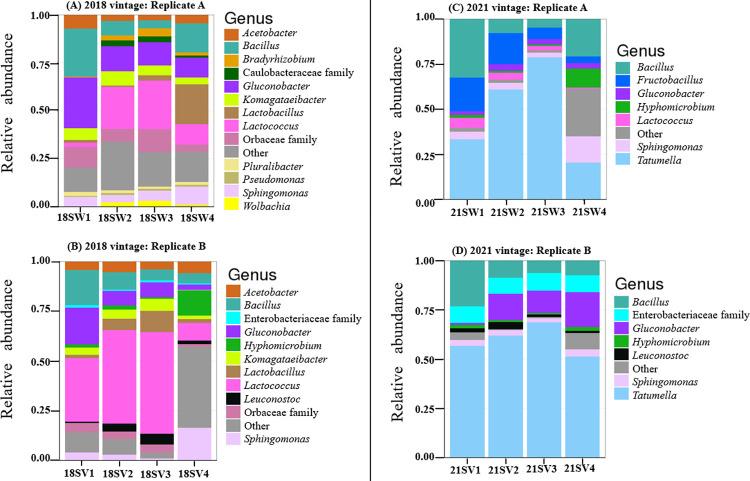
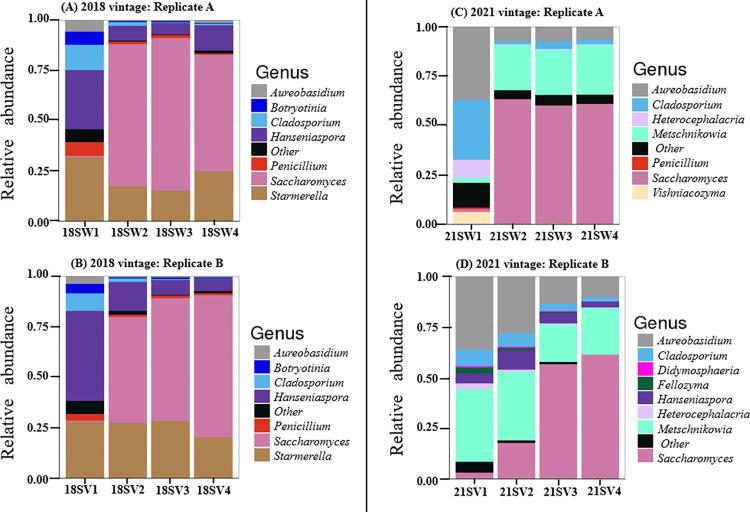
To assess the possible impact of climatic variation on microbial community composition in organic winemaking, we employed a metabarcoding approach to scrutinize the microbiome in a commercial, organic, Pinot noir wine production system that utilizes autochthonous fermentation. We assessed microbial composition across two vintages (2018 and 2021) using biological replicates co-located at the same winery. Microbial dynamics were monitored over four important fermentation time points and correlated with contemporaneous climate data. Bacterial (RANOSIM = 0.4743, p = 0.0001) and fungal (RANOSIM = 0.4738, p = 0.0001) compositions were different in both vintages. For bacteria, Lactococcus dominated the diversity associated with the 2018 vintage, while Tatumella dominated the 2021 vintage. For fungal populations, while Saccharomyces were abundant in both vintages, key differences included Starmerella, copious in the 2018 vintage; and Metschnikowia, substantive in the 2021 vintage. Ordination plots correlated the climatic variables with microbial population differences, indicating temperature as a particularly important influence; humidity values also differed significantly between these vintages. Our data illustrates how climatic conditions may influence microbial diversity during winemaking, and further highlights the effect climate change could have on wine production.
为了评估气候变异对有机酿酒中微生物群落组成的可能影响,我们采用宏条形码方法来仔细研究利用本土发酵的商业性有机黑皮诺葡萄酒生产系统中的微生物组。我们在同一酿酒厂的相同位置使用生物重复评估了两个年份(2018 年和 2021 年)的微生物组成。在四个重要的发酵时间点监测微生物动态,并将其与同期的气候数据相关联。细菌(RANOSIM = 0.4743,p = 0.0001)和真菌(RANOSIM = 0.4738,p = 0.0001)在两个年份中的组成均不同。对于细菌,乳球菌(Lactococcus)主导了与 2018 年份相关的多样性,而塔图拉菌(Tatumella)则主导了 2021 年份。对于真菌种群,虽然酿酒酵母(Saccharomyces)在两个年份中都很丰富,但关键差异包括在 2018 年份中大量存在的星拟酵母(Starmerella)和在 2021 年份中丰富的德巴利酵母-酒香酵母(Metschnikowia)。排序图将气候变量与微生物种群差异相关联,表明温度是一个特别重要的影响因素;这些年份的湿度值也有显著差异。我们的数据说明了气候条件如何在酿酒过程中影响微生物多样性,进一步强调了气候变化对葡萄酒生产的可能影响。


 Zotero 插件