
全球范围内 1990 年至 2022 年体重不足和肥胖趋势:对 3663 项具有 2.22 亿儿童、青少年和成年人代表性的人群研究进行的汇总分析。
Worldwide trends in underweight and obesity from 1990 to 2022: a pooled analysis of 3663 population-representative studies with 222 million children, adolescents, and adults.
出版信息
Lancet. 2024 Mar 16;403(10431):1027-1050. doi: 10.1016/S0140-6736(23)02750-2. Epub 2024 Feb 29.
BACKGROUND
Underweight and obesity are associated with adverse health outcomes throughout the life course. We estimated the individual and combined prevalence of underweight or thinness and obesity, and their changes, from 1990 to 2022 for adults and school-aged children and adolescents in 200 countries and territories.
METHODS
We used data from 3663 population-based studies with 222 million participants that measured height and weight in representative samples of the general population. We used a Bayesian hierarchical model to estimate trends in the prevalence of different BMI categories, separately for adults (age ≥20 years) and school-aged children and adolescents (age 5-19 years), from 1990 to 2022 for 200 countries and territories. For adults, we report the individual and combined prevalence of underweight (BMI <18·5 kg/m) and obesity (BMI ≥30 kg/m). For school-aged children and adolescents, we report thinness (BMI <2 SD below the median of the WHO growth reference) and obesity (BMI >2 SD above the median).
FINDINGS
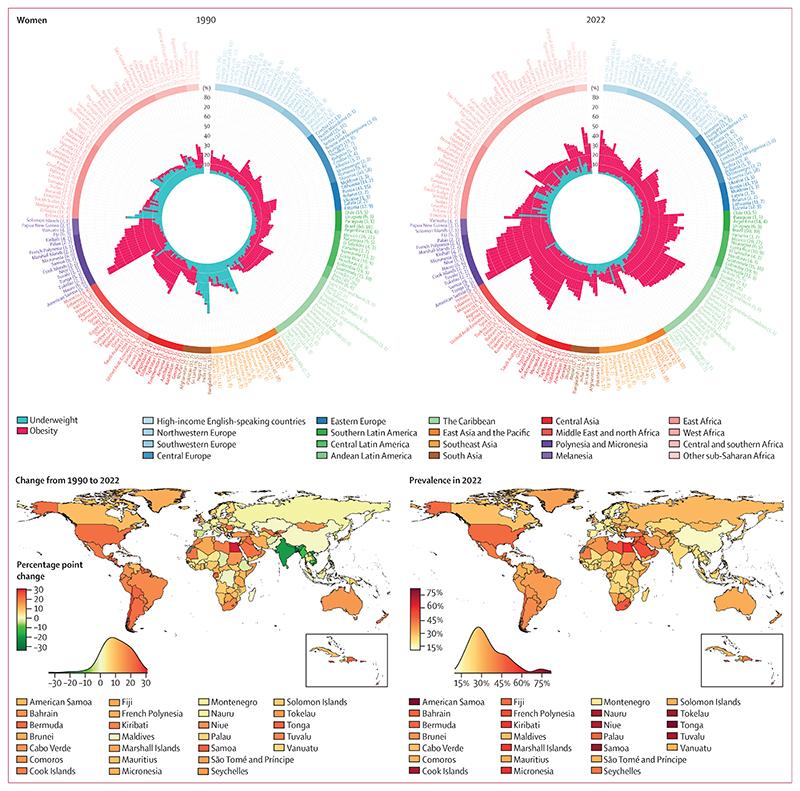
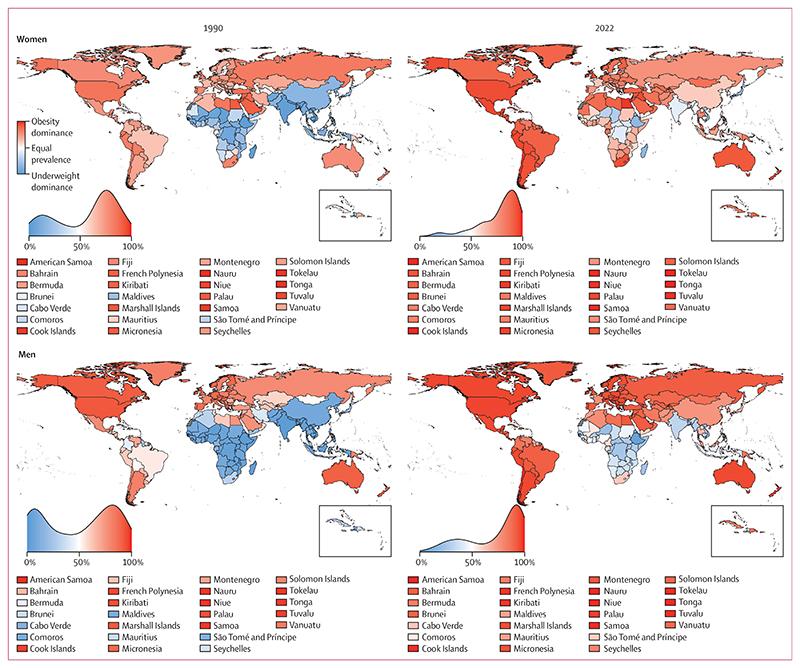
From 1990 to 2022, the combined prevalence of underweight and obesity in adults decreased in 11 countries (6%) for women and 17 (9%) for men with a posterior probability of at least 0·80 that the observed changes were true decreases. The combined prevalence increased in 162 countries (81%) for women and 140 countries (70%) for men with a posterior probability of at least 0·80. In 2022, the combined prevalence of underweight and obesity was highest in island nations in the Caribbean and Polynesia and Micronesia, and countries in the Middle East and north Africa. Obesity prevalence was higher than underweight with posterior probability of at least 0·80 in 177 countries (89%) for women and 145 (73%) for men in 2022, whereas the converse was true in 16 countries (8%) for women, and 39 (20%) for men. From 1990 to 2022, the combined prevalence of thinness and obesity decreased among girls in five countries (3%) and among boys in 15 countries (8%) with a posterior probability of at least 0·80, and increased among girls in 140 countries (70%) and boys in 137 countries (69%) with a posterior probability of at least 0·80. The countries with highest combined prevalence of thinness and obesity in school-aged children and adolescents in 2022 were in Polynesia and Micronesia and the Caribbean for both sexes, and Chile and Qatar for boys. Combined prevalence was also high in some countries in south Asia, such as India and Pakistan, where thinness remained prevalent despite having declined. In 2022, obesity in school-aged children and adolescents was more prevalent than thinness with a posterior probability of at least 0·80 among girls in 133 countries (67%) and boys in 125 countries (63%), whereas the converse was true in 35 countries (18%) and 42 countries (21%), respectively. In almost all countries for both adults and school-aged children and adolescents, the increases in double burden were driven by increases in obesity, and decreases in double burden by declining underweight or thinness.
INTERPRETATION
The combined burden of underweight and obesity has increased in most countries, driven by an increase in obesity, while underweight and thinness remain prevalent in south Asia and parts of Africa. A healthy nutrition transition that enhances access to nutritious foods is needed to address the remaining burden of underweight while curbing and reversing the increase in obesity.
FUNDING
UK Medical Research Council, UK Research and Innovation (Research England), UK Research and Innovation (Innovate UK), and European Union.
背景
体重过轻和肥胖与整个生命过程中的不良健康结果有关。我们估计了 200 个国家和地区的成年人和学龄儿童及青少年从 1990 年到 2022 年的体重过轻或消瘦和肥胖的个体和合并患病率及其变化。
方法
我们使用了来自 3663 项基于人群的研究的数据,这些研究共纳入了 2.22 亿名普通人群的代表性样本,测量了身高和体重。我们使用贝叶斯层次模型来估计 200 个国家和地区从 1990 年到 2022 年不同 BMI 类别患病率的趋势,分别针对成年人(年龄≥20 岁)和学龄儿童及青少年(年龄 5-19 岁)。对于成年人,我们报告体重过轻(BMI<18.5 kg/m)和肥胖(BMI≥30 kg/m)的个体和合并患病率。对于学龄儿童及青少年,我们报告消瘦(BMI 低于 WHO 生长参考中位数 2 个标准差)和肥胖(BMI 高于 WHO 生长参考中位数 2 个标准差)。
结果
从 1990 年到 2022 年,11 个国家(6%)的成年女性和 17 个国家(9%)的成年男性的体重过轻和肥胖合并患病率下降,且至少有 0.80 的后验概率认为观察到的变化是真正的下降。162 个国家(81%)的成年女性和 140 个国家(70%)的成年男性的合并患病率增加,且至少有 0.80 的后验概率。2022 年,加勒比和波利尼西亚及密克罗尼西亚岛国以及中东和北非国家的体重过轻和肥胖合并患病率最高。肥胖患病率高于消瘦,至少有 0.80 的后验概率在 2022 年的成年女性中为 177 个国家(89%),成年男性中为 145 个国家(73%),而在成年女性中为 16 个国家(8%),成年男性中为 39 个国家(20%)。从 1990 年到 2022 年,5 个国家(3%)的女孩和 15 个国家(8%)的男孩的消瘦和肥胖合并患病率下降,至少有 0.80 的后验概率,而 140 个国家(70%)的女孩和 137 个国家(69%)的男孩的合并患病率增加,至少有 0.80 的后验概率。2022 年,学龄儿童及青少年消瘦和肥胖合并患病率最高的国家为波利尼西亚和密克罗尼西亚及加勒比地区的男女,智利和卡塔尔的男孩。南亚的一些国家,如印度和巴基斯坦,尽管消瘦的患病率有所下降,但合并患病率仍然很高。2022 年,学龄儿童及青少年肥胖的患病率高于消瘦,至少有 0.80 的后验概率在成年女性中为 133 个国家(67%),成年男性中为 125 个国家(63%),而在成年女性中为 35 个国家(18%),成年男性中为 42 个国家(21%)。在几乎所有的国家,包括成年人和学龄儿童及青少年,双重负担的增加是由肥胖的增加驱动的,而双重负担的减少是由体重过轻或消瘦的减少驱动的。
解释
大多数国家的体重过轻和肥胖的合并负担增加,这是由肥胖的增加驱动的,而消瘦在南亚和非洲部分地区仍然很普遍。需要进行健康的营养转型,增加对营养食品的获取,以解决仍然存在的体重过轻负担,同时遏制和扭转肥胖的增加。
资金
英国医学研究理事会、英国研究与创新署(英格兰)、英国研究与创新署(创新英国)和欧盟。



 Zotero 插件