
缩小差距:牛津纳米孔技术 R10 测序能够与 Illumina 测序相媲美,可用于基于 SNP 的细菌病原体暴发调查。
Closing the gap: Oxford Nanopore Technologies R10 sequencing allows comparable results to Illumina sequencing for SNP-based outbreak investigation of bacterial pathogens.
机构信息
Transversal activities in Applied Genomics, Sciensano, Brussels, Belgium.
Bacterial Diseases, Sciensano, Brussels, Belgium.
出版信息
J Clin Microbiol. 2024 May 8;62(5):e0157623. doi: 10.1128/jcm.01576-23. Epub 2024 Mar 5.
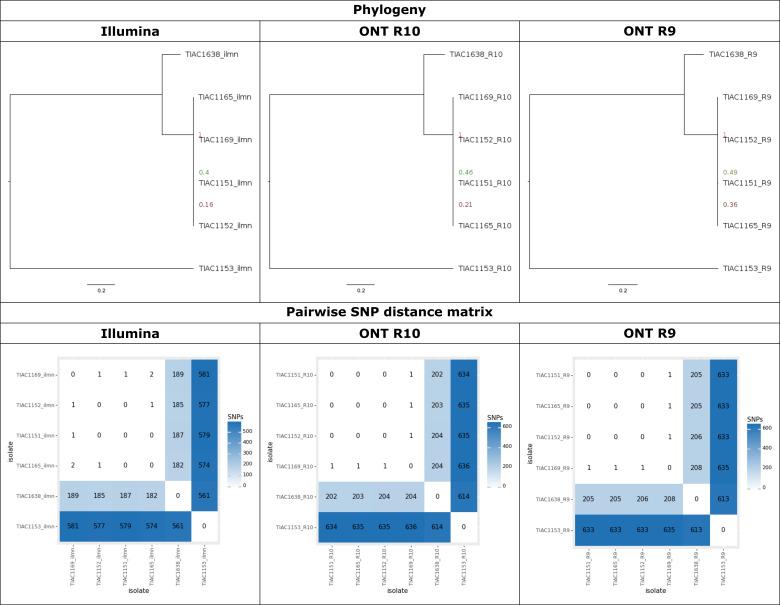
Whole-genome sequencing has become the method of choice for bacterial outbreak investigation, with most clinical and public health laboratories currently routinely using short-read Illumina sequencing. Recently, long-read Oxford Nanopore Technologies (ONT) sequencing has gained prominence and may offer advantages over short-read sequencing, particularly with the recent introduction of the R10 chemistry, which promises much lower error rates than the R9 chemistry. However, limited information is available on its performance for bacterial single-nucleotide polymorphism (SNP)-based outbreak investigation. We present an open-source workflow, Prokaryotic Awesome variant Calling Utility (PACU) (https://github.com/BioinformaticsPlatformWIV-ISP/PACU), for constructing SNP phylogenies using Illumina and/or ONT R9/R10 sequencing data. The workflow was evaluated using outbreak data sets of Shiga toxin-producing and by comparing ONT R9 and R10 with Illumina data. The performance of each sequencing technology was evaluated not only separately but also by integrating samples sequenced by different technologies/chemistries into the same phylogenomic analysis. Additionally, the minimum sequencing time required to obtain accurate phylogenetic results using nanopore sequencing was evaluated. PACU allowed accurate identification of outbreak clusters for both species using all technologies/chemistries, but ONT R9 results deviated slightly more from the Illumina results. ONT R10 results showed trends very similar to Illumina, and we found that integrating data sets sequenced by either Illumina or ONT R10 for different isolates into the same analysis produced stable and highly accurate phylogenomic results. The resulting phylogenies for these two outbreaks stabilized after ~20 hours of sequencing for ONT R9 and ~8 hours for ONT R10. This study provides a proof of concept for using ONT R10, either in isolation or in combination with Illumina, for rapid and accurate bacterial SNP-based outbreak investigation.
全基因组测序已成为细菌暴发调查的首选方法,大多数临床和公共卫生实验室目前通常使用短读长 Illumina 测序。最近,长读长 Oxford Nanopore Technologies(ONT)测序技术得到了重视,它可能比短读长测序具有优势,尤其是最近推出的 R10 化学技术,其承诺的错误率远低于 R9 化学技术。然而,关于其在基于细菌单核苷酸多态性(SNP)的暴发调查中的性能,信息有限。我们提出了一个开源工作流程,Prokaryotic Awesome variant Calling Utility(PACU)(https://github.com/BioinformaticsPlatformWIV-ISP/PACU),用于使用 Illumina 和/或 ONT R9/R10 测序数据构建 SNP 系统发育树。该工作流程使用志贺毒素产生的暴发数据集进行了评估 和 通过比较 ONT R9 和 R10 与 Illumina 数据。不仅单独评估了每种测序技术的性能,还将通过不同技术/化学物质测序的样本整合到相同的系统发育分析中。此外,还评估了使用纳米孔测序获得准确系统发育结果所需的最小测序时间。PACU 允许使用所有技术/化学物质准确识别两种物种的暴发聚类,但 ONT R9 的结果与 Illumina 的结果略有偏差。ONT R10 的结果显示出与 Illumina 非常相似的趋势,我们发现将来自不同分离株的通过 Illumina 或 ONT R10 测序的数据集整合到同一个分析中,会产生稳定且高度准确的系统发育结果。对于这两个暴发,ONT R9 测序约 20 小时,ONT R10 测序约 8 小时后,系统发育树稳定下来。这项研究为使用 ONT R10 进行快速准确的基于细菌 SNP 的暴发调查提供了概念验证,无论是单独使用还是与 Illumina 结合使用。



 Zotero 插件